
EmailTooltester is supported by readers like you. When you purchase through our links, we may earn a commission that helps keep our reviews independent and free.
Writing an author newsletter should be easy-peasy. After all, writing is literally your job. But most authors get stuck deciding what kind of newsletter to send to their list.
Should you send personal updates or keep it strictly professional? Should the newsletter be story-driven or educational? Do you have to send a newsletter weekly, or is monthly enough?
That uncertainty leads to months of silence until you’re launching a new book. But by then, the connection to your readers has gone cold, and your newsletter email feels too salesy to get real engagement.
In this guide, you'll see twelve practical examples of author email newsletters and why they work for fiction and non-fiction writers. Whether you’re an indie author creating your first newsletter or a traditionally published writer refreshing your strategy, these author newsletter examples will give you newsletter ideas to send to your subscribers.
First, why do you need an author newsletter in 2026?
You probably already know this, but a newsletter is no longer a “nice to have.” It's the only marketing channel you really own that gives you direct access to your readers.
Social media visibility depends on algorithms you don’t control. Bookshops and book clubs can’t consistently promote your work. And your website or Amazon page doesn’t show up in a reader’s inbox to remind them why they care about your books.
An author newsletter fills that gap. It lets you maintain a connection with readers between book launches and build a loyal fan base. So, when you launch a new book, you're not emailing strangers, but engaged readers who are already invested in your book.
What makes a great author newsletter?
Author newsletters don’t perform well due to genre, fame, or fancy design. They’re effective when they follow these principles:
1. A clear, recognizable voice
Readers subscribe to authors' newsletters to hear from them. So, your newsletter should sound like YOU showed up in their inbox. Whether it's cozy, witty, reflective, academic, or quirky, your voice should feel intentional and consistent.
2. Real value in every email
Author newsletters aren’t just for sending upcoming release announcements. Yes, promotion matters, but value keeps people opening. Give readers something to enjoy, learn, or feel — a behind-the-scenes detail, a writing insight, a short story snippet, a reading recommendation, or an exclusive offer.
3. Predictable consistency
You don’t need to email daily or even weekly. But you do need to show up consistently. Long gaps followed by sudden bursts of promo emails train readers to ignore you. So, pick a rhythm that fits your life and your writing pace. Biweekly (or even monthly) works as long as readers know what to expect and you deliver value.
4. Simple, purposeful structure
Great author newsletters have an easy-to-follow format. This can be a loose structure that starts with a quick hello or hook, moves into one main idea, adds a secondary update, and then ends with a clear next step. Even personal or story-driven emails (that are like journal entries or mini-essays) can benefit from a logical flow.
5. A clear call-to-action (CTA)
Every email should ask readers to do one thing. The action doesn’t have to be big (or to sell), but it should be intentional. It could be a prompt to reply, to forward the email to friends, or to join a waitlist. CTAs aren’t just for selling; they help keep readers engaged.
12 author newsletter examples to keep your readers engaged
The best author newsletters make readers feel connected, rewarded, and eager to hear from you again, even when you’re not launching a new book. Here are 12 author newsletter examples you can adapt to create or refresh yours, whether you’re a fiction or non-fiction author.
1. Behind-the-scenes newsletter
Readers get more invested when they see what went into the book, not just the polished final result. A BTS author newsletter makes them feel like insiders, which boosts engagement and builds long-term loyalty.
Instead of another book update or promo, you can share the raw material behind your work, such as where an idea came from, a character decision you struggled with, a deleted scene, or a research detail that shaped the story.
This author email newsletter example works especially well for fantasy, sci-fi, and historical fiction authors who build expansive worlds. But it works just as well for non-fiction authors to show their research, thinking, and decision-making process.
Try this for your author newsletter:
Pick one small detail or element from your current or upcoming book and write a short BTS note about it.
- Fiction: Explain a single magic rule, character flaw, or historical detail.
- Nonfiction: Share one idea you almost included, then explain why you cut it.
Keep it digestible – no lore dump. One focused detail per email is enough to hook them. In this author email example, Leigh Bardugo starts with an engaging opener and shares a teaser from the book draft.
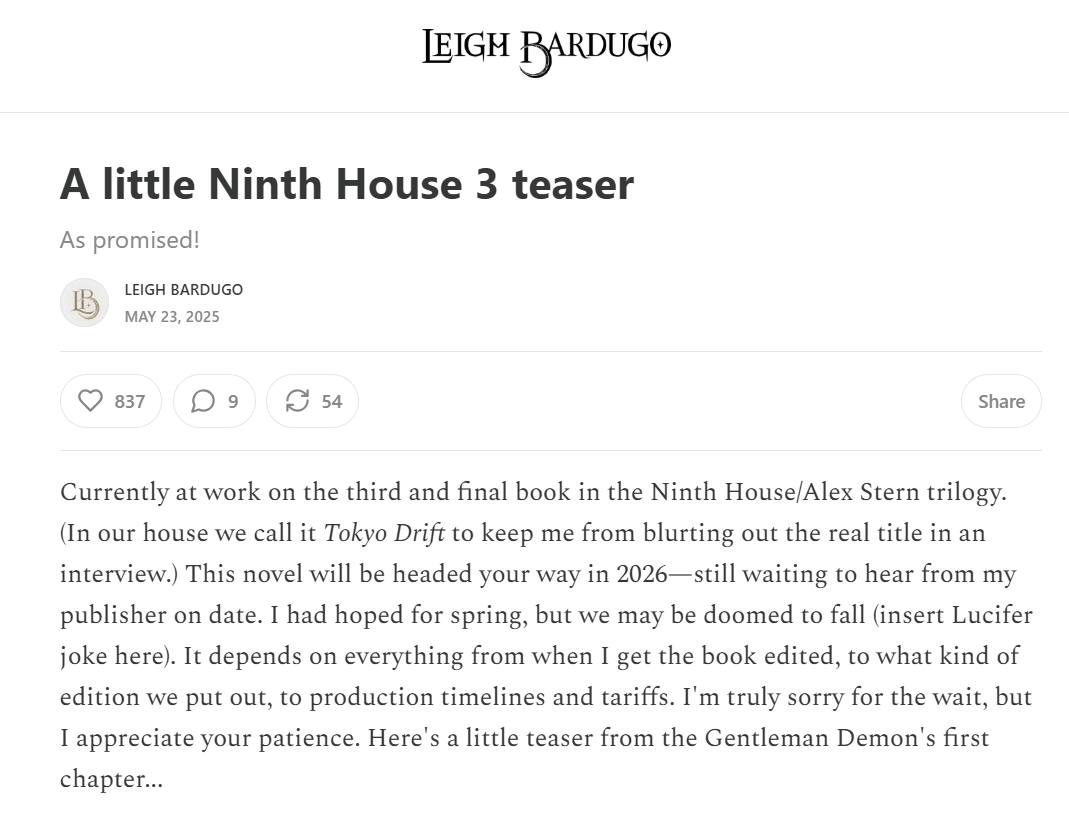
Image Source: Leigh Bardugo
2. Cozy personal update newsletter
Readers don’t just love the book; they often love the writer, too. Cozy author email newsletter: tap into that emotional connection by sharing updates about the human behind the work.
This author newsletter idea works best if your voice is a big part of your appeal, or if you write character-driven fiction, memoir, or reflective nonfiction. The tone is warm, conversational, and low-pressure. Think less announcement, more note from a friend.
And you don’t have to overshare your entire life with your readers. A small anecdote, a moment from your writing life, or a quick “here’s what I’m into lately” is enough to make readers feel closer to you.
Try this for your author newsletter:
Open with one small, ordinary moment from your day, something you noticed, laughed at, or thought about.
- Fiction: Tie the moment to a character, theme, or scene you’re working on.
- Nonfiction: Connect it to an idea you’re exploring or a belief you’re questioning.
Keep it short and end with an update, like what you’re reading or watching. In the author newsletter example below, Maggie Stiefvater shared ten updates, which were a mix of personal and book event updates.
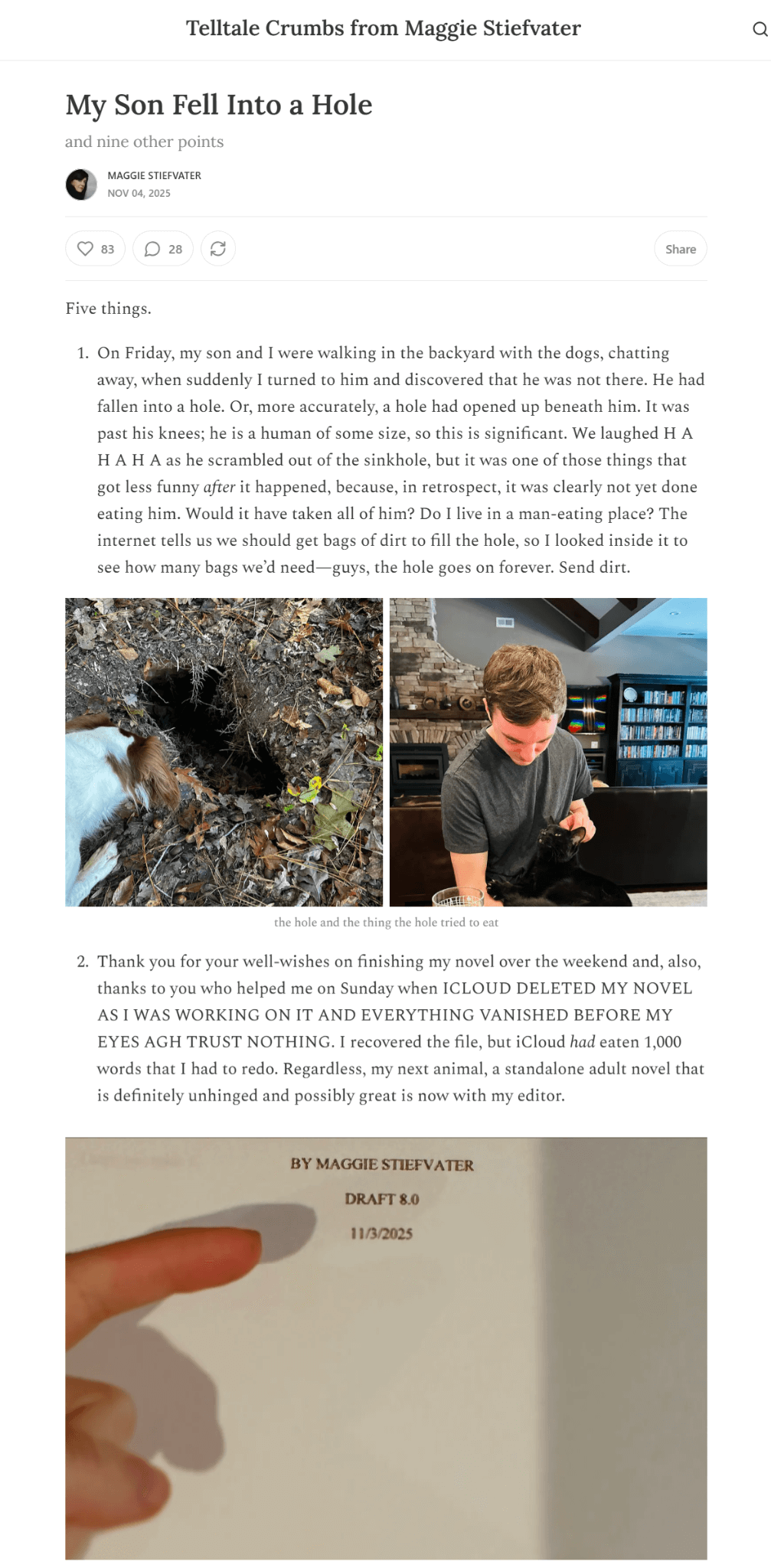
Image Source: Maggie Stiefvater
3. Launch or preorder announcement newsletter
Launch newsletter emails announcing your new book release are the one time readers fully expect promotion. They want to know when the book will be out, if and how they can pre-order, and where to buy.
If you’ve been consistently sending engaging and valuable author newsletters, your launch or preorder announcement will convert better. Readers already trust you and are ready to act. And if you provide social shareable graphics, many will spread the word for you.
The most effective launch newsletters are clear, skimmable, and urgency-driven. They spell out the book details, release dates, and preorder links. Also, exclusive bonuses for early buyers give readers a reason to act now.
This author newsletter works for every author, from debut indie writers to traditionally published authors across fiction and nonfiction. The goal is simple: remove friction and make it easy for excited readers to support the book.
Try this for your author newsletter:
Create a simple launch announcement email that includes:
- One short hook describing the book
- A cover reveal or teaser image
- The bonuses for early buyers
- Direct links to preorder or buy
In this author newsletter example, Ali Hazelwood shared details of where to buy her new book, as well as the different covers and artwork to expect.
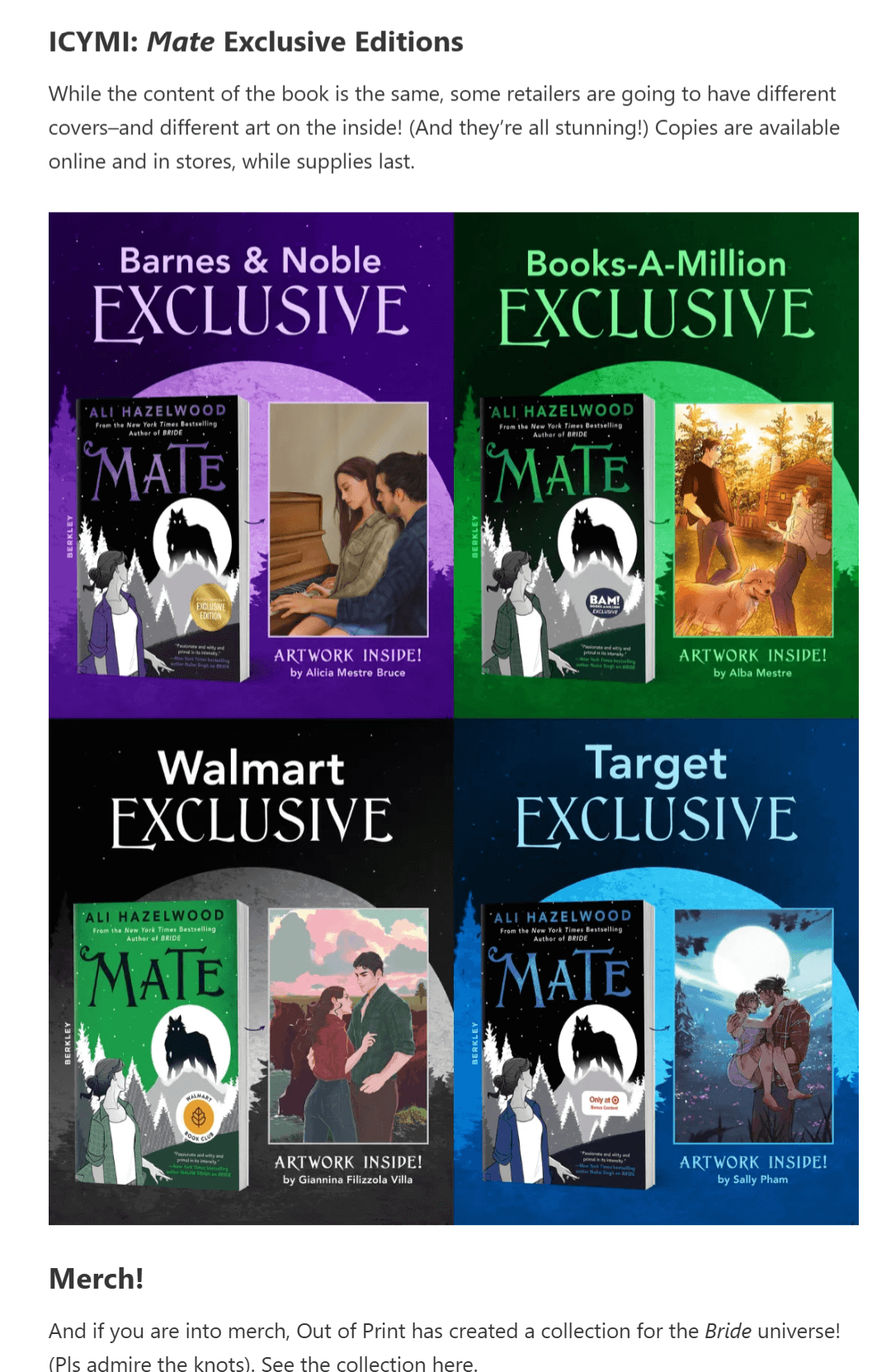
Image Source: Ali Hazelwood
4. Backlist spotlight email
Most authors underuse their backlist. After publishing and selling a book, they move on to the next one. But readers don’t discover you in neat chronological order. They arrive in waves, often through one breakout title.
So, if you have more than one published book or you’re a series writer, you should send a backlist newsletter email. This helps new readers find older favorites, and even reminds old readers to re-read the books.
The key here is relevance. When spotlighting older books, connect them to something timely. Perhaps the season or a related new release, or something happening in the real world.
Try this for your author newsletter:
Pick one of your older titles to spotlight in your newsletter.
- Fiction: Share something you learned while writing the book or why it’s the best starting point in a series.
- Nonfiction: Highlight one idea from the book that still applies today and explain why it holds up.
You may have a small spotlight section in your regular authors’ newsletter, such as a “new reader intro” section. Or write an entire backlist newsletter like Susan Dennard does in this author email example.
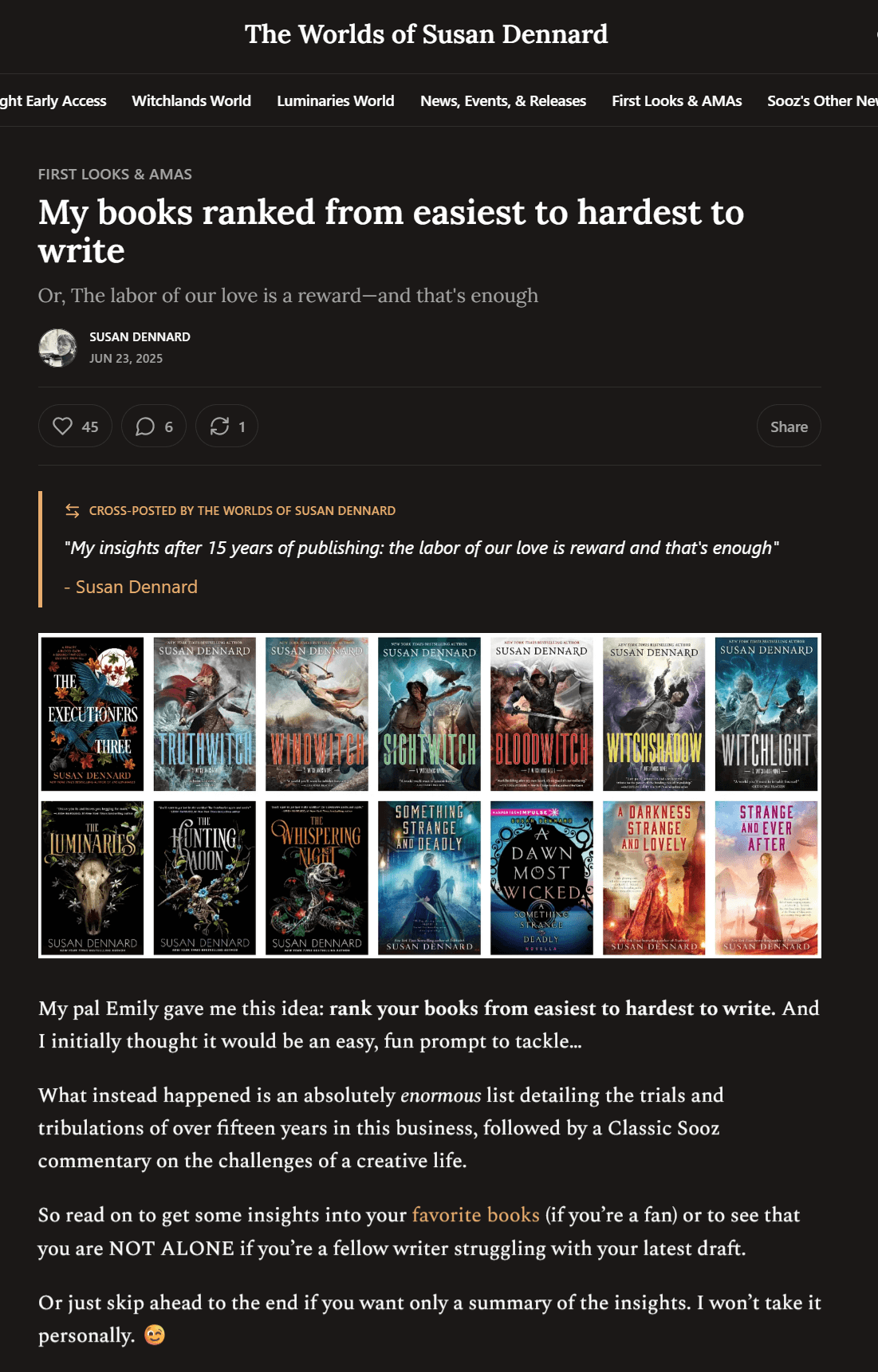
Image Source: Susan Dennard
5. Serialized newsletter
Serialized author emails let you publish short stories or episodes directly to your list. They keep readers hooked and anticipating your newsletter, which increases engagement and turns casual subscribers into superfans.
This author newsletter works best for fiction writers, but narrative non-fiction and memoir writers could also use it. The serialized emails can be spin-offs, prequels, side quests, or entirely new stories.
It’s also a low-risk way to test story ideas with your audience before committing to a full book. Andy Weir famously posted The Martian chapter by chapter online before it was published as a book and became a bestseller.
Try this for your author newsletter:
Plan a short 3 to 5-episode newsletter tied to a season, holiday, or theme.
- Fiction: Write a prequel scene, missing chapter, or side character arc.
- Non-fiction: Serialize a case study, transformation story, or step-by-step idea.
End each email with an open loop or teaser, and invite readers to reply with what they think before the next installment. Erica Drayton’s The Happy Place is an example of an author newsletter that is all about sending weekly fiction stories.
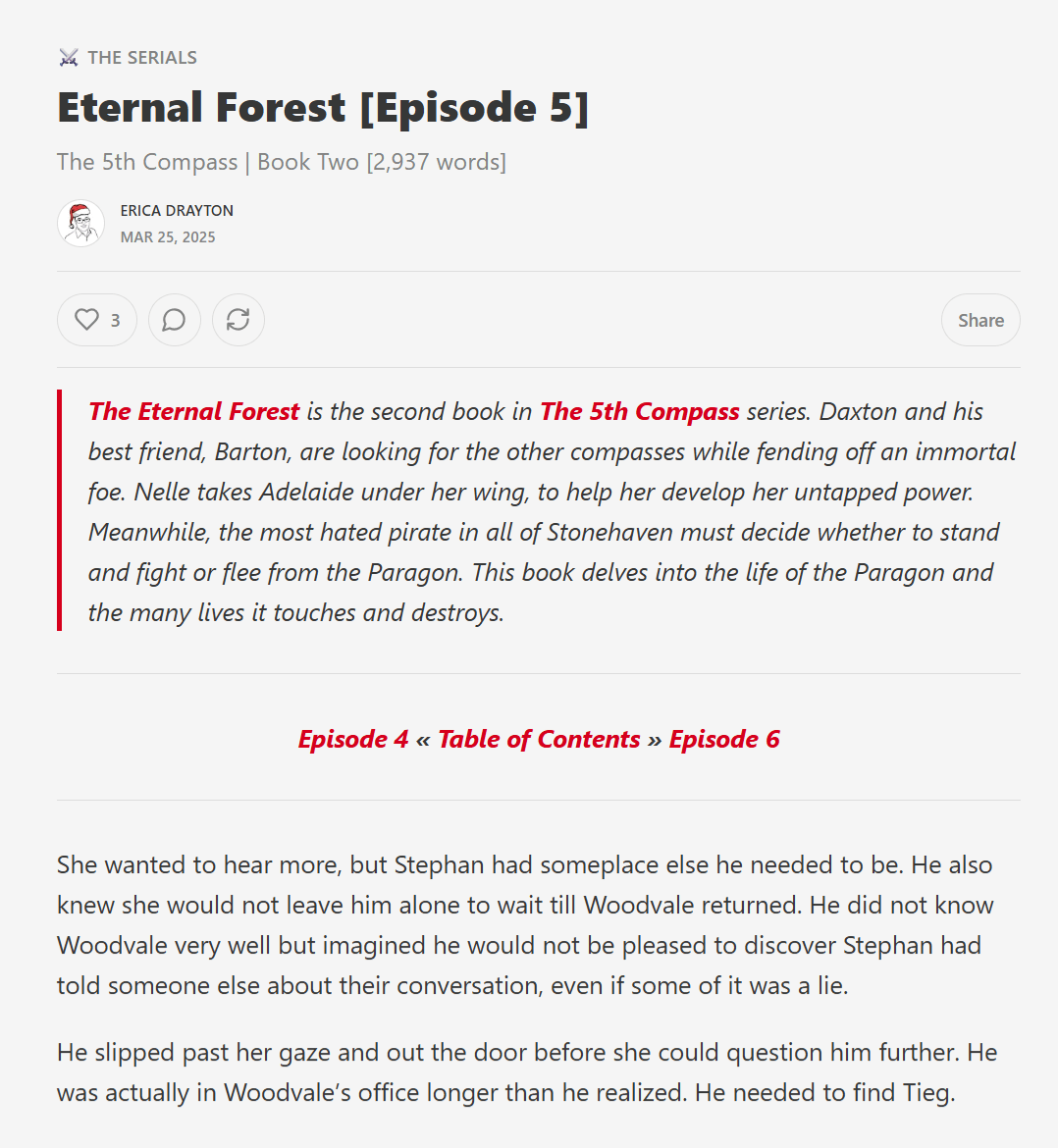
Image Source: Erica Drayton
6. Expert insight newsletter
This author newsletter style works best for non-fiction writers whose books teach, inspire, or challenge how readers think. Subscribers sign up because they trust your perspective and want more of it between book releases.
Strong expert newsletter emails often have a predictable format for delivering insights and frameworks readers can apply immediately. An example is James Clear’s 3-2-1 newsletter and Sahil Bloom’s The Curiosity Chronicle.
The expert author newsletter positions you as an authority and keeps your book top of mind. It also opens doors to speaking invitations and media features, and it builds long-term reader loyalty.
Try this for your author newsletter:
Take one concept from your book or work-in-progress and turn it into a short insight. Like Sahil Bloom does in this author newsletter example.
- Explain the idea in plain language
- Show how it plays out in real life
- End with one practical takeaway
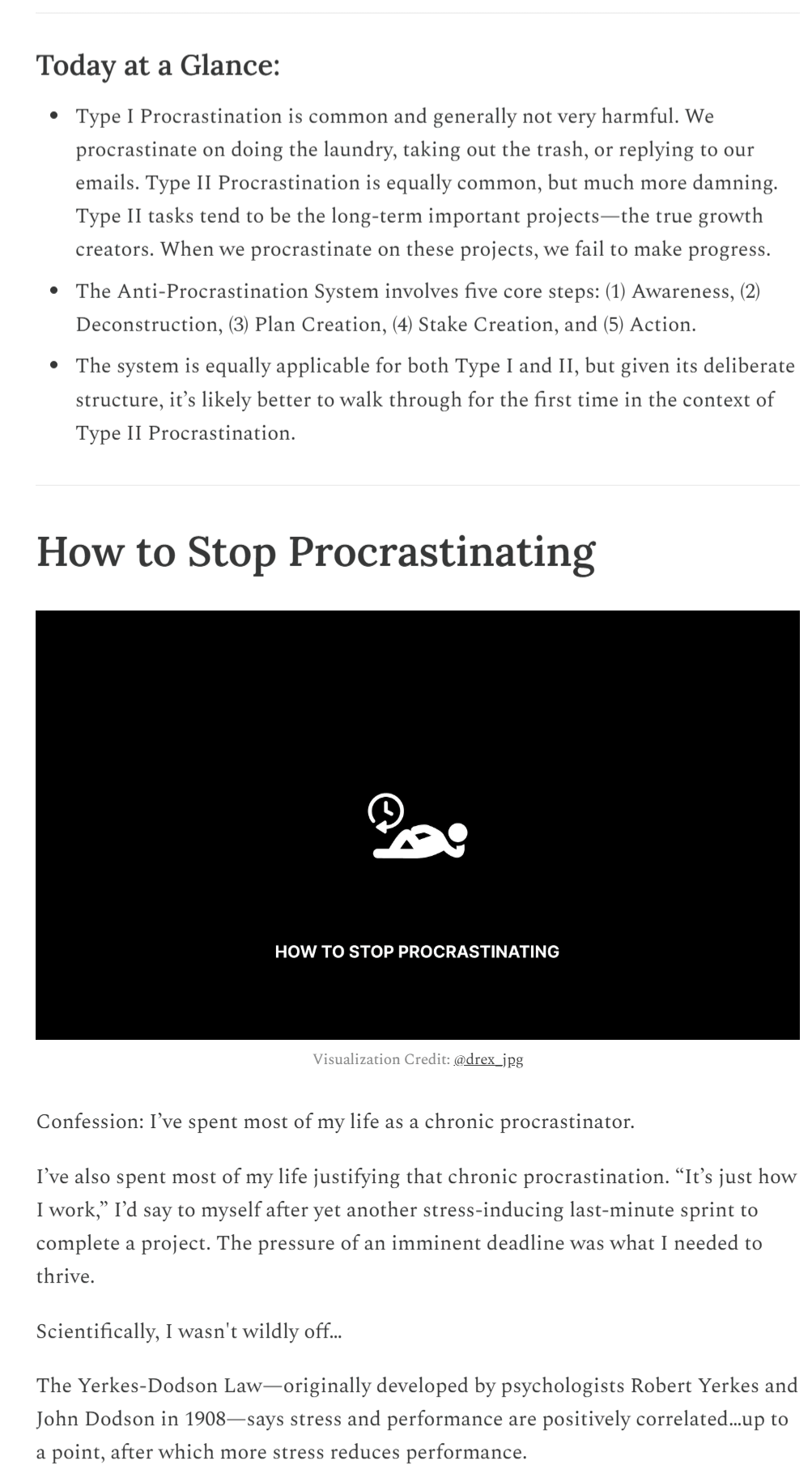
Image Source: Sahil Bloom
7. Reader engagement email
This type of author newsletter turns readers from passive subscribers into active participants. Instead of having a one-way conversation, you invite readers to respond through polls, quick questions, or low-effort actions.
You can ask subscribers to vote on their favorite character or book cover. Invite them to participate in a contest for a giveaway or discount code. Or, ask for their input or opinion on minor decisions, such as cities to tour.
This author newsletter style works because it gives readers a sense of ownership. When people feel involved, they are more likely to preorder, leave reviews, and share your announcements.
Try this for your author newsletter:
Pick one small, non-critical decision and turn it into a single-question email.
- Fiction: Ask readers to vote between two character names, covers, or tropes.
- Non-fiction: Ask which topic, question, or example they want you to explore next.
An author newsletter example that does this well is Jane Friedman’s Electric Speed Newsletter. She includes a question for subscribers to answer in every newsletter, and shares the responses. Mark Manson also does this in his newsletter, Your Next Breakthrough.
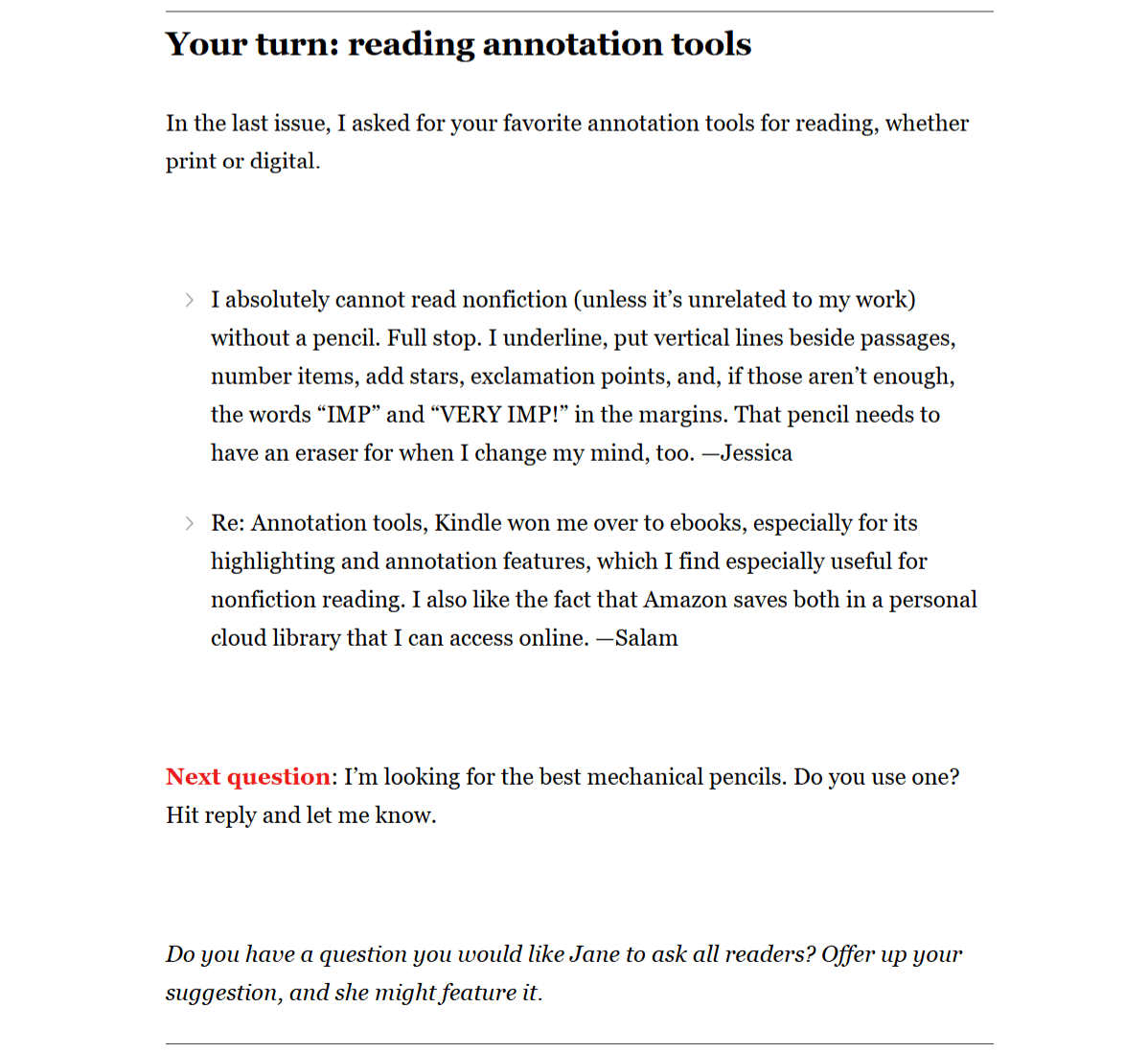
Image Source: Jane Friedman
8. Event or tour announcement newsletter
After your book launch, readers want to know if and when you’re coming to their city for a tour. This author email newsletter helps you share the details, including dates, locations, ticket links, and bonuses such as signed editions.
It also works beyond book launches. You can use it to announce virtual talks, panels, festivals, library visits, workshops, or podcast appearances. The key is to treat it less like a notice board and more like a personal invitation.
Make it more engaging by adding a touch of personality – a quick note about a past tour moment, why you’re excited to visit a particular city, or what you’re looking forward to sharing or experiencing at an event.
Try this for your author newsletter:
Create a reusable event newsletter template with:
- A brief personal opener
- A skimmable list of dates, locations, and bonuses
- A single CTA – get tickets, RSVP, or forward to a friend nearby
Leigh Bardugo, in this author newsletter example, shares why she doesn’t go on tour often and why she’s doing it this time. She also shares dates, locations, and where to get tickets.
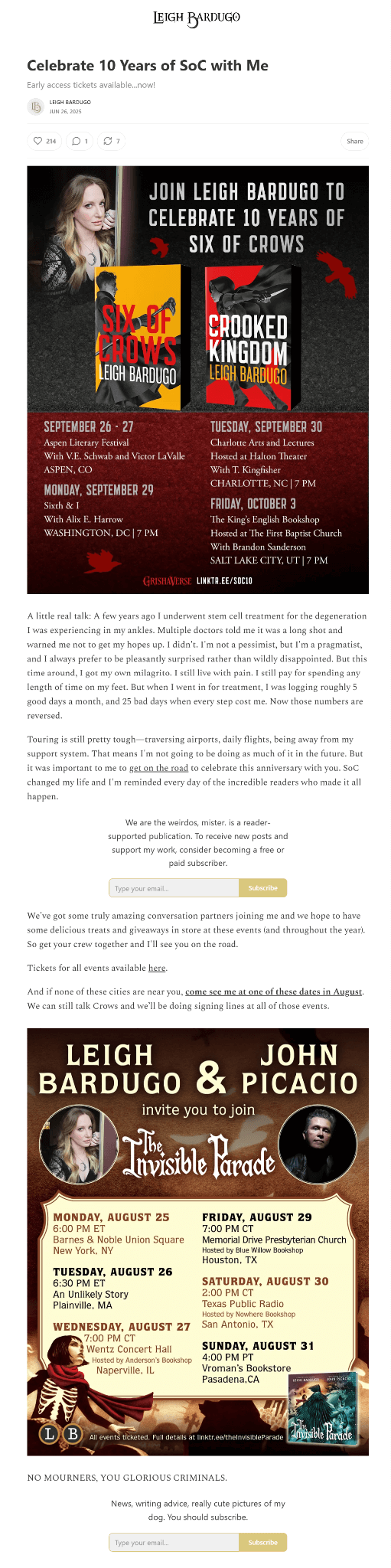 |
|---|
Image source: Leigh Bardugo
9. Collaboration or cross-promo newsletter
Cross-promo newsletters allow authors to “borrow” each other’s audiences. Collaborators spotlight each other’s latest release in your newsletter, which increases exposure without relying on only ads or social algorithms.
This author newsletter idea works especially well for authors in the same genre, authors with overlapping audiences, or authors who are part of an anthology or a co-writing team.
However, it doesn’t have to be a quid pro quo collaboration. Readers appreciate curated recommendations from authors they trust. So, you may simply share the work of other authors that you enjoy.
Try this for your author newsletter:
Feature one book you genuinely enjoyed and explain why your readers would like it. One paragraph in your regular newsletter with a link to the book is enough. You may let the author know you featured their book. If they choose to return the favor later, great; if not, you’ve still added value to your readers.
Emma Straub does this regularly in her author newsletter. Sometimes it’s an entire email like this Emma Straub newsletter. Other times, it’s a brief mention in a newsletter about something else.
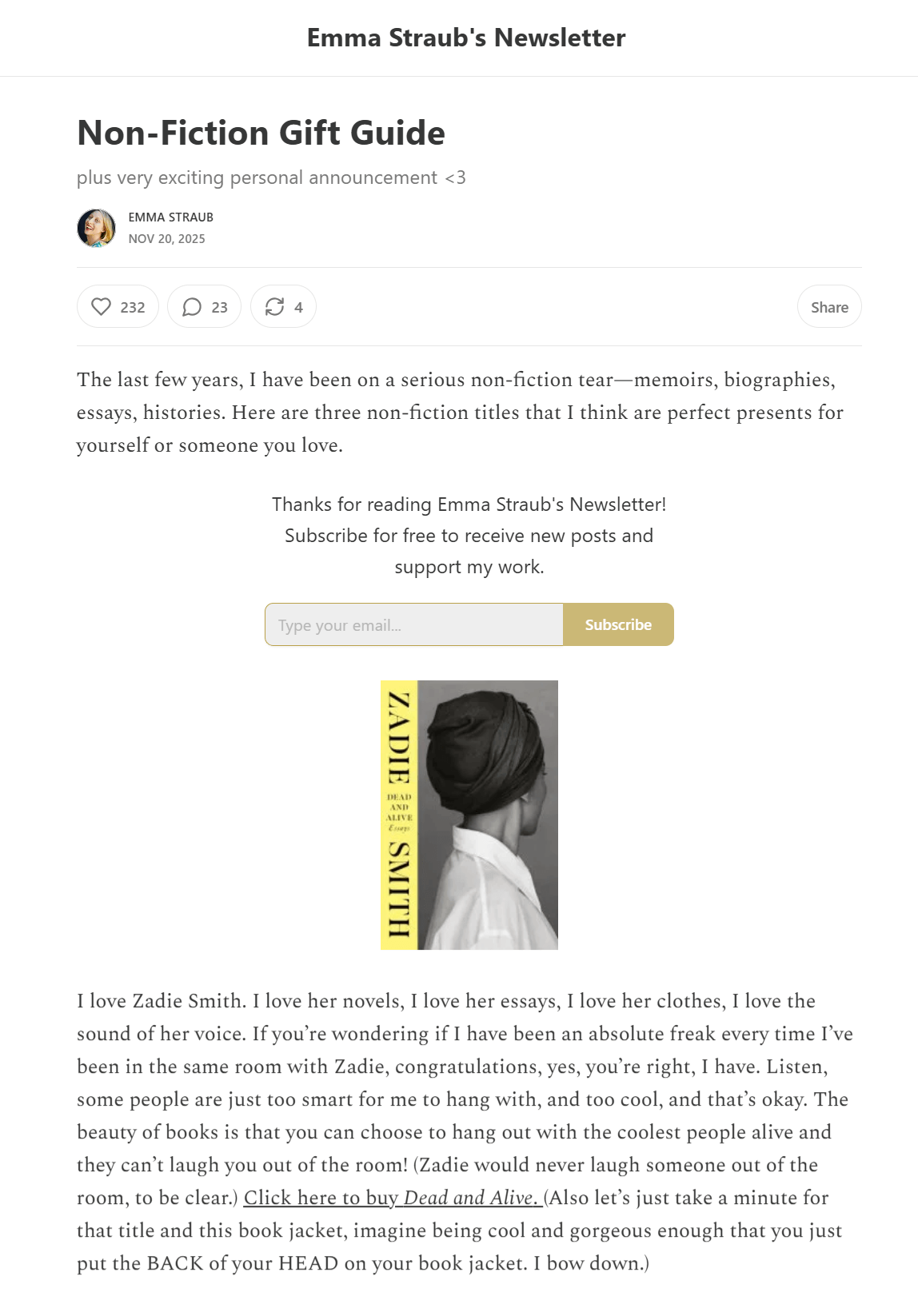
Image Source: Emma Straub
10. Paid Substack-style newsletter
Many successful authors have a paid newsletter (usually on Substack), and you can have one too. It works when you offer exclusive content, deeper insights, or direct access.
However, you don’t want to lock everything behind a paywall. You should have a hybrid model: a free newsletter that builds trust and a paid tier for subscribers who want more depth or insights.
Readers are willing to subscribe to paid tiers for extras like premium essays or stories, live workshops, serialized fiction, behind-the-scenes notes, and more. And even if it isn’t priced high (usually between $20 to $50/month), it’s a steady stream of income.
Try this for your author newsletter
Think about something that readers often ask you about and turn that into a paid offering.
- Fiction: a monthly bonus scene, an exclusive series, or a writing workshop.
- Nonfiction: a deeper essay, case breakdown, or monthly Q&A sessions.
In this author newsletter example, Courtney Maum shares the intro section of the email and gates the rest for paid subscribers.
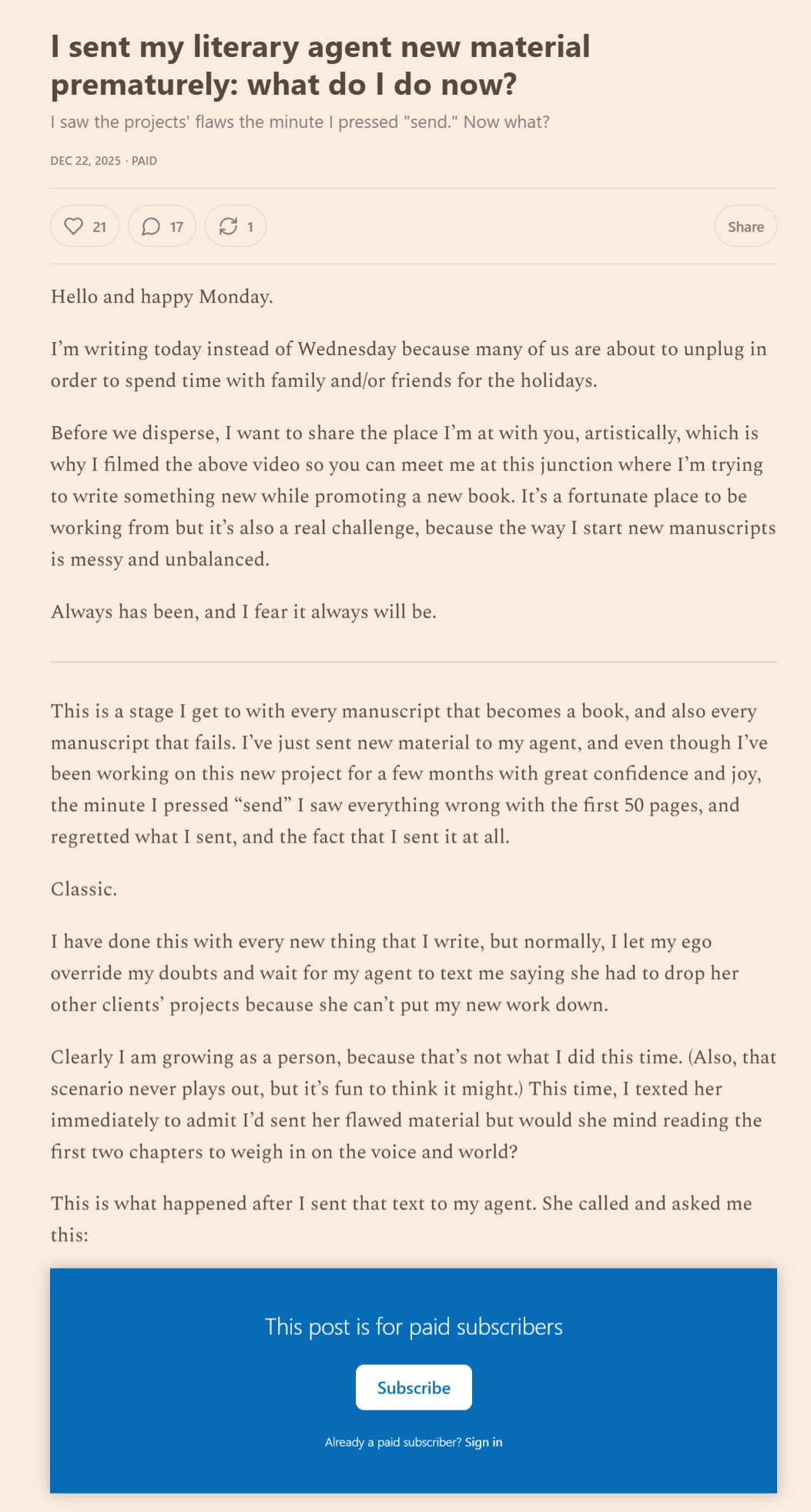
Image Source: Courtney Maum
11. Writing tips newsletter
Many authors forget this, but a chunk of your readers are also writers or aspiring writers. They’re not just on your list because they love reading your books. They want to learn how you think, draft, revise, and solve writing problems.
A writing tips newsletter lets you teach others your process. You can break down how you approach character motivation, structure a chapter, research a topic, or revise a messy draft.
This author newsletter idea works especially well if you enjoy teaching or already talk about the craft online. You can make this newsletter a paid tier or keep it free to build authority and drive demand for your courses, workshops, or coaching.
An example is Matt Bell's No Failure, Only Practice Newsletter, in which he regularly shares fiction writing exercises — some paid, others free.
Try this for your author newsletter:
Pick one concept from your current or past project and write a short explanation of how you approached it.
- Fiction: Show how you chose a point of view, structured a scene, or revealed a character flaw.
- Nonfiction: Explain how you simplified a complex idea or decided what to leave out.
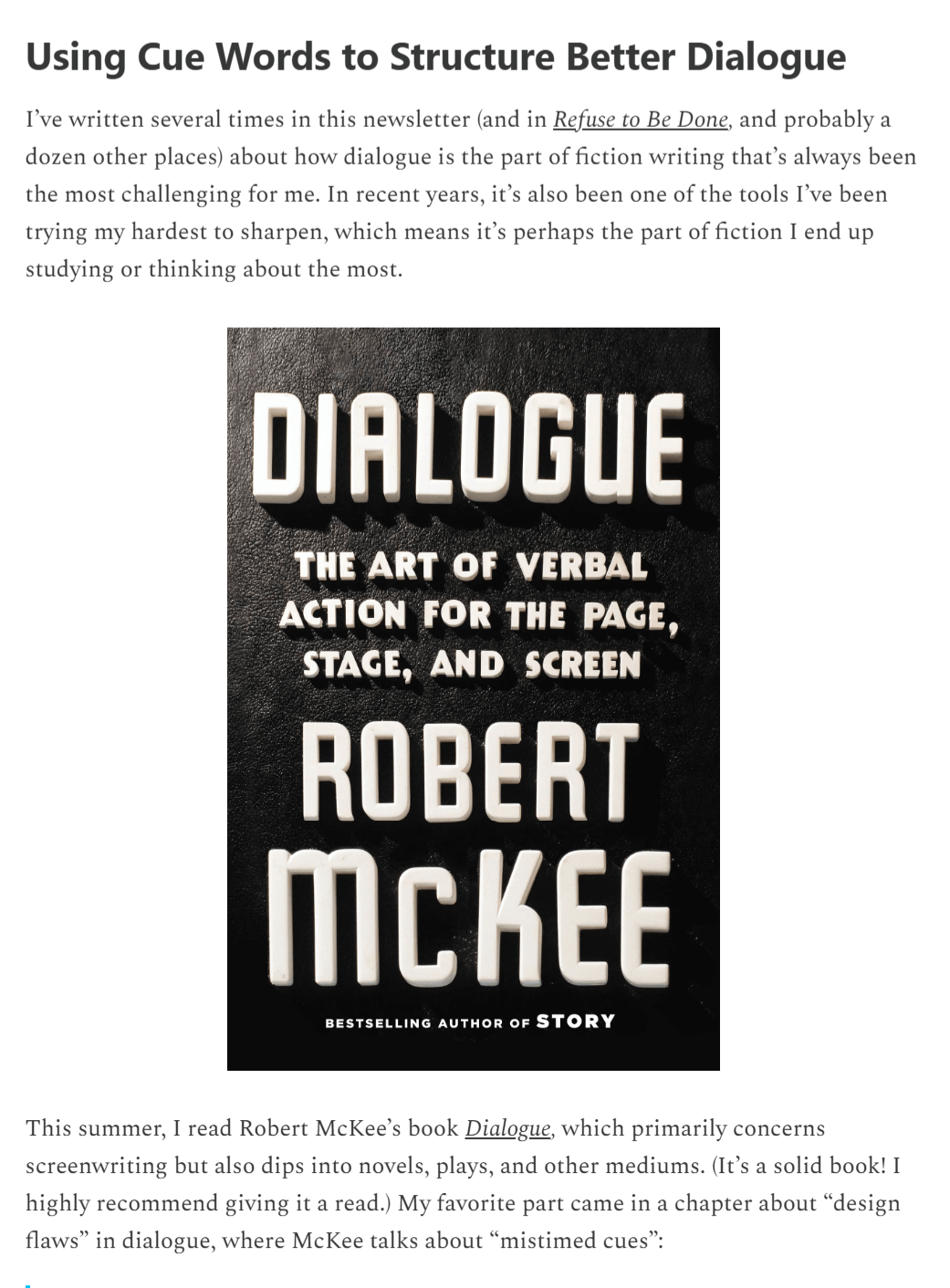
Image Source: Matt Bell
12. Seasonal recommendation newsletter
This author newsletter anchors your email to the moments or seasons readers are living in. Think end-of-year reflections, new year resolutions, summer breaks, and back-to-school energy.
The email newsletter works well because it feels timely and intentional. You’re giving readers something that fits the season, whether that’s reading lists, themed content, or context around how your books match the moment.
Fiction authors can tie recommendations to mood or theme (cozy winter reads, summer romances, spooky October picks). Non-fiction authors can align content with seasonal goals, habits, or challenges their readers face at that time of year.
Try this for your author newsletter:
Create a short seasonal list of 3–5 things you’re enjoying right now.
- Fiction: “If you want a cozy winter read, start here” or “Spooky season reading order for my books.”
- Nonfiction: “What I recommend reading, rethinking, or focusing on this season, and why.”
In this author newsletter example, Catherine McKenzie doesn’t exactly make a recommendation. But she ties the email around two events that were happening around that time – Taylor Swift’s album release and a TV show.
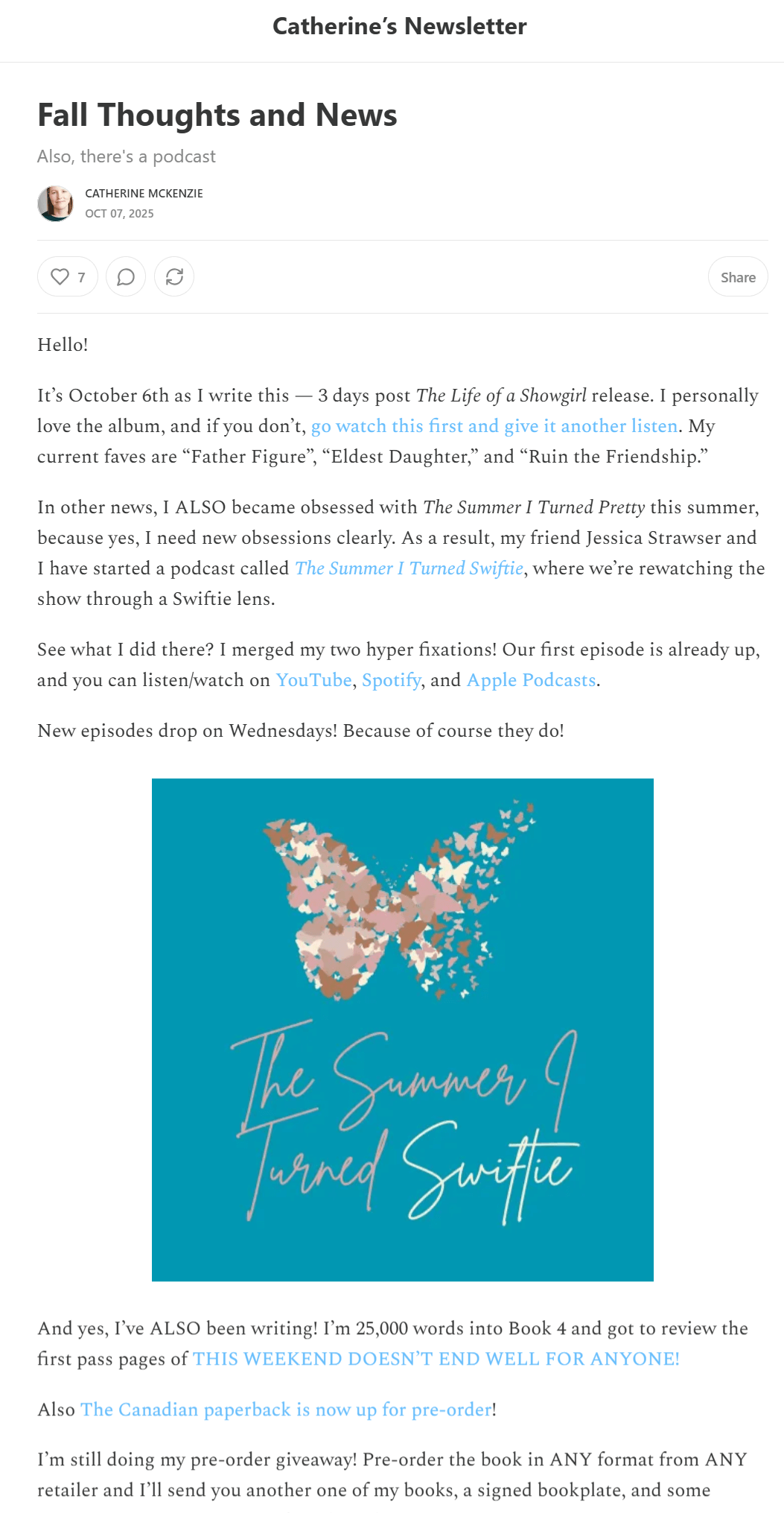
Image Source: Catherine McKenzie
How to start or refresh your author newsletter
You don’t need a complex strategy to run a great author newsletter. With a simple setup, a clear format, and a consistent rhythm, you can get started today. Here’s how:
1. Choose the right email platform
The best email marketing platform is one that makes it easy for you to get started. You can always switch later when your needs change. Here are our top recommendations for authors’ newsletters:
- MailerLite is a strong starting point for most authors. It’s affordable, easy to use, and comes with well-designed author newsletter templates. Also, automation is simple, which makes welcome sequences easy to set up.
- Substack works well if you want a blog-plus-newsletter setup and you’re interested in paid subscriptions. The trade-off is less design control and fewer advanced email marketing features.
- Beehiiv is ideal for writers publishing long-form content. It offers a similar experience as Substack newsletters, but has more flexibility, better analytics, and built-in growth tools.
- Kit (formerly ConvertKit) is a good choice if you want advanced tagging, segmentation, or paid newsletter tiers. It’s powerful for separating readers by interests or engagement level.
2. Offer something better than updates
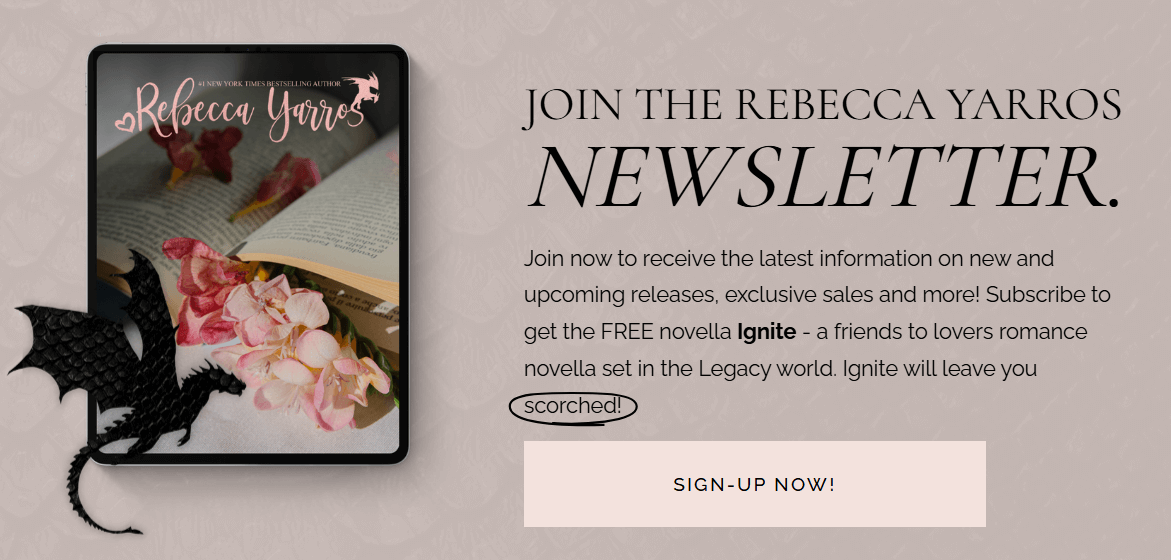
“Subscribe for latest updates” isn’t a compelling reason for readers to subscribe to your author newsletter. Readers want a tangible reward, not a vague promise. So, offer a lead magnet as an incentive on the sign-up form.
Your signup incentive could be a:
- Free chapter or short story
- Deleted scene or bonus essay
- Discount or early access perks
- Short email course or serialized story
- Reading guide or recommended book list
3. Set up a simple welcome email
Many authors skip this and miss the opportunity to start a relationship with subscribers. Readers sign up, and hear nothing until months or weeks later, usually right before a book launch.
At minimum, set up one welcome email that:
- Delivers the freebie you promised
- Explains what kind of emails they’ll receive
- Sets expectations around frequency and tone
If you want to go a step further, create a welcome series or mini-onboarding sequence with different types of emails to turn new subscribers into engaged readers.
Conclusion: Use one or two author newsletter ideas from these email examples
You don’t need to invent a new newsletter format. Pick one or two styles from the author newsletter examples we’ve explored in this post and commit to testing them for a few months.
Start small:
- A poll or reader question as part of your weekly email
- One behind-the-scenes email per month
- A short personal update between launches
- A simple backlist spotlight every quarter
The best author newsletters aren’t perfect. They’re consistent, human, and useful. Once you find a format that feels natural and gets engagement, double down on it. That’s how you turn a mailing list into a readership, and a readership into book sales.
You can read our guide for more newsletter best practices. And if you need extra help choosing the right platform or shaping your author newsletter format to fit your writing style and schedule, book a consult to get clear, practical guidance tailored to you.
The authors
Learn more about us

Our Methodology
This article has been written and researched following our EmailTooltester methodology.
Our Methodology