

AI-generated emails. In our industry, it feels like everyone has an opinion on them.
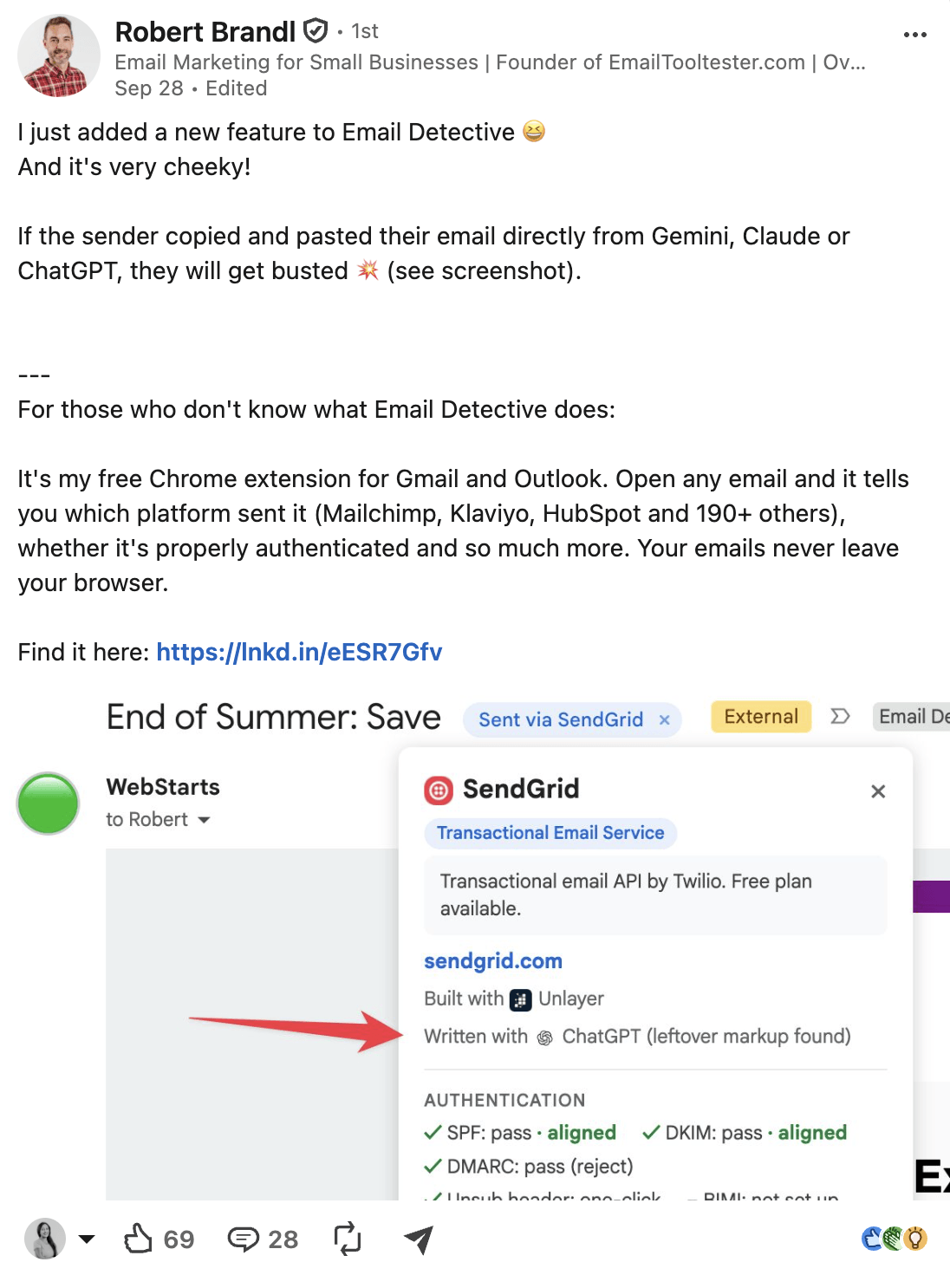
This was made all the more obvious when I published the following post on LinkedIn. It was about a new feature I recently introduced to our Email Detective Chrome Extension, which automatically detects whether an email was copied over directly from ChatGPT, Claude or Gemini:
And boy, were the opinions on this divided!
Some people loved it. Others had a very reasonable question: Who cares?
After all, AI is already deeply embedded in the way many of us work. People use it to draft emails, adjust their tone, and generally get through their inbox faster. So if the end result is clear, useful and well written, does it really matter whether ChatGPT helped produce it?
As one commenter put it, “These tools are cool. But I still can’t understand the business of knowing which LLM it came from or whether the copy is AI-written, etc. Folks, it’s either accept that we are in the AI era or keep fighting it.”
It’s a fair point.
But after looking more closely at the research, it seems like yes, it can matter. Quite a lot, actually – for a few different reasons.
Your subscribers may care more than you think
Adobe recently surveyed more than 1,000 US consumers about AI in marketing emails. One of the most interesting findings was that 37% said they trusted brands more when their emails felt human, even if they were less polished.
What’s even more concerning for marketers is that 18% said they had already unsubscribed from a brand because they suspected its emails were AI-written, while 46% said they would be more likely to unsubscribe if they knew an email had clearly been written by AI.
At the same time, 37% also didn’t care whether an email sounded AI-generated, as long as it was still useful and relevant. But it clearly starts to matter when the end result feels less personal, less authentic, or simply less worthy of the recipient’s attention.
For email marketers, that’s not a trivial issue. We spend a lot of time trying to build trust, familiarity and loyalty with subscribers. If the use of AI starts to weaken any of those things, then it undoes a lot of that hard work.
A thoughtful, personalized message suggests that someone took the time to think about what they wanted to say and why they were saying it to you. AI can now reproduce those signals very convincingly.
Another 2025 study found that people tended to trust communications less when they were told AI had been used. And the effect was even stronger when AI use was exposed by a third party, than when the sender disclosed it themselves. (Which is probably not what anyone flagged by Email Detective wants to hear. Sorry about that. 🙈)
So if the recipient finds out that what looked like a personal email was actually generated in seconds, and sent to dozens (or hundreds!) of people, that email becomes much less meaningful.
AI makes every email sound the same
There’s another problem that you yourself might have noticed, especially if you spend a lot of time in your inbox: AI writing can slowly homogenize the way we communicate.
A recent workplace survey cited by Omni Calculator found that 25% of AI users felt their communication had become more generic and less like them. What’s more, 57% said they had noticed a coworker’s personality disappear from their emails after they started using AI.
While AI-assisted writing is usually perfectly competent, it’s also often completely forgettable. And that can be a real problem for marketers.
Brands spend years trying to develop a recognizable voice. They want subscribers to feel like there is a real person, or at least a distinct personality, behind the emails they receive.
If everyone starts feeding similar prompts into the same handful of AI tools, those differences can quickly disappear. You end up with emails that are technically good, but could have been written by almost anyone.
AI can cause a disconnect between the email and the sender
Traditionally, the way someone writes gives us clues about the kind of person they are. That can become harder to gauge when AI is heavily involved.
An interesting example comes from a piece published by the Alexander von Humboldt Institute for Internet and Society by Dr Georg von Richthofen. He described exchanging very warm and enthusiastic emails with someone before interviewing them, only to find that the person seemed much less engaged during the actual conversation.
He later discovered that the interviewee had been feeding bullet points into ChatGPT and asking it to turn them into friendly emails. So the tone had created an impression of the sender that wasn’t entirely real.

If your emails sound warm, personal and opinionated, but every other interaction with your brand feels generic or disconnected, people are eventually going to notice the gap.
And once readers begin to question whether the personality in the email is genuine, it becomes much harder to build the kind of relationship email marketing is supposed to create.
Why this matters for email marketers
For email marketers, all of this goes beyond a debate about whether AI-written copy is good or bad.
Email works because it builds familiarity over time. Subscribers get used to your tone, your opinions, your way of explaining things. That voice is what separates your newsletter from another.
When too much of the writing process is handed over to AI, that can get lost. If your emails start sounding like the same polished, vaguely enthusiastic copy everyone else is sending, you lose some of the personality that made people subscribe in the first place.
And as the Adobe research shows, even the mere suspicion that you’ve used AI can be enough to make them unsubscribe.
So, should marketers stop using AI?
I know I’ve just spent the entire article tearing down AI-written emails, but I am actually not completely against them.
I use AI myself, and I think it can be genuinely useful for email marketing. It can help you tighten a paragraph, come up with subject line ideas, check your grammar, or turn a rough first draft into something clearer.
Some research even suggests AI-assisted communication can work perfectly well, especially when the email is mainly functional. If I’m receiving a transactional email like a password reset or an appointment confirmation, I probably don’t care whether AI helped write it. In those situations, clarity and speed are much more important than personality.
But a newsletter is different. So is a personal sales email. In these cases, using AI as an author (rather than an assistant) can lead to losing the things that make your emails worth reading in the first place: your opinions, your experience, your sense of humor, and the little quirks that make your writing sound like you.
A useful rule of thumb is this: Use AI to improve what you want to say, not to decide what you want to say.
That’s especially important if your newsletter is written in a personal voice. The more your subscribers associate the emails with a particular person, the more noticeable it becomes when that personality suddenly disappears.
> Want to see which emails are likely to be written by AI (and find out which technology senders are using in the process)? Install Email Detective for Chrome, our free extension.
What do you think – is there a place for AI in generating marketing emails? Let me know your thoughts in the comments below.
The authors
Learn more about us

Our Methodology
This article has been written and researched following our EmailTooltester methodology.
Our Methodology