
“We're excited to introduce…”
If your last product launch email started anywhere near those five words, I probably already know why your emails didn’t convert as much as you wanted.
Most launch emails announce the product and expect subscribers to be “excited to buy.” But subscribers don’t care that you’re launching a product. They care about what your product is going to do for them.
So to write a product launch email that converts, you must stop announcing and start making prospects see how your product solves their problems and why it's worth taking action right now.
In this guide, you’ll learn step-by-step how to write a product launch email that does that. You’ll also find real examples to study and ready-to-use templates you can download and adapt for your next launch.
Let's get into it.
What is a product launch email?
A product launch email is the email you send when you launch a new product. But it isn’t just an email to announce the product’s release, list the features, and throw in a discount offer.
The moment you think of it as an “announcement,” you write it like one — formal, feature-heavy, brand-first. And, announcement-style emails inform people without compelling them to act.
A product launch email's real job is to move subscribers to buy.
Not to notify or update. But to make a reader who has a problem, but no intention of buying your solution (or still considering) click through to the sales or order page.
When your product launch email works, it doesn't feel like a launch at all. Rather, it feels like a solution showing up at exactly the moment they need it.
Why most product launch emails fail to convert
Here's what most launch emails look like in practice.
Subject line: “Introducing [Product Name].”
Opening line: “We're thrilled to announce the launch of…”
Body copy: a bullet list of features (maybe + benefits)
CTA: “Learn more.”
Sound familiar? It’s what most businesses default to, and it’s why most product launch emails get opened once, skimmed for two seconds, and forgotten. Let’s break down the reasons this happen:
- The “We’re Live” trap
This is the most common mistake. The email leads with something like, “We’re excited to announce…” Or “Our new product is finally here.”
But prospects aren’t exactly “excited” that your product is live. Even the ones who have been on your waitlist are really just interested in what your launch means for them.
So, a product launch email shouldn’t start with your excitement (except it’s a close-knit personal brand). It should start with the pain, outcome, or transformation that your subscribers recognize immediately.
- Features overload
Prospects aren’t thinking, “great, it has 12 integrations,” or “cool, it’s made from recycled materials.” They’re thinking, “How does this make my life easier?”
So, just sharing your product features isn’t enough, no matter how many. Because features on their own don’t create desire.
Instead, connect features to clear benefits or outcomes. And then take it a step further by showing the transformation they’ll experience after getting the benefit.
- Treating it as a single event
A product launch email is a moment inside a longer conversation. Actually, you should have a product launch email sequence that includes a pre-launch and post-launch sequence (not a single email).
Businesses often make the mistake of focusing on only the email they send on launch day.
But if the first time your reader hears about your product is the day you launch it, they won’t be primed to buy. And if they don’t hear about it after launch day, you’re leaving conversion on the table.
How to write a product launch email (step-by-step)
Whether you’re launching an online course, physical product, SaaS feature, or something else, these steps will help you write a product launch email that converts. Think of them as a connected arc, not a checklist.
Step #1: Get clear on the outcome
Subscribers care about their problems, goals, and frustrations. Your product is only interesting once they can see how it can help them get on the other side.
So, before you write your product launch emails, get clear on what that other side looks like for them. What does your prospect’s life, workflow, or business look like after they use your product?
A simple prompt to make this easier before writing your launch emails is to complete this sentence:
“This product helps [target audience] go from [current frustration] to [desired result].”
Make sure to describe the frustration and desired result in detail, as this would be helpful in writing your product launch email.
Step #2: Hook them with something they recognize
Your hook determines whether the rest of the emails get read. So, drop them straight into something familiar. This may be a problem, frustration, or pattern they’ve experienced.
Make it so specific that they think that you’re reading their mind. That doesn’t mean you should exaggerate. It means using voice-of-customer data to reflect their lived experiences back at them.
For instance, if you're launching a project management tool for small teams, don’t write “managing projects can be challenging.”
Instead, write, “You’re running three projects simultaneously. Half your team is working from messages buried in three different apps. And somehow it’s still your job to know exactly where everything is.”
The more specific you are, the more prospects trust that you understand their pain or struggles and can help fix them.
Step #3: Make the problem feel expensive to ignore
Most product launch emails describe the problem without making it sting. So prospects nod along and then move on to the next email because the problem feels familiar but not urgent. They’ve lived with it this long, what’s another week?
So, you should attach a real cost to inaction in time, money, missed opportunity, or compounding frustration. What happens if they don't solve this? What have they already lost by leaving it unsolved?
Say you're launching an inventory management tool for ecommerce stores. Don’t just describe the chaos of spreadsheets. Show what that chaos costs:
- The oversold products that leave customers disappointed
- The hours spent reconciling numbers manually every Sunday night
- The sale that nearly slipped because the stock data was two days old
Make the before feel expensive, and the after feels worth paying for.
Step #4: Position the product as the logical next step
If you’ve done the first three steps right, your prospects are primed. They can see where they want to be and understand what staying stuck is costing them.
Now you can introduce the product. But, don't announce it — position it.
The framing shouldn’t be “we built or created a thing.” It should be “there's a direct path from where you are to where you want to be, and this product is the bridge.”
Make sure to keep this section tight. Name the product, say what it does in one plain sentence, and connect it directly back to the transformation.
Resist the urge to list every feature. Detailed feature descriptions are for your sales or order page. So, mention only the important features. And make sure they’re written alongside the benefits (and transformation), like it’s done in this email from Gozney.
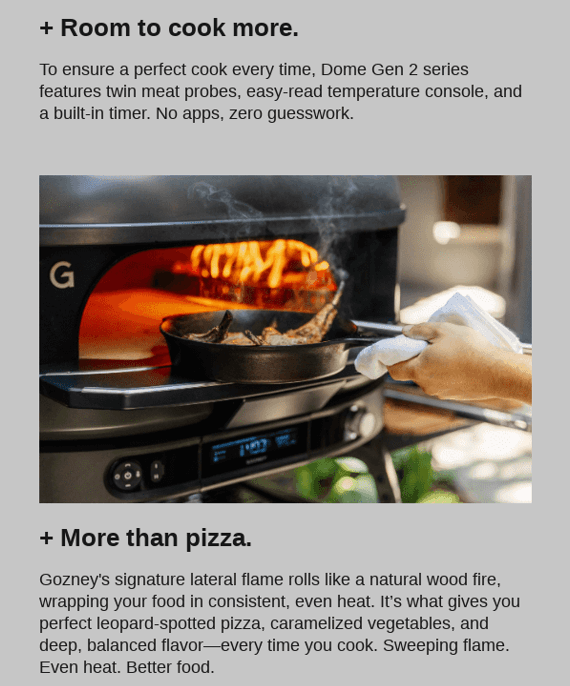
Image Source: Really Good Emails
Step #5: Frame the offer so it feels like a no-brainer
At this point, prospects are thinking, “Okay, this sounds useful, but is it worth it?”
Most launch emails answer that with a bonus or discount offer. That works. Just make sure that you state the offer plainly. No price confusion, unclear bonus details, or buried discount conditions.
But framing the offer goes beyond discounts and bonuses. The goal is to remove hesitation altogether, and that can look like:
- Showing how the product pays for itself
- Highlighting what they get immediately, not someday
- Positioning early access as an advantage, not just a bonus
- Reducing perceived risk with free trials, flexible plans, and money-back guarantees
When your offer is framed right, you increase the perceived value and reduce friction at the same time. Michal Eisik does this well in this email promoting ScaleTribe.
The offer is framed around the value of being a founding member. And she doesn’t just state the price. She asked three pointed questions that show what the investment is worth and make the decision feel logical instead of risky.
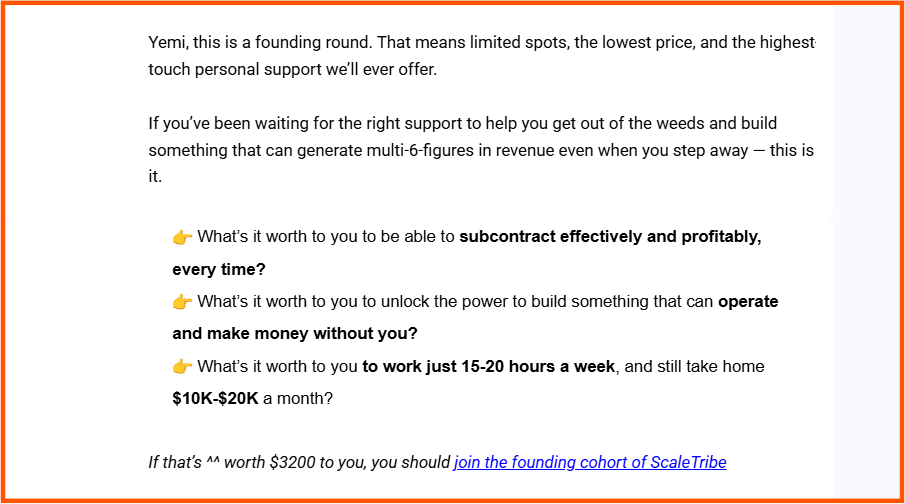
Image Source: Michal Eisik
Step #6: Add proof that it actually works
The reality of launch emails is that you’re asking people to trust something they’ve never tried. And that’s why desire alone isn’t enough to get prospects to buy. They also need to believe it’ll work for them specifically.
The challenge with a new product launch is that you may not have customer proof yet. But you have options:
- Beta tester results
- Early access feedback
- A waitlist response that signals demand
- A stat that validates the scale of the problem your product solves
- Your own results, if you built the product to fix your own problem first
Any of these gives prospects a reason to trust the solution before they’ve experienced it. In fact, a single specific quote from a beta user will do more work than three paragraphs of product description.
And if you don’t have any of these yet, lean into transparency. “We built this because we were tired of [problem] and couldn't find anything that actually fixed it” is a form of social proof. And it tells the reader you're solving a real problem, not a hypothetical one.
Also, you can use social proof from your other products that shows you always deliver. For example, in this email from Prerna Malik for Claude for Conversions, she layers in specific testimonials from previous workshops that highlight a clear result.
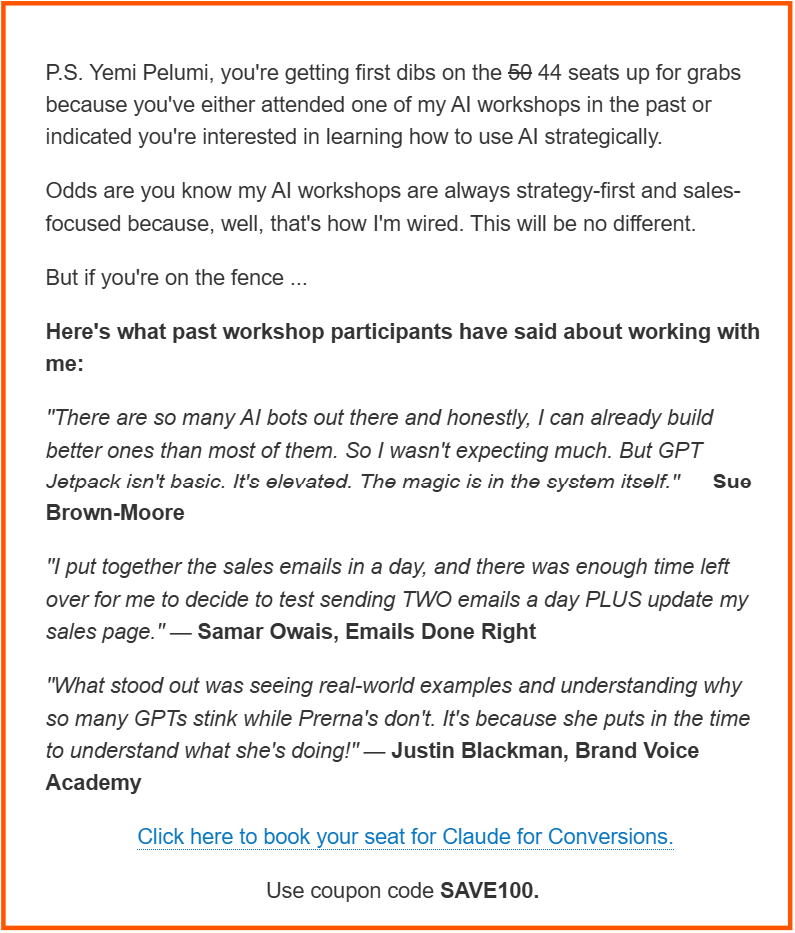
Image Source: Prerna Malik
Step #7: Create urgency that doesn’t feel fake
Urgency is the most misused tool in email marketing for pushing people to act. Countdown timers for no reason. “Limited time offer” with no actual limit. “Act now” with no consequence for waiting.
Subscribers have seen it all, and they’ve learned to ignore it. So if you’re using urgency in your product launch email, make sure it comes from real constraints.
- Early bird pricing that genuinely expires at a specific date
- Launch discounts or bonuses that disappear after launch week
- Limited number of onboarding slots because you’re involved in setup
For SaaS launches, early access cohorts work well. For example, the first 100 users get a lower price, direct access to the founding team, or a feature not available in the standard plan.
For ecommerce, a first-run production quantity with no guaranteed restock is a legitimate constraint if it's true.
The goal is to give prospects a reason to act now rather than later. An example is this email from Eman Ismail to subscribers on the waitlist for her Subscriber-Led Sales course.
The urgency is layered and tied to real constraints: a 24-hour bonus and limited spots. Also, the bonus is explained to avoid confusion.
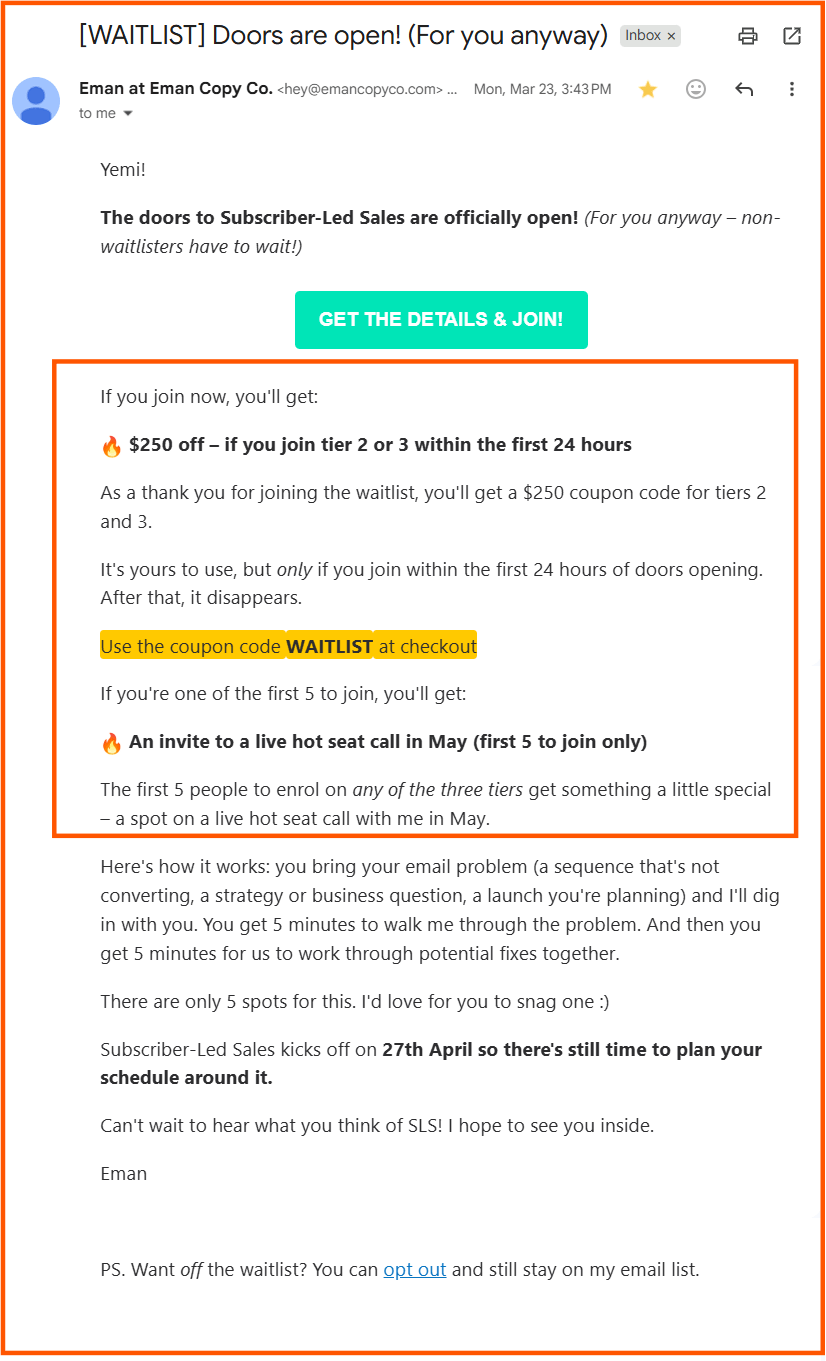
Image Source: Eman Ismail
Step #8: Write one CTA to drive action
When you have more than one primary CTA in your product launch email, you’re making polite suggestions instead of one clear ask. And polite suggestions get ignored.
Pick one action you want the reader to take. Not the most obvious one, but the most important one. The action that, if taken, moves them toward becoming a customer.
Then write a conversion-driven CTA button copy.
- “Get Early Access” beats “Sign Up.”
- “See It in Action” beats “Learn More.”
- “Claim Your Launch Discount” beats “Shop Now.”
The CTA copy should tell the reader what they get, not what they do. Place it once or twice at most, if the email is long enough to warrant repeating it.
Step #9: Write the subject line last
Most people write the subject line first. And that’s why many product launch emails are never opened, let alone get the chance to convert.
The one job of your subject line is to sell the open. Not the product or the launch. But the decision to click open the email.
When you write the subject line after the email, you write from knowledge instead of guesswork. You know exactly what the email delivers, what the emotional arc is, and what the single most compelling thing about this launch actually is.
The most effective product launch subject lines do one of four things:
- Create curiosity. E.g., “This took us 18 months to build”
- Name the transformation. E.g., “Send less email, close more deals”
- Signal exclusivity. E.g., “Early access is live, but not for long”
- Make a bold claim. E.g., “This replaced 3 tools for our team”
I like to write 5 to 10 subject line options before picking one. The good ones almost always come after the obvious ones are out of the way.
Check out this post for product launch subject line examples you can adapt for your launch email.
10 product launch email examples (and why they work)
Here’s a breakdown of a few product launch email examples to help you see how the steps can play out in a real email and what they’re doing right that you can borrow.
Lululemon – BeCalm Collection
Lululemon's product launch email is visually stunning and lets the product speak through experience. The email shows the clothing in motion, lifestyle, and context.
But the headline is a textbook example of the announcement trap. It works because the audience already trusts the brand. If your brand is newer, you would need more benefit or problem framing.

Image source: Really Good Emails
Huha – Horse Girl Energy
This pre-launch email leads with identity and exclusivity: “Calling all horse girls…” The “limited drop” framing adds urgency to drive waitlist subscription. And the design reinforces a specific aesthetic and vibe.
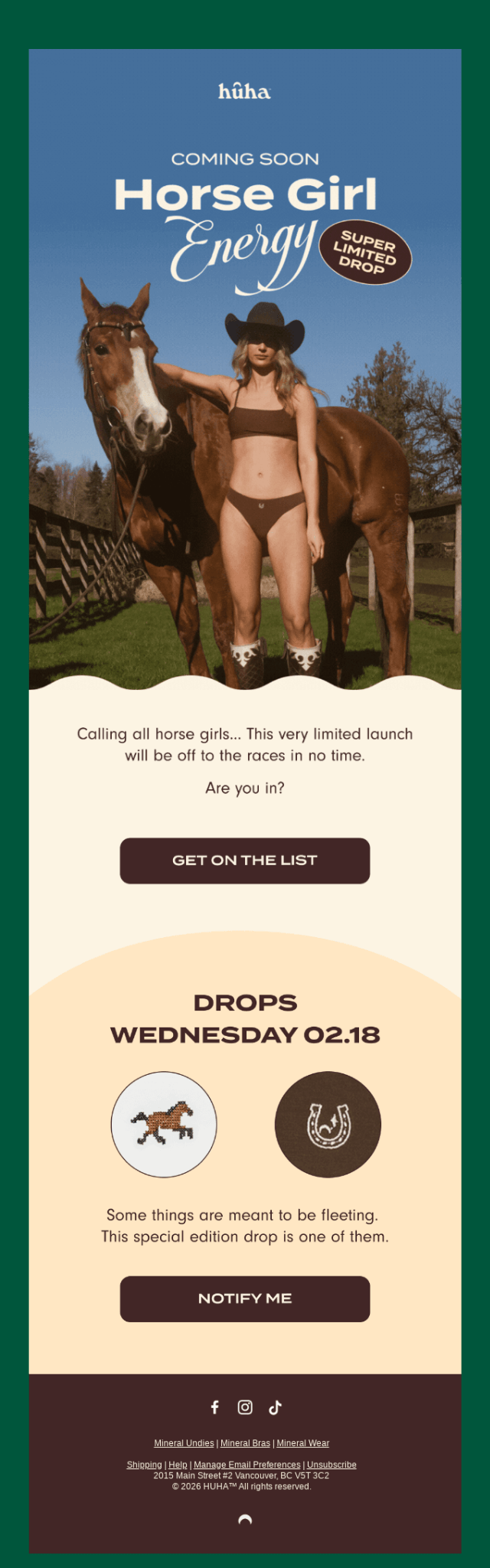
Image Source: Really Good Emails
Milk Bar – Holiday Desserts Early Access
Milk Bar frames this as a gift to the reader, not a product announcement. And the early access positioning makes the subscriber feel like an insider.
The product photography shows the desserts, not just the packaging. However, the product copy is just feature descriptions rather than the benefit or why it matters.
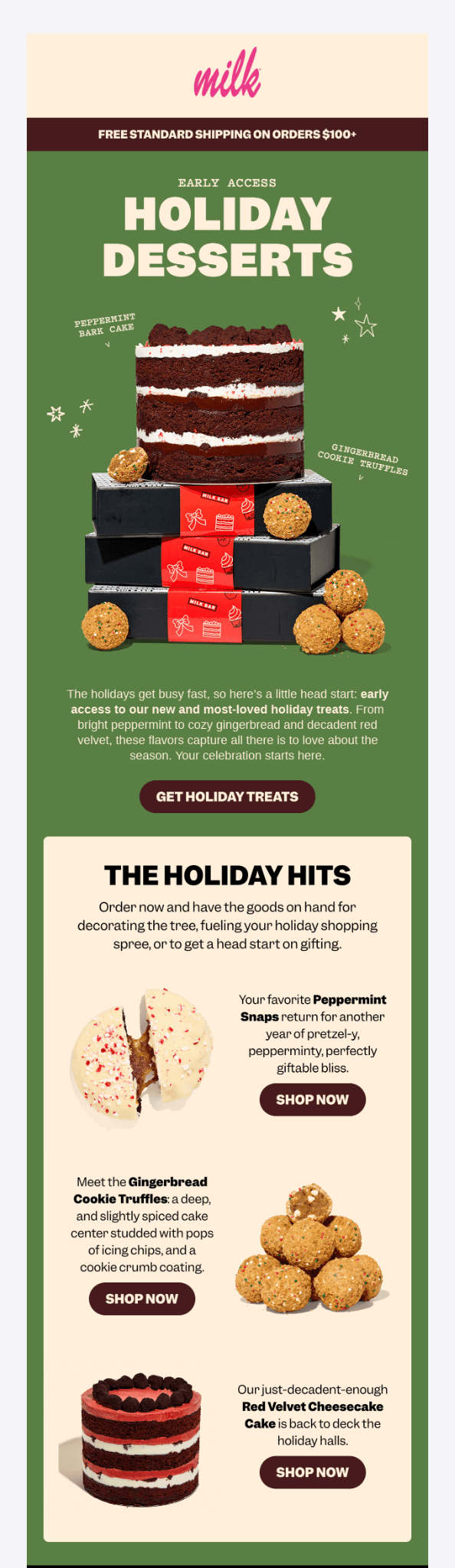
Image Source: Really Good Emails
Gozney – Dome Gen 2 Series
Gozney positions the product as a step up in capability: “A new era of cooking with fire.” Instead of just listing specs, it shows that the product enables better cooking, more versatility, and pro-level results.
Features are framed through outcomes and benefits. And every image shows the oven doing something, not just sitting there.
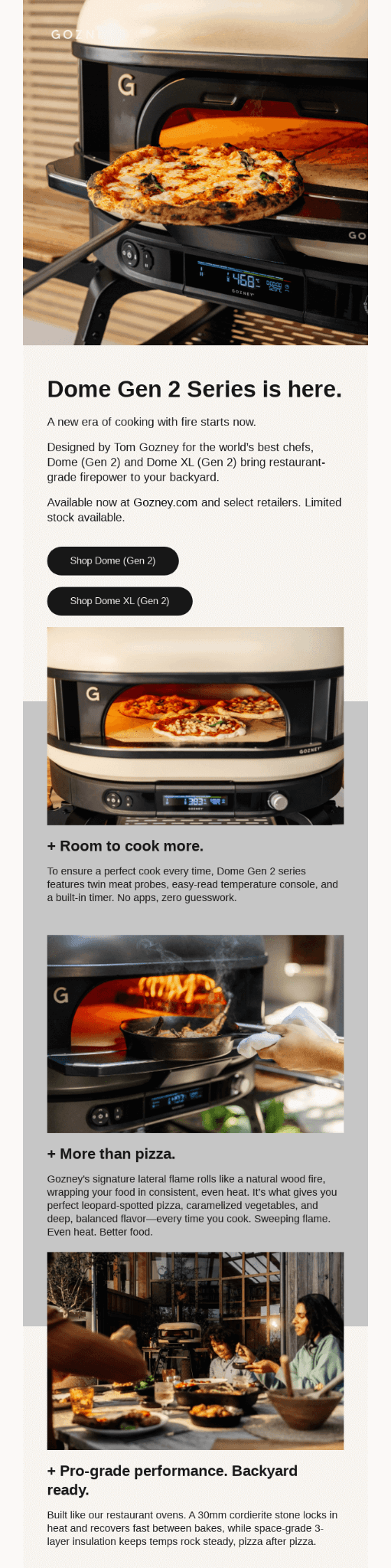
Image Source: Really Good Emails
Miro – Miro AI Launch
This launch email opens with differentiation. It pitches the transformation by telling what's different and why it matters specifically. The step-by-step walkthrough body copy then shows the product in action.
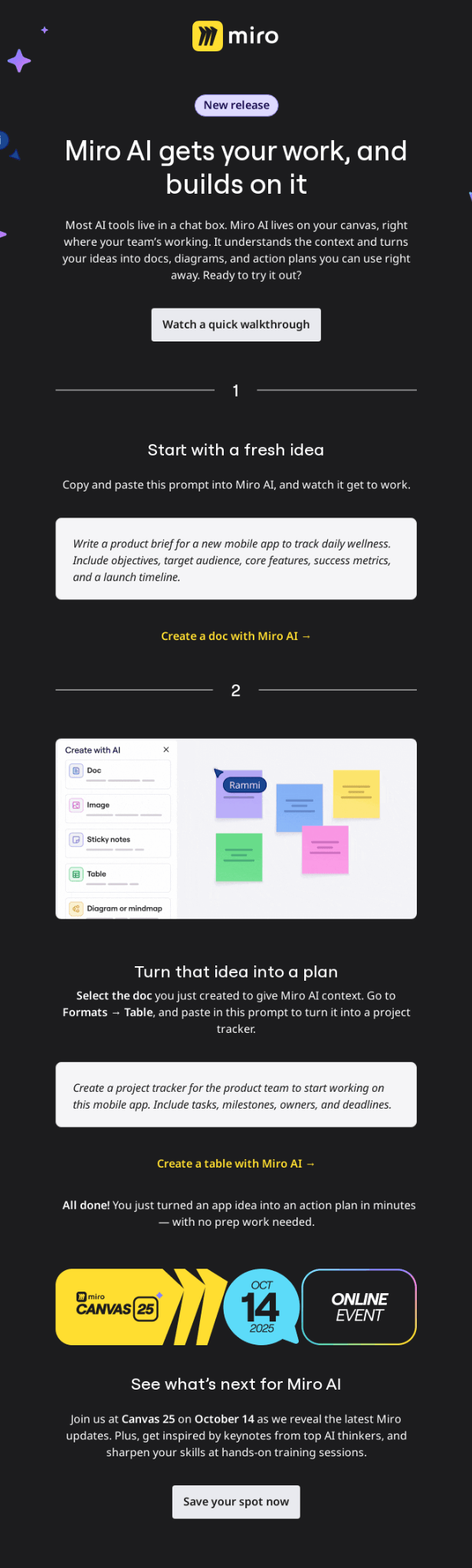
Image Source: Really Good Emails
Michal Eisik – ScaleTribe Founding Cohort
This type of launch email works best for high-ticket offers where trust matters more than brevity. It starts with the reader’s situation and builds credibility through specific pain points.
Then, it introduces the offer with detailed outcomes and proof. And the bullets aren’t just features, they’re framed as solutions to known problems.
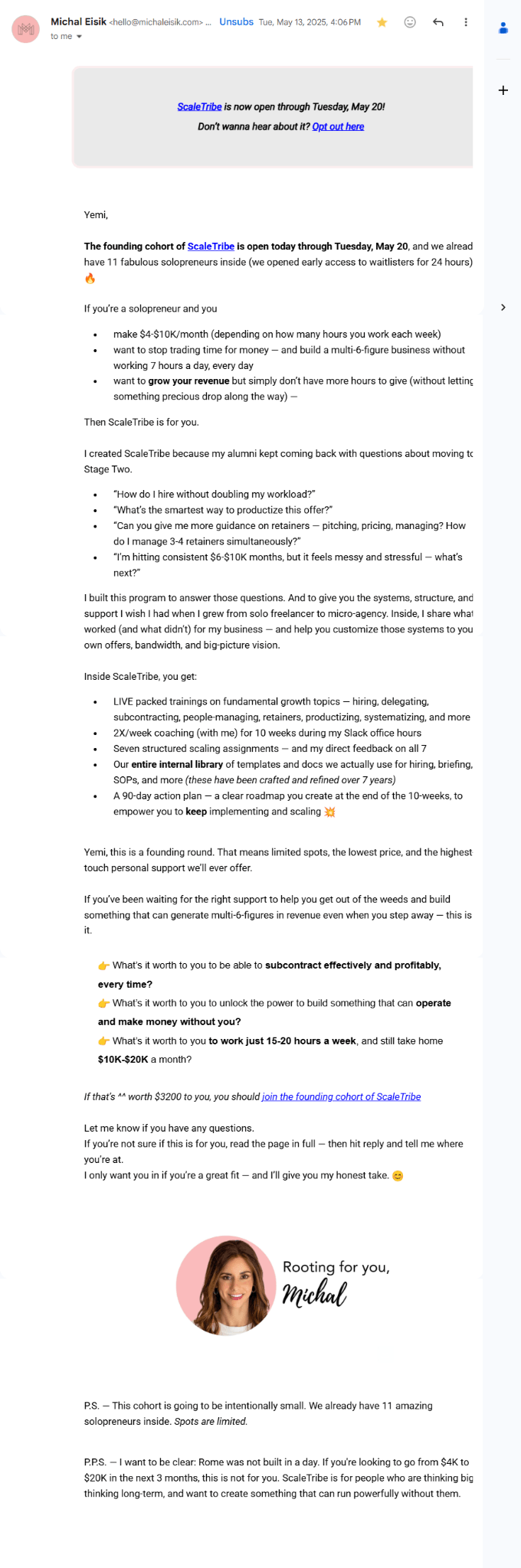
Image Source: Michal Eisik
Pura – Pura Mini
Pura's launch email keeps it simple by opening with the use case immediately. It tells the reader their problem (small space) has been thought about.
The rest of the email is clean, easy to scan, and focused. The feature list is supported by the benefits. And the images show the Mini in a real bathroom, not a studio.
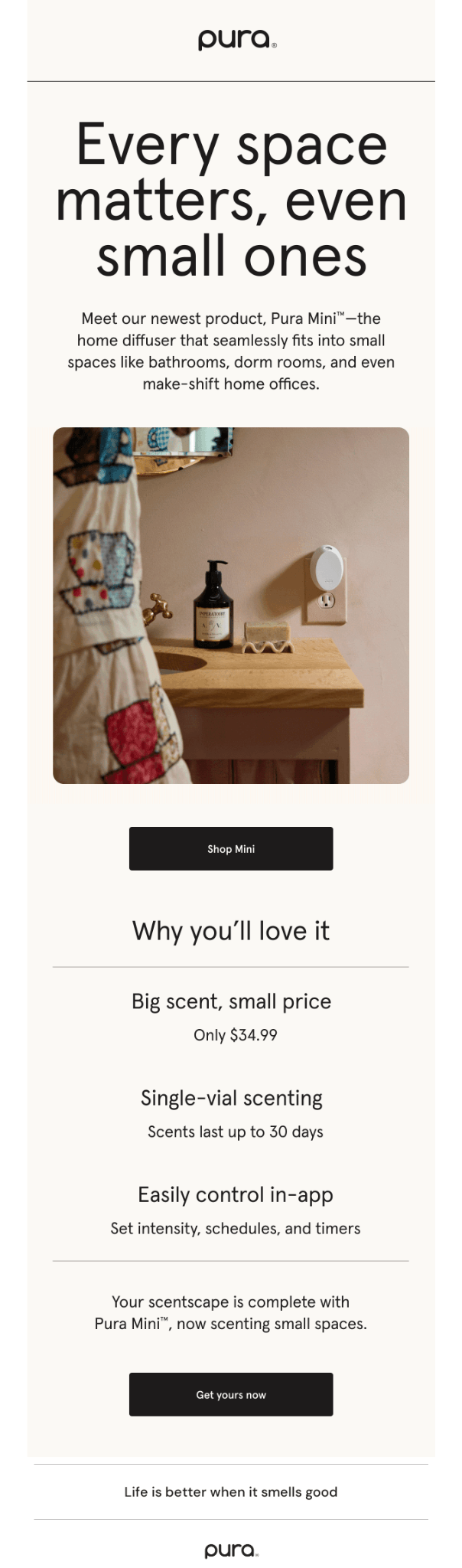
Image Source: Really Good Emails
Avelo – Supertrainer Kickstarter Launch
This launch email leans heavily into value framing. It breaks down what you get, what it’s worth, and why the price makes sense.
Layered on top of that is strong social proof from testers. This directly addresses the “is it worth it?” question most buyers have. However, the “Learn More” CTA is a drawback. A prompt to join a waitlist or a launch day reminder would have worked better.
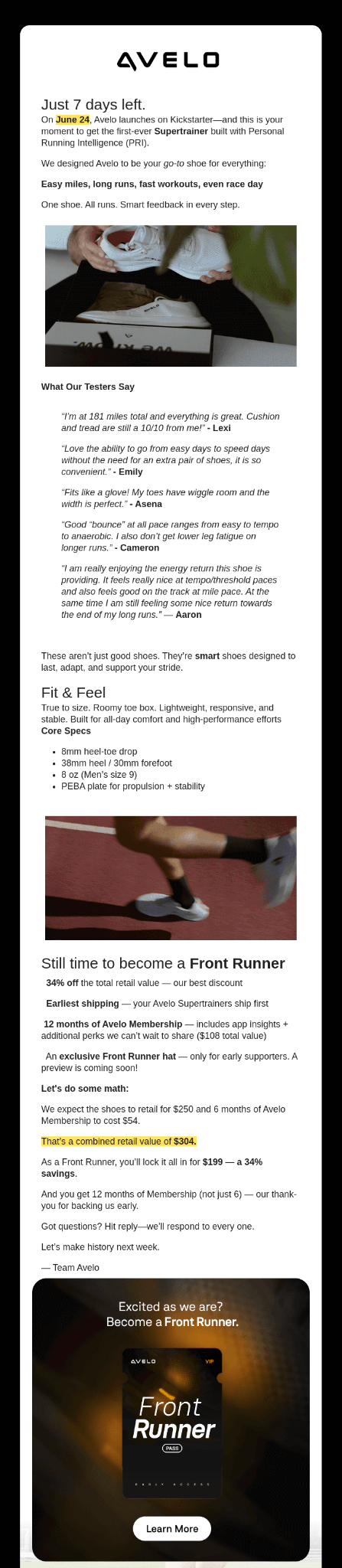
Image Source: Really Good Emails
Buoy – Rainforest Collection
Buoy's launch email opens with a stat, which it uses to agitate the problem. Then it stacks credibility, context, and product visuals to support that claim.
The product is introduced as the natural answer to that problem. It also makes an irresistible offer for subscribers to try the new product before it's released.
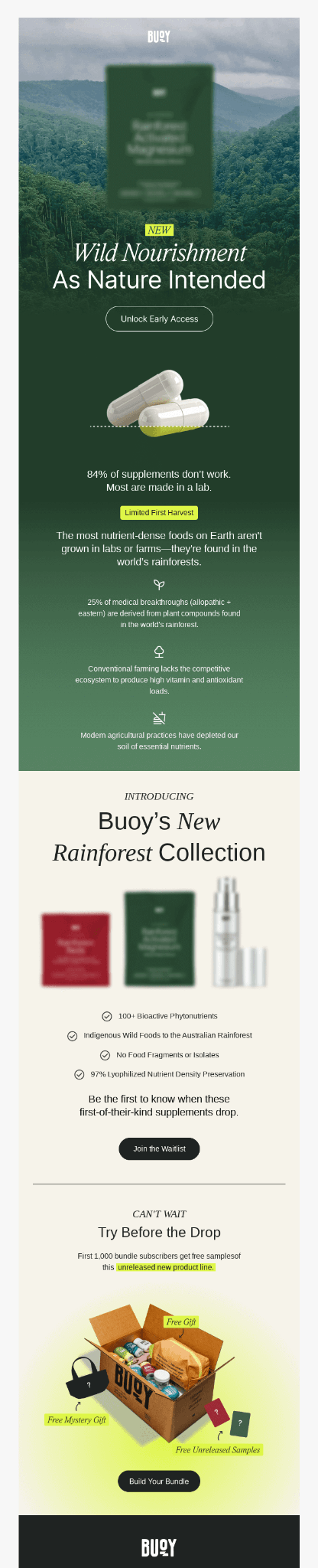
Image Source: Really Good Emails
Imbodhi – Mari Skort Dress
This launch email leads with a strong visual and a simple (but announcement-style) headline. The body copy that follows focuses on the benefits of the dress.
Also, the “What’s to love” section is great for outlining the features. The only drawback is that they're not connected to the benefit or use of each feature.
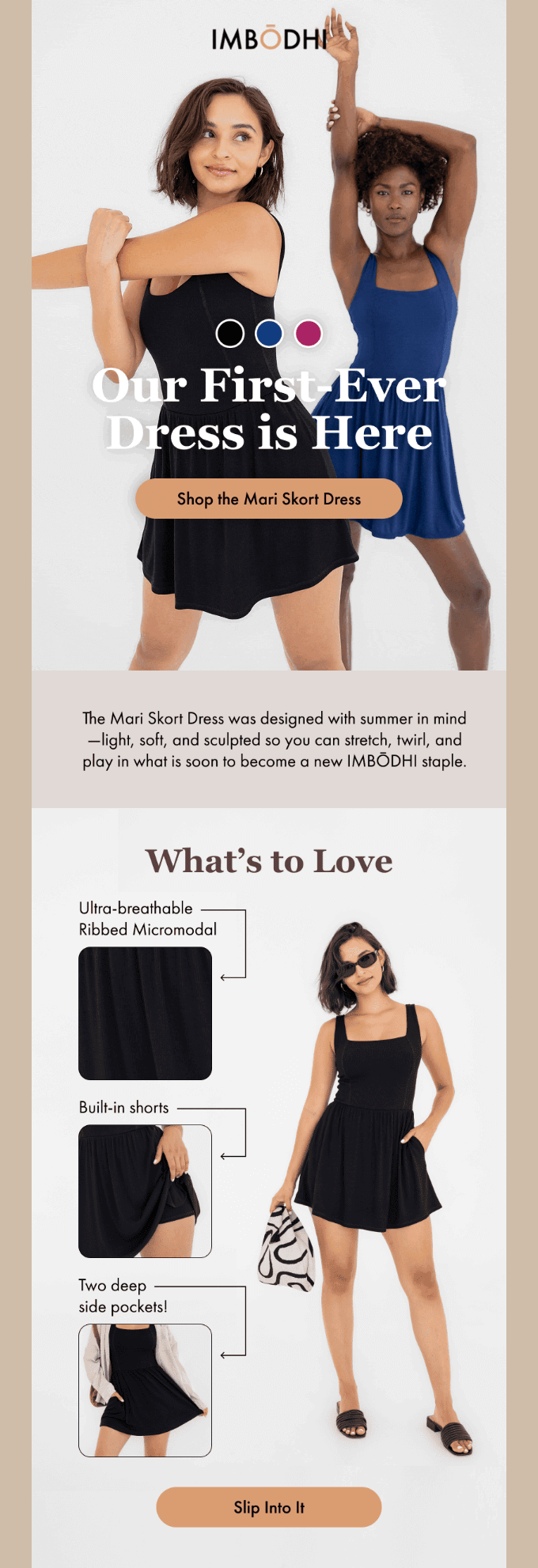
Image Source: Really Good Emails
5 Free Product Launch Email Templates To Get You Started
Understanding how to write a product launch email and seeing examples is one thing. But when you're staring at a blank doc the week before launch, it’s harder to get started.
You second-guess the hook, overthink the offer frame, and end up rewriting the same paragraph three times.
So instead of starting from scratch, we’ve put together five ready-to-use product launch email templates to help you move faster.
Each template follows the nine-step structure from this guide. And the copy prompts tell you exactly what to write in each section, so you can adapt it to your product, voice, and audience.
Download Your Free Product Launch Email Template
Product launch email tips to improve performance
These small tweaks will help you convert more subscribers with your product launch emails.
- Segment before you send
A prospect on your waitlist is in a different place than someone who just joined your list yesterday. They don’t have the same motivation to buy and shouldn’t get the same email.
So, email segmentation isn’t optional for your product launch campaigns. Make sure you group your subscribers so you can send them personalized emails that will engage and resonate with them.
You can segment by demographic data, such as age and gender. But for product launch emails, behavioral segmentation matters most.
For example, segmenting by those who joined the waitlist, interacted with your pre-launch content, or clicked through but didn’t buy.
- A/B test the subject line and hooks
The subject line gets the open, and the hook earns the read. Both are worth testing.
Try different angles:
- Pain-driven vs outcome-driven
- Direct vs curiosity-led
- Short vs descriptive
You don’t need to overcomplicate it or change five things at once. A/B test one variable at a time and look at what actually gets opened and clicked.
The best email marketing service providers, including Brevo, ActiveCampaign, and Klaviyo, let you A/B test subject lines and send to segments automatically.
- Timing matters more than most people realize
When you send your launch email affects whether it gets seen. According to MailerLite's analysis of 2 million email marketing campaigns, the best time to send emails is between 8 am and 11 am on most weekdays.
And Mailchimp’s send-time optimization data points to Tuesday, Wednesday, and Thursday as the strongest days, with 10 am in the recipient's own time zone as the top-performing send time.
That said, test against your own list’s behaviour rather than assuming industry benchmarks apply to you. Your audience’s habits are the only data that actually matter.
- Design for mobile first
The majority of your subscribers will open your emails on their phones. And on that small screen, long paragraphs become walls of text, and multiple CTAs become a scroll of confusion.
So make sure to use single-column layouts, short paragraphs, and appropriately sized CTA buttons. These aren’t just design preferences, but requirements for engagement and conversion.
- Use images strategically
Images can improve how your product launch email performs. But only when they’re used with intention.
Most brands either overload their emails with visuals or rely on them to do all the selling. Both approaches hurt conversion. Your copy should carry the message, while the images support it.
For ecommerce, this means showing the product in context, not just clean product shots. Think: how it’s used, what it looks like in real life, or the outcome it creates. For SaaS, skip generic UI dumps. Instead, highlight a single feature in action or show the “after” state your product creates.
The goal isn’t just to make your email look good. It’s to make your product easier to understand and more desirable.
Conclusion: Write product launch emails that do more than announce
The product launch email that converts isn’t the one that’s perfectly written. It’s the one that doesn’t feel like an announcement and sells a solution to your prospects.
That’s harder than it sounds. Most of us tend to default to writing about what we built because we’ve been living inside the product for months and are excited to launch it.
But the best product launch emails are written for the reader. What does your product help them achieve? How does it make their life easier or better? What changes when they buy?
So, start with the one sentence that clarifies everything: “This product helps [audience] go from [frustration] to [result].” Then, use the steps, examples, and templates in this guide to write your product launch emails.
And if you're running an ecommerce store, download our free ecommerce email flow cheatsheet to set up your product launch campaign easily.
The authors
Learn more about us

Our Methodology
This article has been written and researched following our EmailTooltester methodology.
Our Methodology