
Most product launch email subject lines fail because they announce instead of earning the open.
They assume subscribers are already sold and waiting to buy. But even a warm list of subscribers needs a reason to click.
The fix isn’t just following email subject line best practices. It’s also understanding which emotional lever to pull at each phase of your launch and writing a subject line that compels subscribers to open your product launch emails.
This guide will help you do that. You’ll find 60+ product launch email subject line examples across five launch phases. Plus, why they work, so you can adapt them for your launch campaign.
Let’s get into it.
First, what makes a product launch email subject line work?
A good subject line might get opened. But a strong one gets opened by the right people for the right reason. Here are the three core features that make a product launch subject line work.
- Specificity beats hype every time. You can add specificity through a clear outcome, a timeline, a specific number, a defined audience, or a known pain point. The more concrete the detail, the more real the stakes feel.
- The emotion needs to match where your subscriber is in the launch journey. Urgency in a pre-launch teaser kills curiosity before it builds. Exclusivity framing on a post-launch email lands awkwardly. Each phase of a launch has a primary emotional job that you must get right.
- Curiosity, urgency, and exclusivity are tools, not templates. The best subject lines usually lean hardest on one trigger. Trying to pack all three into a single line often weakens the subject line or makes it unconvincing.
Now, let’s get into product launch email subject line examples, organized by the different phases of a launch campaign — from the pre-launch phase to the launch closing phase.
Product Launch Subject Lines for Pre-Launch Emails
Pre-launch emails aren’t meant to sell, but to build early curiosity. And the job of the email subject line is to create a question in the subscriber’s mind that they can only answer by opening the email.
Most product launch email subject lines in this phase either reveal too much. Or, they’re so vague they give subscribers nothing to be curious about, so they scroll past.
The sweet spot is creating relevant curiosity. Write the subject line to hint at a shift, result, or problem that your subscribers already care about, without fully revealing the content of the email.
The subject line should create a gap between what the subscriber knows and what they want to find out. That gap is what drives curiosity and gets them to open.
Here are 12 pre-launch teaser subject lines and the reason each one earns attention:
- “This might fix your [specific problem]
Problem-anchored curiosity. The “might” softens the claim just enough to feel honest rather than hype-y. - “You asked. We listened. (Details inside.)”
Frames the product as subscriber-driven. Creates a sense of ownership before the reveal, and it’s especially effective if the product came from community feedback. - “This changes how you [key outcome]”
Benefit-led without naming the product. The more specific the outcome, the better it lands. - “You’ll want to see this before it drops”
Makes it feel like they’re getting insider access to get ahead of the “news” before everyone else does. - “Something we've been working on for a while…”
The subject line is an open loop, which they have to open to discover the “something” that’s been worked on. - “The thing we've been too nervous to announce”
Vulnerability hook and unusual framing for a launch, which is exactly why it stands out in an inbox full of confident brand announcements. - “3 days until [specific outcome]”
A countdown anchored to a subscriber-relevant result, so it creates more pull - “You should probably clear your calendar.”
Confidence and dry humour together. Works best when the product genuinely warrants it. - “It's not a [obvious product category]”
Negative framing that subverts expectations creates intrigue. Subscribers immediately want to know what it actually is. - “Behind the scenes: What we've been building”
Promises a look at the process, not just the product. Works well for brand-loyal audiences who are invested in the story. - “This is for people who hate [pain point]”
Identity-based targeting so subscribers who feel the pain immediately recognize themselves and open. - “We've been keeping something from you.”
Short and direct confession framing. It makes the subscriber feel like they're being let in on something.
The ellipsis and idiom create an open loop in this launch email from Huha that creates curiosity. Also, “saddle up” works perfectly as the email was targeted at “horse girls” to join a waitlist.

Image Source: Really Good Emails
This Michal Eisik product launch subject line asks for permission instead of making a pitch, which immediately lowers the subscriber’s guard.

Image Source: Michal Eisk
Pro Tip: For curiosity-driven launch email subject lines, your preview text should deepen the mystery, not resolve it.
If your subject line is “Something we've been working on for a while…”, the preview text shouldn't read “We're launching [product name] next week.” Try instead: “You'll want to be ready for this one.”
Product Launch Subject Lines for Waitlist and Early Access Emails
Waitlist subscribers raised their hands. They opted in specifically to be first to hear about your product. So, you shouldn’t treat product waitlist emails like regular launch promo emails.
Instead, create a real distinction between them and those who didn’t join the waitlist. And that doesn’t just mean sharing product information with them early. But also, it should feel like they’re getting exclusive access or perks that other subscribers won’t get.
Here are 12 waitlist product launch subject lines:
- “You're on the list. Here's what that means.”
Confirms their status immediately, then creates anticipation for the payoff inside the email with “here’s what that means.” - “[Waitlist Only] Early access opens in 6 hours”
Specificity plus exclusivity in one line. The waitlist tag confirms their status, and the 6-hour window creates anticipation. - “Your spot is confirmed. Use it before [date]”
Light urgency framed as a reminder, not a warning. Treats them as VIPs rather than customers being chased. - “We said waitlist gets first dibs. We meant it.”
Delivers on a promise made at sign-up. This builds trust and drives action at the same time. - “Waitlist note before we go public”
Insider framing. The subject line hints that they’re getting something before everyone else does. - “Cart open. Only for you, until midnight”
Time-boxed exclusivity. Clear, direct, and doesn't require any additional context to understand the stakes. - “[First name], your early access link is inside.”
Personalisation plus a clear CTA in the subject line. The subscriber knows exactly what they're opening for. - “You waited. Here's your reward.”
Simple acknowledgment of patience. It’s a “thank you” that emotionally connects with subscribers. - “4 hours left for early bird pricing”
The stakes are specific. “4 hours” is more specific and feels more real than “closing soon.” - “Nobody else can see this yet.”
Straightforward exclusivity framing. Also, short subject lines like this stand out in the inbox. - “Waitlist-only bonus disappears when we go public”
Loss aversion with a concrete, believable deadline. The bonus disappearing before the main offer gives subscribers a reason to act. - “This email goes out to 312 people only”
A specific number makes the exclusivity feel real rather than claimed. Pair it with a preview that says, “Everyone else waits” to sharpen the distinction.
This Lululemon subject line confirms the subscriber's status and uses an open loop to earn the open. Subscribers would want to know what the “good stuff” is.

Image Source: Really Good Emails
“Boomski” in this Wimp Decaf launch subject line is unexpected and playful. It turns a regular confirmation email into a personality moment that makes a great first impression.

Image Source: Really Good Emails
These product launch emails from Eman were sent to subscribers on the waitlist. The [WAITLIST] tag signals exclusivity. The first subject line uses urgency, while the second one uses curiosity.
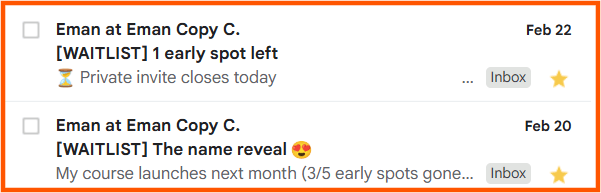
Image Source: Eman Ismail
Pro Tip: Segment your waitlist subscribers into their own list or tag from the moment they opt in to make sure your early access email goes only to them, not your full list.
Sending a “waitlist-only” launch subject line to subscribers who never joined the waitlist breaks the trust immediately and dilutes the exclusivity framing in every future campaign you run.
Product Launch Email Subject Lines for Launch Week
“IT'S LIVE! 🎉🎉🎉” with no context isn’t a strong launch email subject line. It tells subscribers what happened, not why it matters to them.
So, the best product launch subject lines don’t just announce the launch or availability of your product. Instead, they’re specific, clear, and benefit or outcome-led.
Even a warm list that's been primed through a pre-launch (and waitlist) sequence needs the subject line to do real work on launch day.
Here are 18 launch email subject lines for when your product is ready:
Direct subject line:
- “[Product name] is officially open”
Clean and confident. Works best when you’ve done the pre-launch work and the product name means something to your list. - “[Product name] now available”
Short and declarative. Effective for ecommerce drops where the product itself grabs attention. - “Doors are open: [Product name]”
Signals access and puts the subscriber in the position of someone being invited rather than notified. - “Starting today: [clear benefit]”
Leads with what subscribers gain, not what you’re launching. This makes it more attractive. - “We’re live” (Pair with the preview, “Finally, fix [specific problem]”)
The preview text names the pain the product solves to connect with subscribers and earn the open.
You can also get creative on launch day, as Michal Eisik did below. The playful onomatopoeia is human and stands out in an inbox full of polished announcements.

Image Source: Michal Eisik
Curiosity-led subject line
- “Open this before anything else today.”
Priority framing creates urgency without a countdown. Strong for a product launch your audience has been anticipating. - “The one thing we didn't tell you about [product name].”
Withholds a final detail even from warm subscribers. Earns the open even from people who think they already know everything about the product. - “We launched. Here's what surprised us.”
Self-aware and honest, which makes it stand out in an inbox full of ‘over-confident’ announcements.
The analogy in this Myndlift subject line explains the product, but also creates curiosity. Subscribers would want to know what they really mean.

Image Source: Really Good Emails
Exclusivity-led subject line:
- “Only 200 people will get this price. Ever.”
A strong exclusivity claim that requires truth to land. If it's genuine, it's one of the most compelling subject lines you can send on launch day. - “This won't be on Amazon. Just here.”
Channel exclusivity. Highly effective for DTC ecommerce brands where direct purchasing is genuinely the only option. - “Founding member pricing: 11 spots left.”
SaaS-specific framing that combines community status with scarcity. “Founding member” carries weight beyond just the discounted price.
This Milk Bar's new product launch subject line uses exclusivity. The language is also casual — “first dibs” is the kind of thing a friend would say.

Image Source: Really Good Emails
Social proof-led subject line:
- “47 people already bought in the last hour.”
Real-time social proof with a real number. If possible, feature some of the people in the email. - “Here's what beta testers said.”
Subscribers have been conditioned to expect inflated testimonials. So, make sure to include verifiable proof in the email. - “The reviews are in”
Pair it with a preview that says, “We’re a little overwhelmed” to deliver an emotional hook. - “From [pain point] to [outcome]”
Story hook for a case study email drives momentum. Works when the story is credible and worth telling.
This launch email subject line from Eman leads with social proof that shows that people are already signing up. And the preview delivers the urgency.

Image Source: Eman Ismail
Urgency-led subject lines:
- “[X] units. First come, first served”
Inventory scarcity made concrete. A specific number is far more believable than “limited stock available.” - “This bonus disappears before the offer”
Two separate deadlines (one for the offer and the other for the bonus) create layered urgency. The subscriber now has a reason to act before the main offer closes. - “You have until 11:59 pm to get [specific benefit].”
Benefit-first urgency. Not just “hurry” but also here's what you're hurrying for.
This Gozney product launch subject line announces availability and creates scarcity. Subscribers who have been waiting for the Dome Gen 2 to be restocked will quickly open the email.

Image Source: Really Good Emails
This launch email subject line from Prerna Malik is direct and specific. And the preview builds trust and creates an open loop. Subscribers would want to open to find out why else they should sign up.

Image Source: Prerna Malik
Pro Tip: Each email in your product launch week sequence needs its own reason to be opened. Map your subject line style to the job of that specific email.
Direct lines for the product launch day, curiosity, exclusivity, and social-proof subject lines for mid-sequence, and urgency for the final push before cart closes.
Product Launch Closing Email Subject Lines
The closing phase isn’t just about sending “LAST CHANCE!!!” “FINAL 30 MINUTES!!!” or “DON’T MISS OUT!” subject lines. Most subscribers have learned to ignore them because of the fake urgency.
Countdown timers on products that never actually close. “Last chance” emails followed by a week-long extension. “Final hours” sent at 9 am with 15 hours still on the clock. The pattern is so common that urgency language has become inbox wallpaper.
The closing product launch email subject lines that still convert are those where the deadline is real, the stakes are specific, and the email acknowledges the subscriber's natural scepticism.
Here are 12 last chance subject lines built around genuine urgency:
- “Tonight. That's it.”
Brevity creates weight here. The bluntness signals confidence in the deadline with no explanation needed. - “Closing the cart in 3 hours. No exceptions.”
“No exceptions” signals the deadline isn’t negotiable, which is the one thing that separates a real deadline from a performative one. - “[X] spots left.”
Inventory or cohort scarcity, that’s short and direct. - Last call for [Product Name]
Works best mid-closing sequence when subscribers already know what's at stake and the product name carries some weight. - “Last email about this. Promise.”
Respects the subscriber's inbox while creating urgency. The “promise” acknowledges that you know they've received a lot of launch emails. - “Final hours: here's what you'd be giving up.”
Loss framing rather than gain framing. The “what you'd be giving up” requires the email body to actually answer that question — make sure it does. - “Still on the fence? Read this.”
Acknowledges hesitation directly. Useful for high-ticket products where objections may still be active in the subscriber’s mind at this stage. - “Here’s why we won't reopen this”
A reason for the scarcity is more convincing than scarcity alone. Subscribers are used to being told something is limited; they’re not used to being told why. - “Still thinking? This usually makes the decision obvious.”
Handles objection and creates curiosity at the same time. And the tone is helpful, not pushy. - “After midnight, the price goes up permanently. (This is that email.)”
No need for a preview. Or use “this is that email” as the preview. It acknowledges this is the urgency email subscribers expected and leans into it.
This Prerna Malik’s launch subject line uses loss framing and an open loop to earn the open. Subscribers would want to open to find out what they’d be losing.

Image Source: Prerna Malik
This product launch subject line from Google is direct and brand-led. “ends soon” signals urgency (without specificity), but the product name does the heavy-lifting to earn the open.

Image Source: Really Good Emails
Pro Tip: Urgency product subject lines only work if the urgency is real. Using fake countdown timers or “last chance” framing on evergreen offers is ineffective and trains your subscribers to ignore every future deadline you set. So, only use these email subject lines when you mean it, and your list will believe you when it counts.
Product Launch Email Subject Lines for Post-Launch Sequence
Most brands go quiet after the cart closes. That's a mistake, and it's leaving both conversions and goodwill on the table.
Post-launch emails serve four distinct jobs:
- converting stragglers who missed the window
- capturing intent for the next drop before desire fades
- deepening the relationship with subscribers who bought
- building social proof for future marketing campaigns
Most brands skip all four. Which means the post-launch phase is one of the least contested spaces in any inbox.
Here are 9 post-launch email subject lines to use:
- “We sold out in 4 hours. Here's what happened.”
A launch story email. Builds brand credibility, rewards curiosity, and creates genuine FOMO for non-buyers without being manipulative. - “Missed it? Here's when we're doing this again.”
Seed the next waitlist immediately while purchase intent is still active. A subscriber's disappointment is at its highest right now, so meet it with a clear path forward. - “312 customers in 48 hours”
Social proof rollup. Validates buyers and surfaces regret in non-buyers in the same email, without directly selling to either group. - “What stopped you from buying?”
A direct survey hook prompts replies that generate useful data to improve your product or next launch. - “We're already building [v2 / the next drop]. Want in first?”
Immediately captures intent for the next launch. Sending this within 48 hours of cart close catches subscribers while interest is still warm. - “One thing we'd do differently next launch.”
Transparency email. Unusual and trust-building. Very few brands are willing to acknowledge anything less than a flawless launch. - “Quick 30-second favour”
A review request that works better than “Please leave us a review.” The specificity of “30 seconds” removes the time barrier. - “What [X] buyers figured out in their first week.”
Outcome-focused social proof. Validates the purchase for buyers and triggers regret in non-buyers. - “The launch is over. But not this.”
Curiosity hook for a follow-on campaign, bonus release, or extended offer. Works best when there's genuinely something else coming.
This post-launch email subject line is framed as a question to invite responses from waitlist subscribers who didn’t buy.

Image Source: Eman Ismail
Pro Tip: Post product launch email subject lines work best when they’re sent with a specific group in mind. Buyers need a different email than non-buyers and cold subscribers who have never engaged at all. Make sure you segment your list before sending.
7 tips to write product launch email subject lines that work for your audience
Seeing examples of product launch email subject lines is helpful. Writing the launch email subject lines for your specific product and list isn’t as easy. So, here are some tips to help you adapt the subject line examples.
- Match the subject line style to the launch phase
Most business owners’ instinct when planning a product launch campaign is to lead with excitement. But excitement is the sender's emotion, not the subscriber's.
So, match the trigger (curiosity, urgency, exclusivity, social proof) to what the subscriber needs to feel at that specific moment in the sequence, not what you're feeling while writing it.
- Consider your industry or target audience
Product launches in different industries need different emotional registers. For instance, ecommerce subject lines tend to lean on desire and FOMO because the product is physical and the scarcity is often real.
On the other hand, SaaS subject lines usually need to lean harder on credibility and transformation because the subscriber is making a longer-term commitment and needs more than urgency to act.
- Write 5–10 options before picking one.
I like to write at least 5 subject line options for every launch email (10+ for launch week itself). Sometimes the simplest one wins. Other times, the slightly unexpected one does.
The first subject line is almost never the best one. It’s usually the most obvious one. Volume forces you past the obvious and into the territory where you come up with better lines.
- Treat your subject line and preview text as a pair
They’re read together as a unit in every inbox. A subject line that opens a question and a preview text that deepens it creates a combination that's genuinely hard to ignore.
While a subject line that teases and a preview text that explains what you're teasing give subscribers no reason to open the email.
Also consider your subject line and preview length. When they’re too long, important details may get cut off. Or the cut-off might be at an awkward point that changes the meaning of your subject line.
Use our free subject line tester tool to see how your subject line and preview will appear in your subscribers’ inboxes.
- Read the subject line without context
If the intrigue only makes sense to someone already sold on the product, the subject line isn't doing its job. Test it by imagining a subscriber who vaguely remembers opting in six weeks ago. Does this line make them pause, or scroll past?
- A/B test the subject lines across the whole sequence
Launch week gets all the testing attention. But your pre-launch subject lines shape how many subscribers arrive warm by the time you send the product launch email. And last chance subject lines determine how many conversions you leave behind.
A/B testing one variable in all your product launch sequences across a portion of your list takes 20 minutes and can meaningfully shift your engagement and conversion. And the best ESP tools make it easy to do this with a simple click.
- Write the subject line last
Writing the email before the subject line helps prevent writing something generic. It gives you a clearer sense of the sharpest angle, the most compelling detail, or the one thing worth leading with.
Final thoughts: Stop treating your product launch subject line like an afterthought
When a product launch email campaign underperforms, it’s easy to blame the emails, the landing page, the pricing, or even the audience.
But the problem usually shows up much earlier — in the subject line, which decides whether your launch email gets opened or ignored.
Most business owners and marketers treat subject lines as an afterthought. Something to write last-minute before hitting send. And that can cost you a successful launch.
Because if your product launch email subject lines don’t grab attention, most subscribers will never open your email, let alone learn about your product and decide to buy it (or not). All the work you put into the launch sequences becomes irrelevant the moment they scroll past.
The good news is you don’t need to reinvent the wheel or start from scratch. You now have 60+ examples in this post that you can adapt to write yours.
Pick three subject lines from each phase that feel closest to your product and audience, and write five variations of your own. Don't aim for perfect, but for five options that are better than your first instinct.
And if you want to move faster, use ChatGPT, Claude, or an AI tool built into your email marketing platform to generate variations based on your selected example. Feed it details about your product and your product launch email copy so it has context. Then, use the output as options to refine, not a final subject line to send.
Want more subject line examples to adapt? Check out this post for 458 newsletter subject line examples.
The authors
Learn more about us

Our Methodology
This article has been written and researched following our EmailTooltester methodology.
Our Methodology