

Mailchimp is, without a doubt, a major email marketing player, boasting an impressive 14 million active users. It’s long been the go-to choice and a default starting point for many new to the newsletter world.
But if you’re a content creator, blogger, or marketer focused on monetizing your newsletter, you might wonder: Is Mailchimp really the right fit for you?
That’s a valid question. While Mailchimp may be swinging the upper hand with its strong reputation and features, newsletter-focused tools like Beehiiv are bringing in the buzz.
As a creator-friendly platform, Beehiiv may be better equipped to assist with your goals and growth.
So let’s revise the question: Between Beehiiv vs. Mailchimp, which platform is built to support your next big step?
Let’s find out.
Beehiiv vs Mailchimp: Summary
Mailchimp is a versatile and feature-rich email marketing service, while newcomer Beehiiv is a creator-first platform with advanced tools for newsletters and monetization. With the stark difference in their offerings, the right choice will depend on your audience size, goals, and content strategy.
Here’s a quick TL;DR so you’ll know what to expect from these two:
- Beehiiv and Mailchimp are good options for building, designing, and automating email content at scale.
- Beehiiv excels at simplifying monetization and audience engagement for content creators, niche bloggers, and independent writers.
- Mailchimp stands out for its robust automation, extensive integrations, and advanced analytics. It’s suitable for media companies, brands, and other organizations that would like to earn money off of their content, but need other functionalities like ecommerce.
- If cost is a big factor in the decision-making, Beehiiv is generally more affordable for new and growing creators. It scales well as your following grows. Mailchimp’s pricing is affordable at first, but it skyrockets with larger lists. Extra fees might also catch you off-guard.
Round 1: Ease of Use
Beehiiv’s dashboard boasts a straightforward layout paired with a crisp, contemporary look. From the start, it’s clear that the platform prioritizes simplicity, focusing on giving creators the means to create a blog and a newsletter under one roof.
Finding features is effortless since everything is neatly categorized into sections like Audience, Design, and Monetize. I find this logical grouping of tools prevents overwhelm and keeps things easy to navigate.
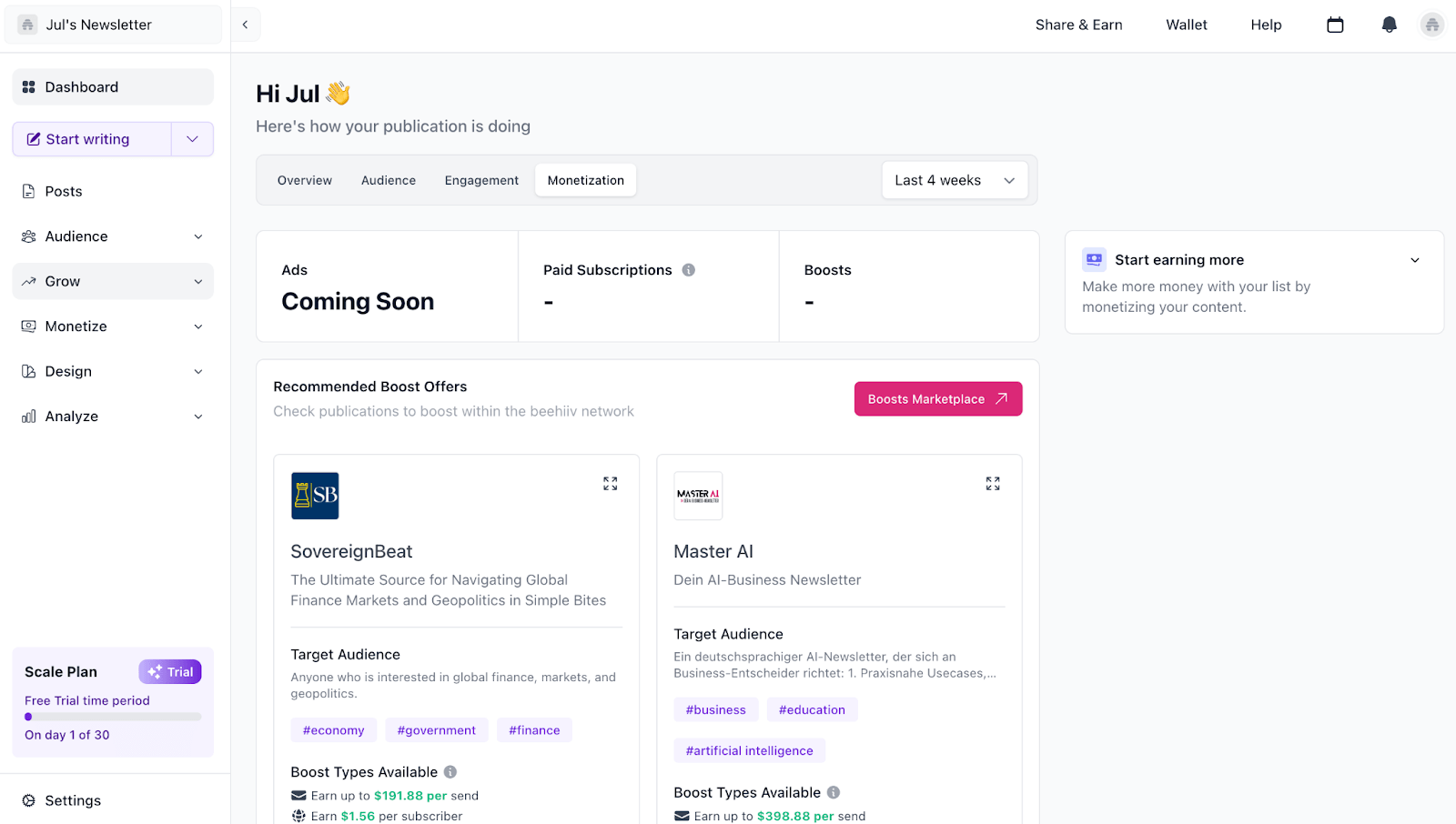
Beehiiv’s dashboard is simple and well-organized
I can’t say the same for Mailchimp, though. The interface is comprehensive, but it’s also clunky.
As an email marketing tool catering to various industries, its dashboard packs in a lot of tools, so it can feel crowded and intimidating at first.
There are too many expandable buttons on the sidebar menu. And each click gives way to a more overwhelming workspace view, like so:
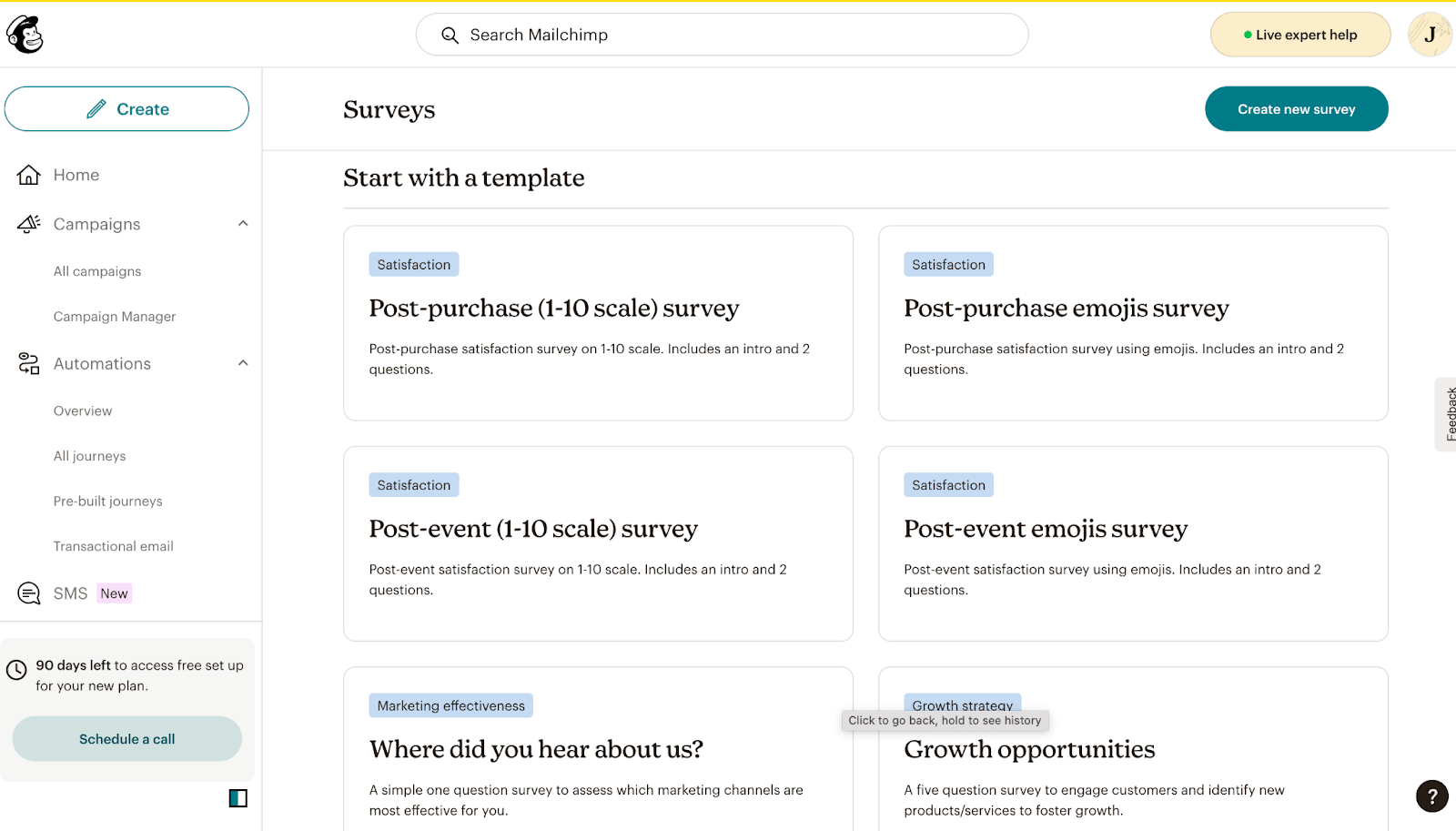
Mailchimp’s dashboard can feel a little cluttered and overwhelming
All that to say, be ready to spend a bit of time learning your way around.
Winner: Beehiiv. It excels in keeping things simple and focused on content creation. Mailchimp’s wide suite of tools is cluttered, which makes it more intimidating and less user-friendly.
Beehiiv – 1
Mailchimp – 0
Round 2: Email Editor
Immediately, Beehiiv stands out to budding content creators thanks to its simple editing interface.
You get an intuitive all-in-one editor to craft newsletters and sign-up forms with adjustable content elements like texts and images. Beehiiv keeps things simple and you don’t need technical expertise to design your emails and landing pages. That being said, if you’d like some further customization, there’s a code-block option available in the editor.
What I find thoughtful is Beehiiv’s sleek, multi-step publishing experience conveniently available right at the top of the editor.
It consists of the basic content creation workflow steps: compose (area to write and edit with your team), audience (subscriber permissions and other settings), email (configure email elements, A/B test, and more), web (SEO tools and more), and review (schedule and sharing options):
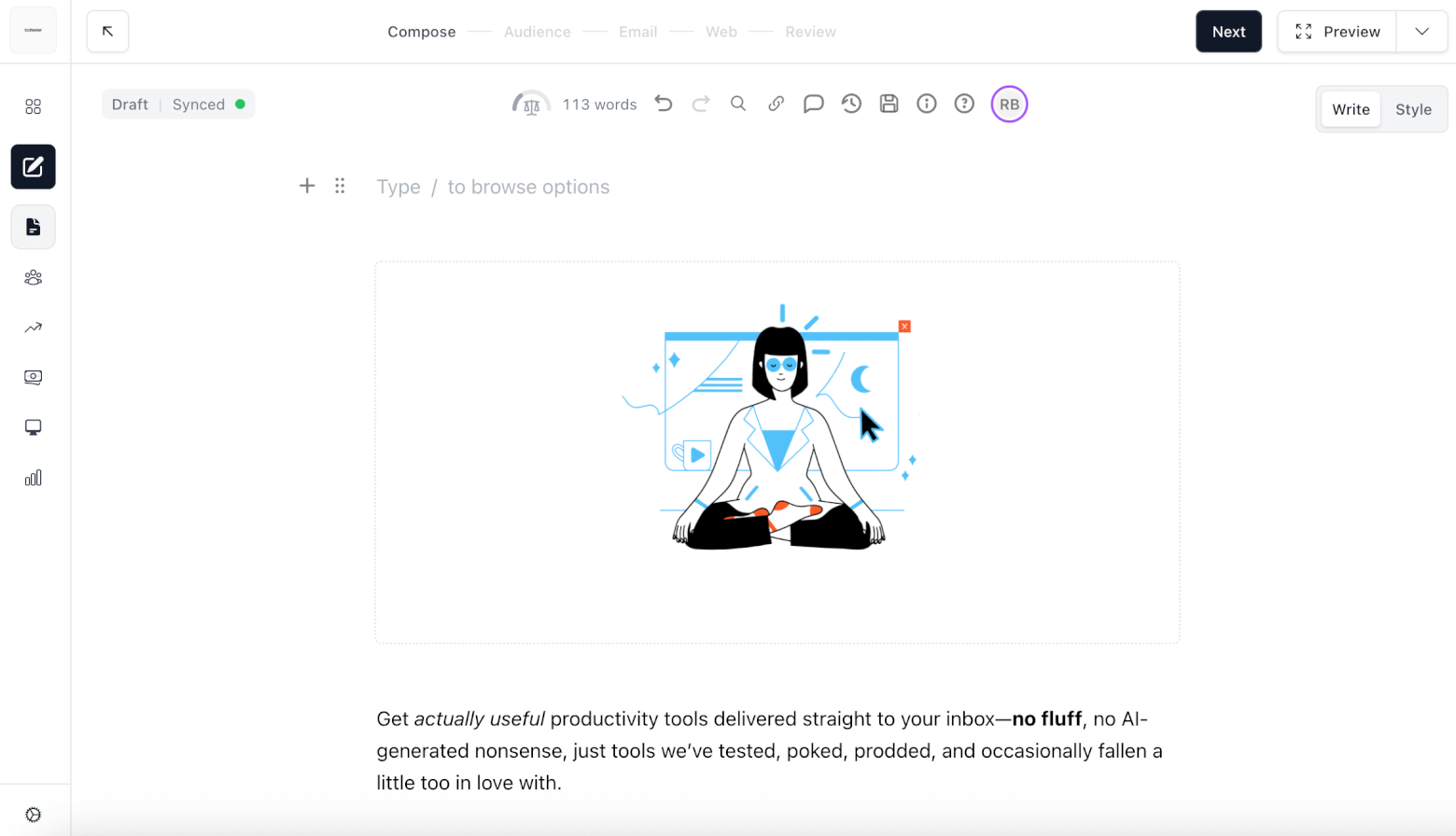
Beehiiv’s newsletter editor keeps things simple
The layout is clearly designed with creators in mind. It’s distraction-free, collaborative, and accessible, ensuring you don’t miss out on any important configurations when crafting your content.
With Beehiiv, you can also customize hassle-free signup and subscription upgrade pages.
A sign-up page, for example, contains only three sections: the above-the-fold area, where interested subscribers can enter their email address, and the testimonials and featured posts areas. The last two you can easily toggle off if you don’t want them displayed.
The main drawback with Beehiiv is that it’s not as flexible as other email editors, and lacks the drag-and-drop functionality that you get with editors like Mailchimp. Creating an eye-catching email with a unique design may be a little more challenging with Beehiiv, so it’s worth keeping in mind if your brand relies heavily on visuals.
Shifting gears to Mailchimp, the platform offers two impressive email builders which also makes use of reliable drag-and-drop content modules:
- The Classic Builder is the best choice for custom coding templates and including RSS feeds in emails.
- The New Builder has a sleeker design and is outfitted with advanced capabilities like undo/redo, survey content blocks, and Content Optimizer (which makes in-line recommendations on how to improve email content based on best practices). Plus, there’s a support and help section to guide you.
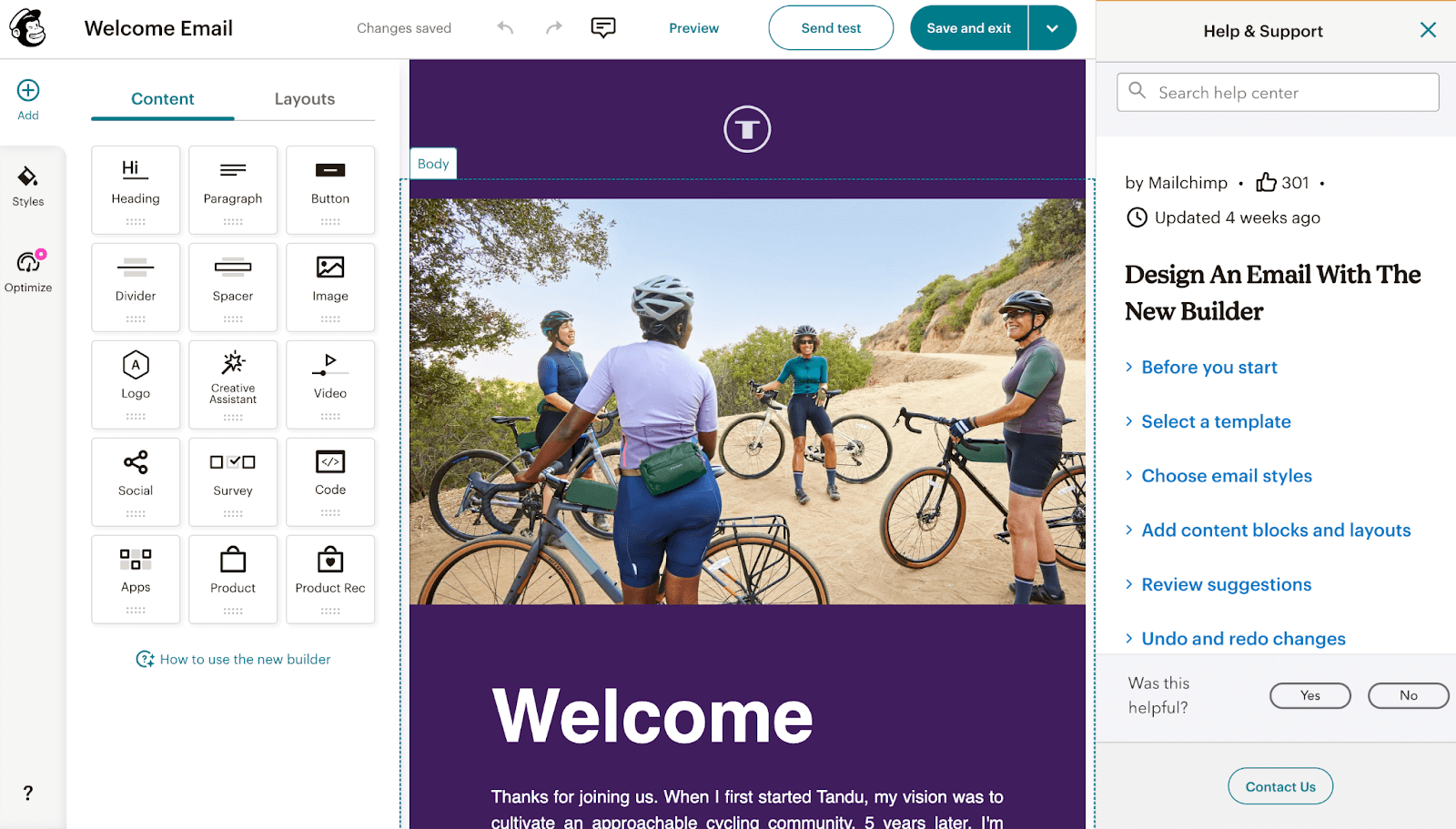
Mailchimp’s visual editor offers plenty of options
As for landing pages, Mailchimp has a separate free editor accessible through the Campaigns section.
While it’s tricky to locate at first, it’s intuitive once you get started, enabling you to manage and create optimized pages effortlessly.
Winner: It’s a tie – and it all comes down to your needs. The simplicity of Beehiiv makes it an obvious choice for marketers and creators who want to focus on email-first content, while Mailchimp is a great option for those who need additional features like custom coding and integrated landing pages.
Beehiiv – 2
Mailchimp – 1
Round 3: Design And Flexibility
So far, Beehiiv has the lead, but could this be the round where Mailchimp steals the show?
When it comes to design, there’s one important thing to note: Beehiiv doesn’t come with many pre-built email templates. And the handful that are available are pretty simple in design. Again, this could be great if you want the main focus of your emails to be your content. But if you’re after something more visually striking, you might have a little more work on your hands.
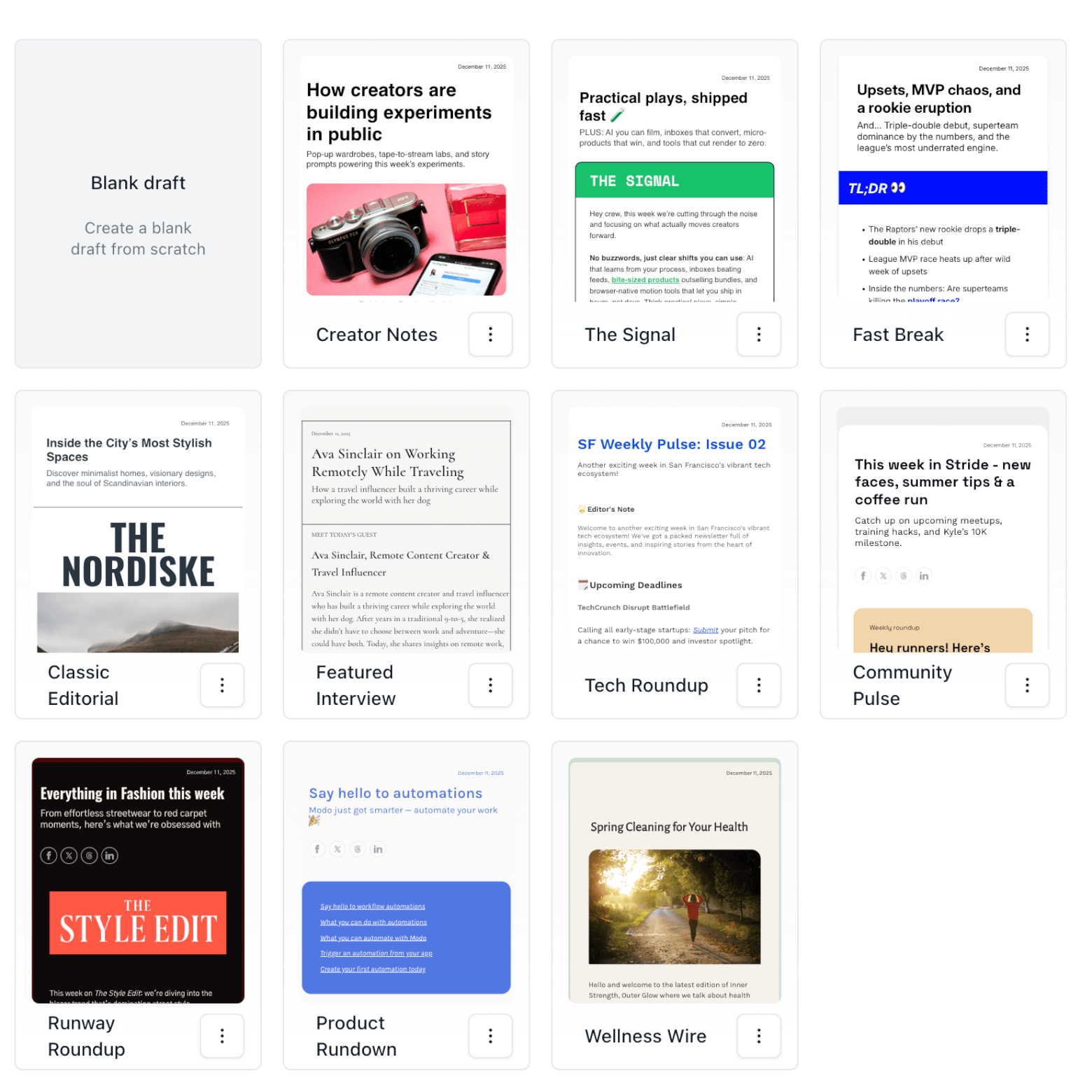
Beehiiv’s newsletter templates
Mailchimp, on the other hand, offers over 100 email templates included with any paid plan (Free plan users have access to some pre-built designs). If the available options don’t cut it, you can code your own or purchase one from the Mailchimp Marketplace.
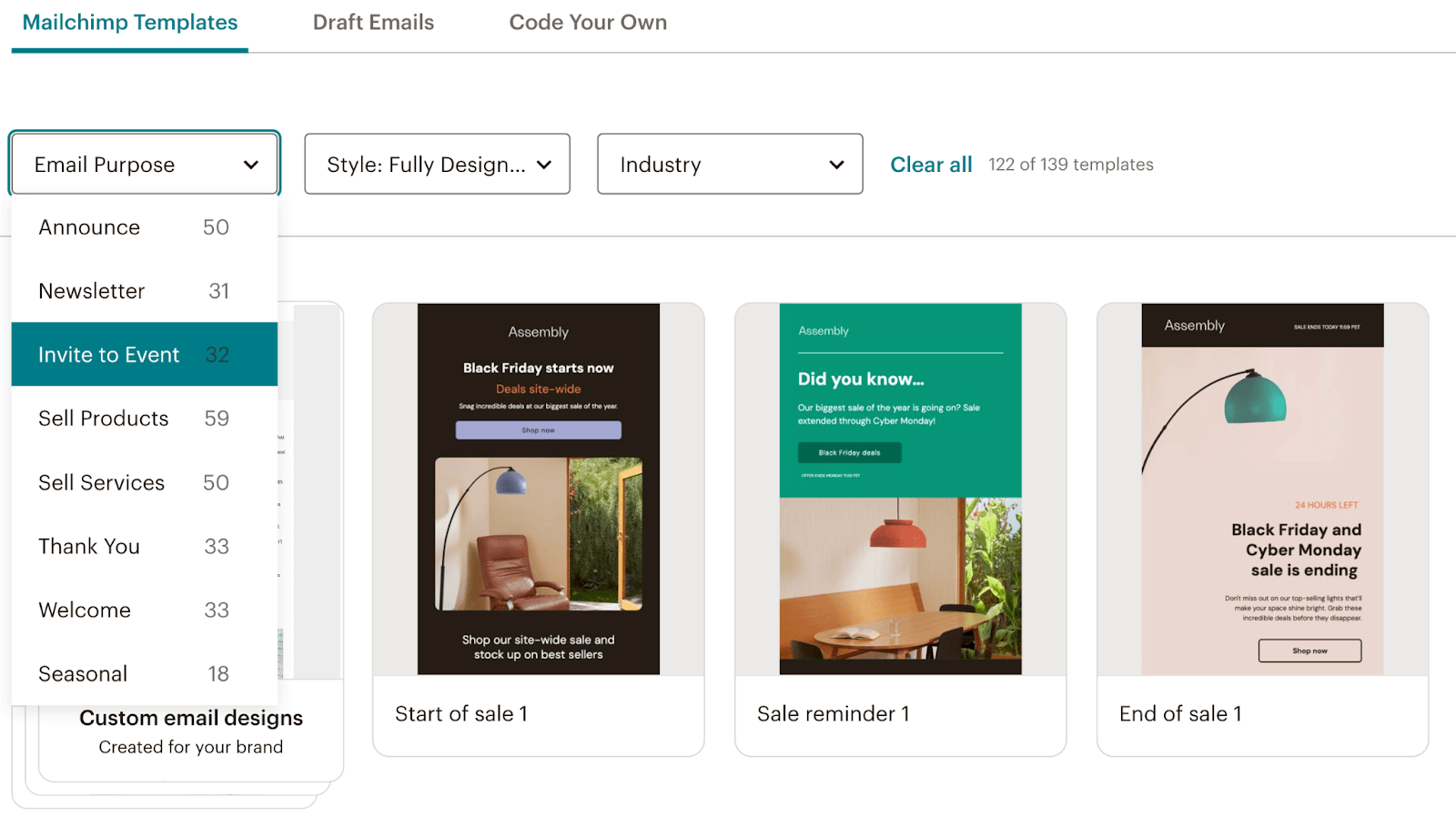
Mailchimp’s email templates
Mailchimp’s templates look clean and sleek, but they’re mostly geared toward ecommerce. There are only 31 templates available for newsletter design.
But, I’m happy to report that they’re all professionally designed, responsive, and mobile-optimized, sparing you the hassle of making sure they work well on any device.
Mailchimp also offers free landing page templates, which are neatly split into basic and themed categories, alongside varied design options for sign-up forms—offering embedded, pop-up, and block options. You can customize everything to fit your specific branding needs and workflow.
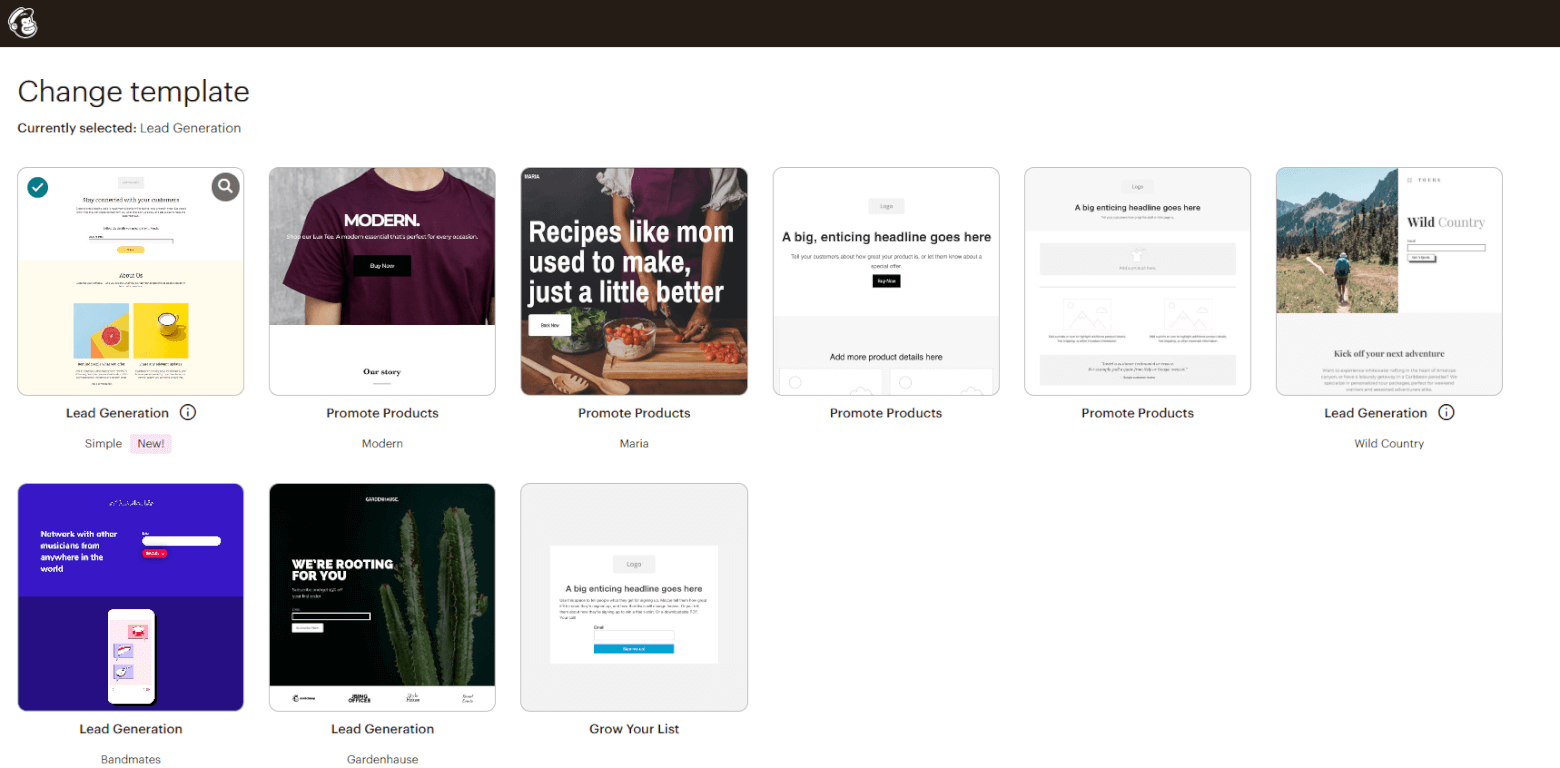
Mailchimp’s landing page templates
However, Beehiiv stands out with a website builder that is purpose-built for newsletter publishing. While Mailchimp does offer a basic website builder, it’s primarily designed for small business sites. Beehiiv, on the other hand, lets you turn your newsletter into a full blog or Substack-style publication, with posts automatically living both on your website and in your subscribers’ inboxes.
You can choose from modern, publication-focused templates, customize them with your branding, and use Beehiiv’s AI chat assistant to refine the design and layout, which makes it a much more natural fit for creators who want their newsletter to double as a content hub rather than just a supporting marketing page.
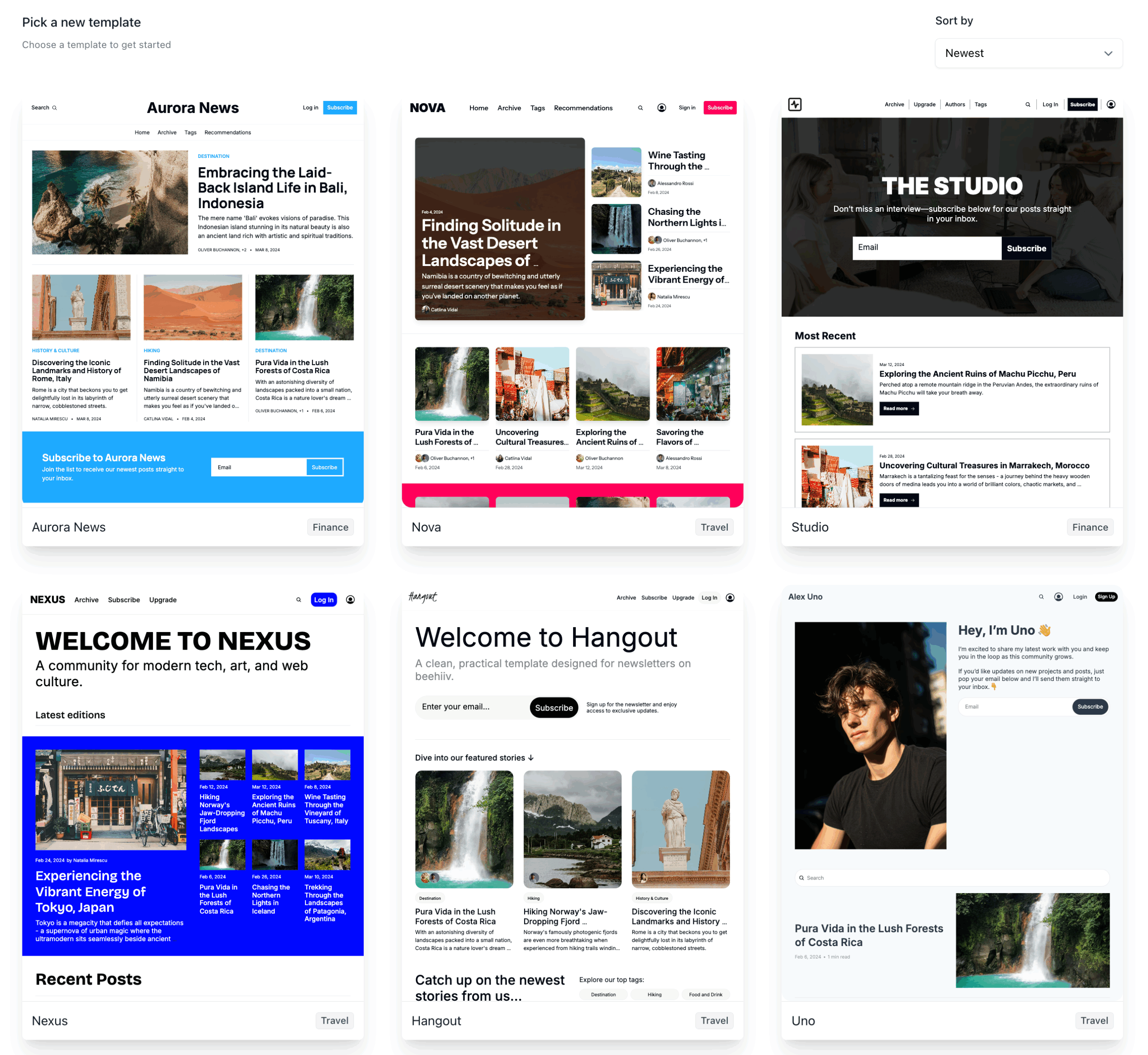
Beehiiv’s website templates
Winner: In terms of email designs, Mailchimp offers more design versatility and pre-built options. But Beehiiv’s website builer – and its modern, AI-powered designs – make it a better choice for anyone looking to publish their newsletters online. So let’s call this one a tie!
Beehiiv – 3
Mailchimp – 2
Round 4: Monetization Options
Beehiiv positions itself as the platform for “paid newsletters made simple”—and that simplicity extends beyond just crafting content. It also covers the revenue generation part quite well.
Beehiiv offers a suite of tools to help you set up multiple tiers of paid subscriptions, integrate sponsored content, and add ads directly to your newsletter.
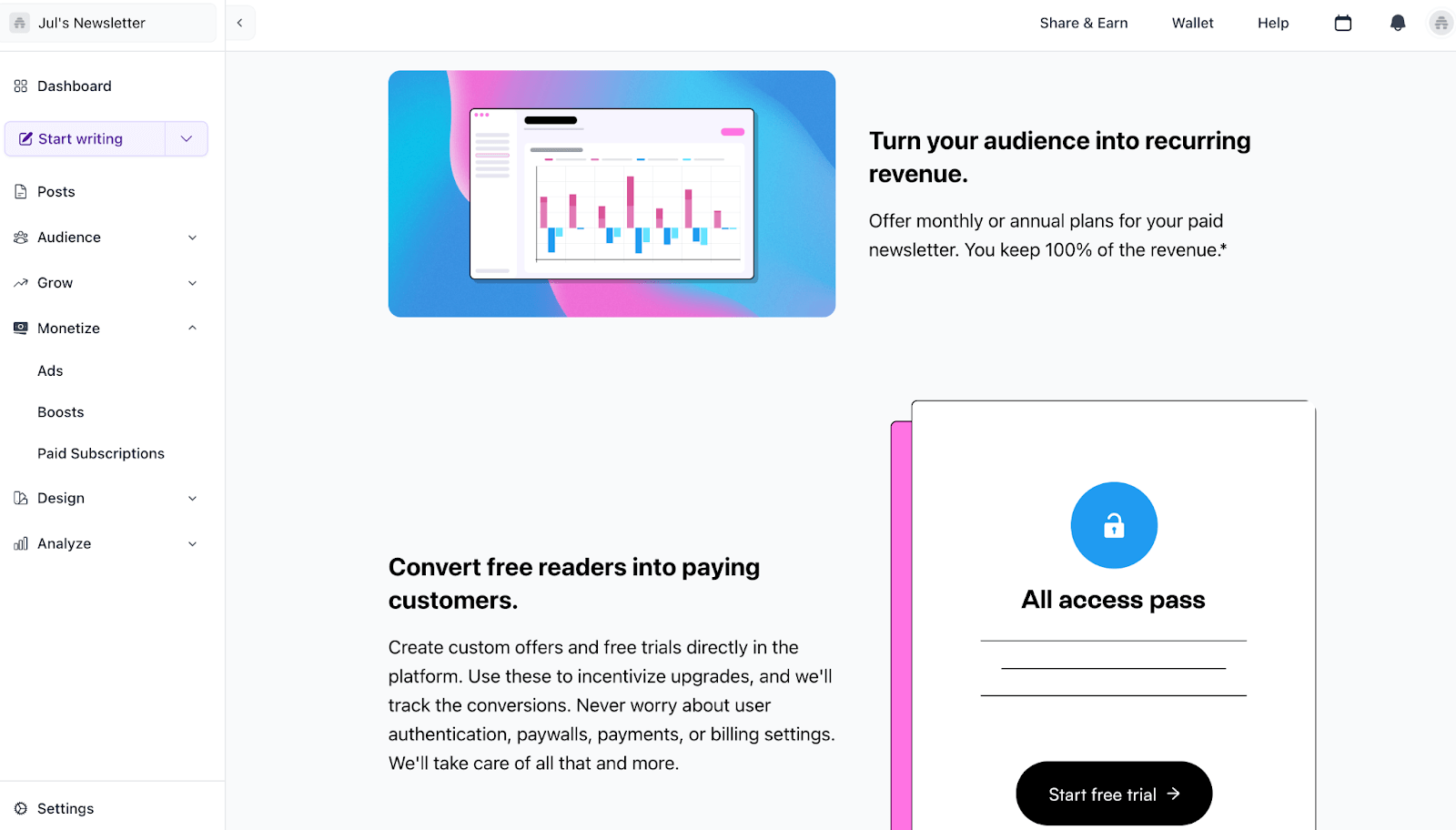
Beehiiv offers some great monetization options, including paid newsletters and custom offers
One standout feature is the Recommendations Network (more on that below), which lets you earn by promoting other newsletters to your audience, or pay to get your own newsletter promoted in others. It’s an easy way to generate passive income or speed up your growth, and it feels very much designed with creators in mind.
Beehiiv has also introduced digital product sales, so you can sell things like ebooks, templates, or other downloads directly through the platform, not just subscriptions.
Having all these revenue-focused features is excellent for solo creators and niche publishers who want to make the most out of their newsletters.
The only drawback? All these incredible monetization features are only available in paid plans.
Meanwhile, Mailchimp doesn’t quite measure up in this department. Many of its growth-oriented tools cater more to ecommerce businesses, such as personalized product recommendations and promo code blocks.
Don’t get me wrong: These are great add-ons if you sell physical or digital products like courses, ebooks, or merchandise—but they’re not as helpful for monetizing your newsletter.
Adding to that, Mailchimp enforces strict policies on affiliate marketing (though affiliate links are generally allowed), so you’ll need to make sure you’re always playing by the rules.
Winner: Beehiiv takes the crown back with features designed to help creators monetize with ease and scale their audience without limits.
Beehiiv – 4
Mailchimp – 2
Round 5: Audience Engagement Tools
Growing a newsletter involves gaining and retaining subscribers.
Fortunately for you, Beehiiv takes a hive-powered approach to growth with several key features:
- The Recommendations Network, a two-sided marketplace, which lets you advertise with other newsletters. You set your price and only pay for engaged subscribers who sign up. Creators who leverage this feature see an average overall monthly growth of 137%. There is also a free version which allows you to exchange recommendations with other newsletters
- A referral program to incentivize your subscribers to share your newsletter. It’s simple to set up and runs on autopilot.
While Beehiiv currently doesn’t support discussion forums like Substack, your audience can still interact with you and fellow readers through the comments section.
Mailchimp simply misses the mark, offering none of these cool, collaborative features for creators to create the same sense of community or expand reach.
To increase subscriber count, you’ll need to focus on running active campaigns in your emails and make use of strategies like adding signup forms or widgets to your website and Facebook page.
Winner: Beehiiv wins once again for its thoughtful creator-friendly features like Recommendations and a built-in referral program.
Beehiiv – 5
Mailchimp – 2
Round 6: List management
With Beehiiiv, you can manage and track your audience with advanced list segmentation and engagement monitoring. This makes it easier to tailor your content to specific reader interests and behaviors.
Personally, I find the subscriber profile dashboard a nice touch. This tool shows you each user’s metrics and lets you monitor their engagement individually:
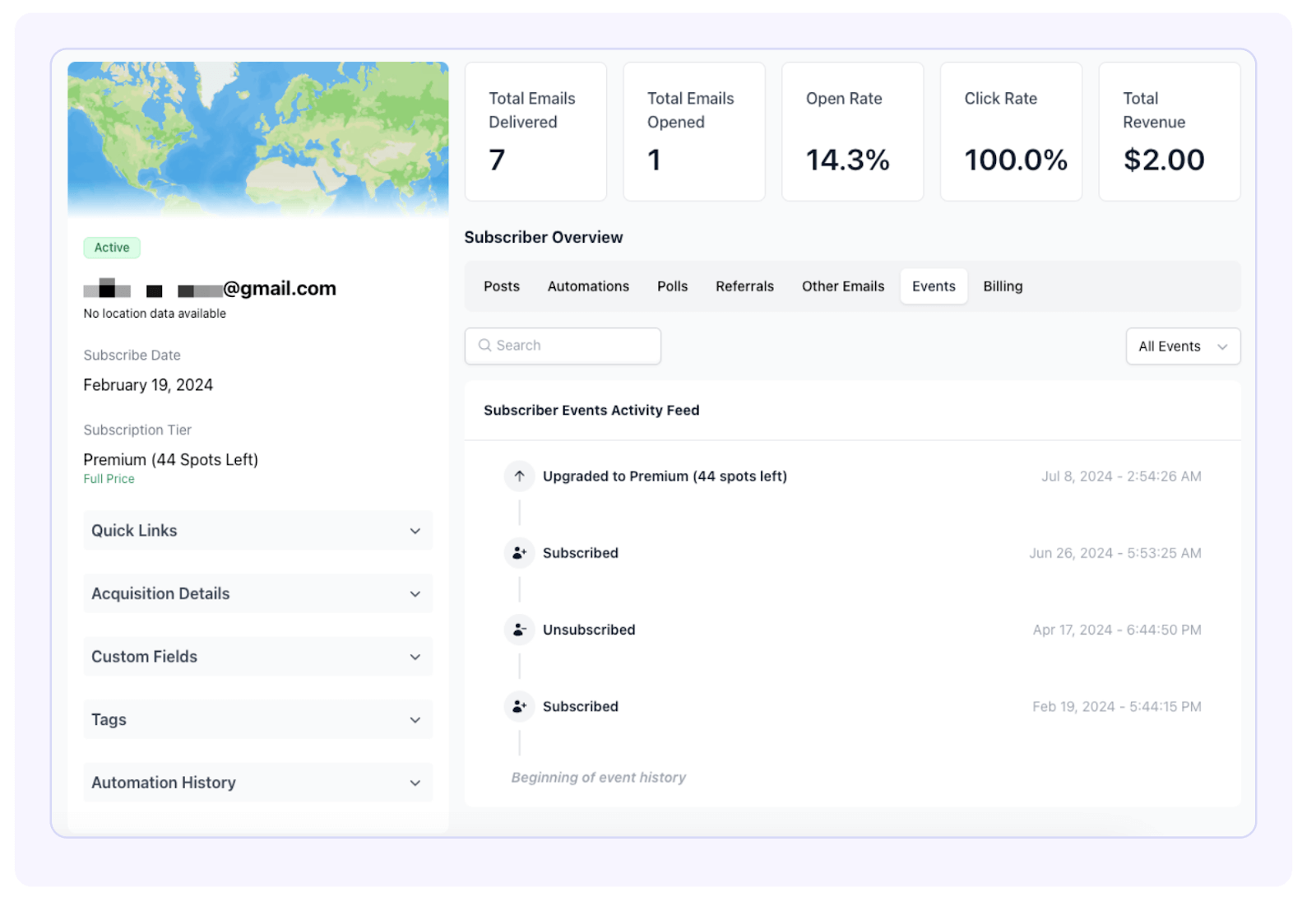
Source: Beehiiv
You can manually or automatically update your segment lists to make sure you’re always sending the right emails to the right group. Tags based on criteria like subscriber type, custom categories, and sign-up origin are a big help here, giving you the flexibility to group readers according to your content strategy.
Mailchimp, on the other hand, recommends you create only one list for your primary audience, then use tags and segments to sort them out. This can be messy, and you’ll need Marie Kondo-level of organization to make the most out of it.
If you opt to create multiple lists, however, there’s a caveat: Duplicate contacts in separate lists will increase your total contact count, likely driving up your costs.
However, it has one shining feature called Groups, which uses subscriber-provided data to create categories based on interests and preferences. Your readers are also allowed to group themselves.
Winner: Beehiiv’s simple but effective contact management approach trumps Mailchimp’s restrictive and expensive methods.
Beehiiv – 6
Mailchimp – 2
Round 7: Automations
Automations help you create effective workflows that run in the background while you focus on delivering quality content and building relationships with your readers.
Beehiiv’s automation tools are refreshingly simple yet flexible. They let you design multistep journeys tailored to your readers with triggers based on key subscriber actions, such as signing up, submitting forms, or upgrading to premium subscriptions.
Plus, you can add time delays or conditional branches to ensure that subscribers get exactly the content they need, when they need it.
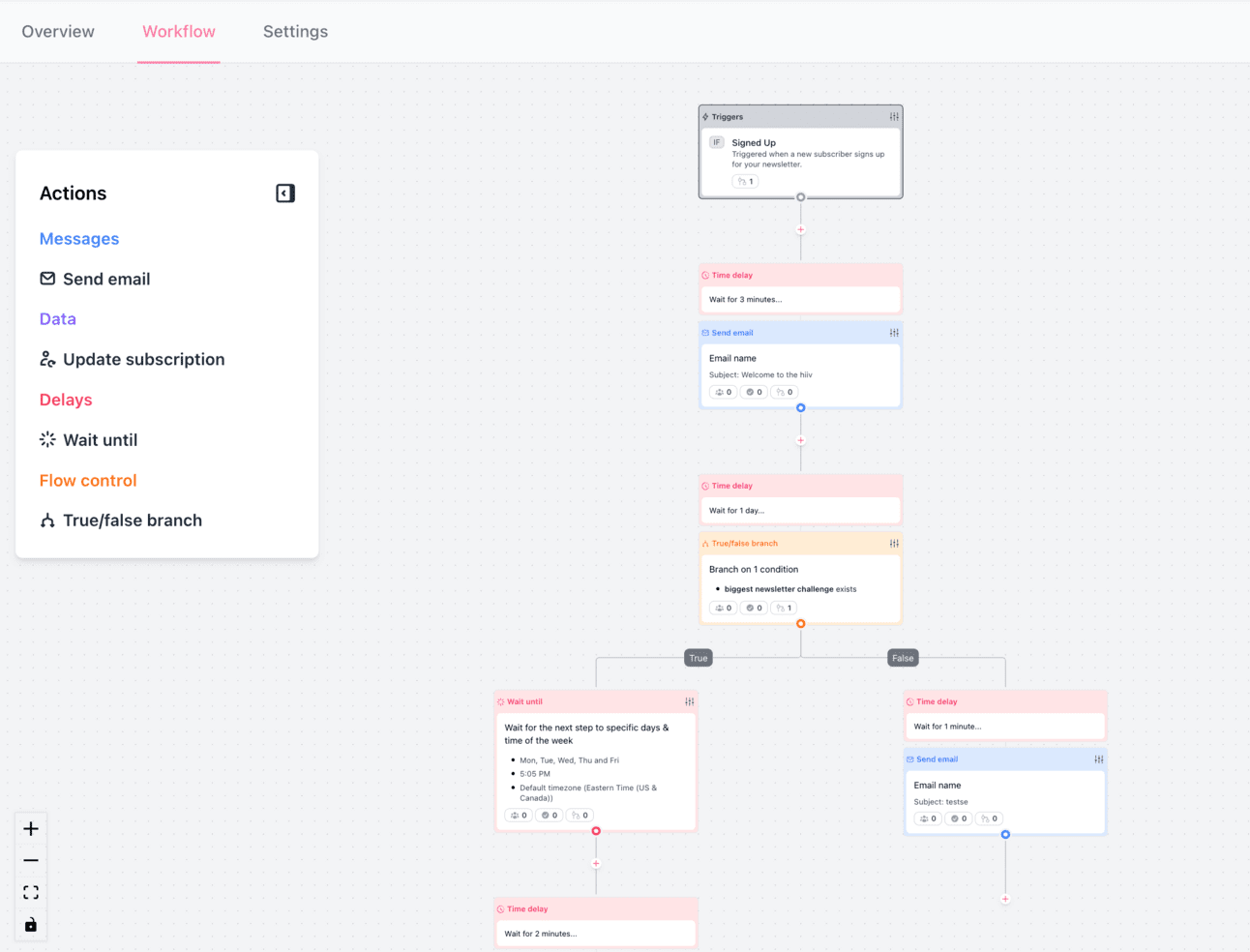
Beehiiv’s workflow builder
That said, Mailchimp is miles ahead of the competition. Its Classic Automation handles essential campaigns tied to your subscriber’s important details, milestones, and activity.
It then raises the bar with advanced features like customer journey builders to tailor experiences that match your follower’s behaviors.
For instance, you can create an email automation flow for active subscribers who might have missed your special announcement:
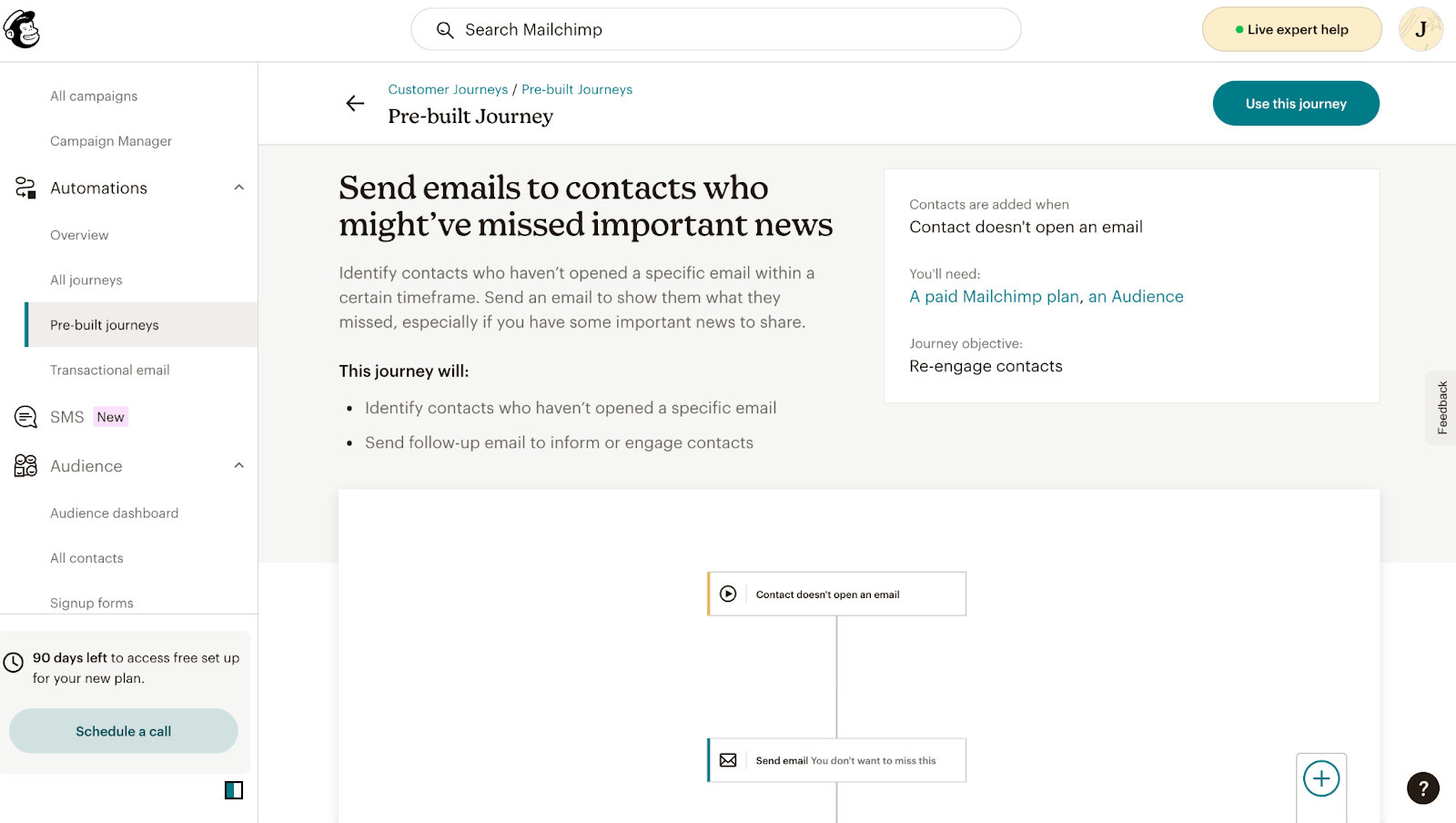
Mailchimp’s customer journey builder
It’s easy to re-engage your audience when Mailchimp thinks of the many ways (through pre-built journeys) that you can do so without breaking a sweat. And if you do want to roll up your sleeves and get to work, there’s also the option of building your own automated customer journeys.
Winner: Mailchimp takes care of most of the heavy lifting, all you need to do is set it in motion.
Beehiiv – 6
Mailchimp – 3
Round 8: Deliverability
It doesn’t matter how beautiful your emails look if they never reach your audience. That’s why strong deliverability support is essential when choosing a platform.
When it comes to email deliverability, we focus on the features that help you maintain a good sender reputation, like authentication setup, complaint handling, IP warmup, and list management policies.
Let’s see how Beehiiv and Mailchimp compare:
| Star Rating | Comment | ||
|---|---|---|---|
| Beehiiv |  |
Beehiiv covers most of the core features, including authentication guidance, bounce suppression, built-in list cleaning, and warmup support. However, it falls short on FBL access and doesn’t include monitoring tools. They lack a deliverability dashboard, a health score, and more. | |
| Mailchimp |  |
Mailchimp also handles the basics well, like FBL data, bounce handling, and IP warmup help, but it doesn’t enforce proper email authentication, and it lacks list cleaning or deliverability dashboard features and a health score. | . . |
Winner: Beehiiv
This one’s close, but Beehiiv edges ahead with a more modern and guided setup experience, including an authentication wizard and better support accessibility. Mailchimp still delivers solid performance, but its missing enforcement on authentication keeps its score slightly lower.
Beehiiv – 7
Mailchimp – 3
Round 9: Analytics and Reporting
Beehiv’s dashboard landing page gives you a quick snapshot of your publication’s performance based on the time frame you set (e.g., last 4 weeks, last 7 days, etc.).
You can toggle between an overview mode or dig into other metrics related to audience, engagement, and monetization right on the home screen as well.
Personally, I think this quick access is a huge time-saver, letting you catch a glimpse of critical information without needing to dig through layers of menus.
The platform’s standout reporting feature, 3D analytics, hones in on what matters for creators like you: your posts and your subscribers. Beehiiv separates this into two separate insight panels:
- Posts Reports, which track performance and engagement metrics for your content
- Subscribers Reports, which monitors acquisition channels and strategy performance.
Together, these tools let you measure ROI on your campaigns effectively. There’s an added perk of Clicks Reports, where you can monitor which links are driving the most clicks and how your audience is engaging in near real-time.
That said, if you think Beehiiv’s reporting tools are doing a great job, next to Mailchimp’s, you might find them lacking.
Mailchimp has a far more granular and highly-adaptable analytics and reporting suite. You get:
- A thorough marketing dashboard for monitoring your overall performance metrics, including individual and detailed message performance, which tracks the most critical email marketing KPIs like open rates, revenue, click rates, bounce rates, and unsubscribe rates for every email you send.
- Impressive reports variety for reviewing advanced email marketing metrics like email forwards and forward opens, average revenue per automation, and top subscriber locations and email clients.
What’s more is that you can customize and organize reports to focus only on the metrics you want to track:
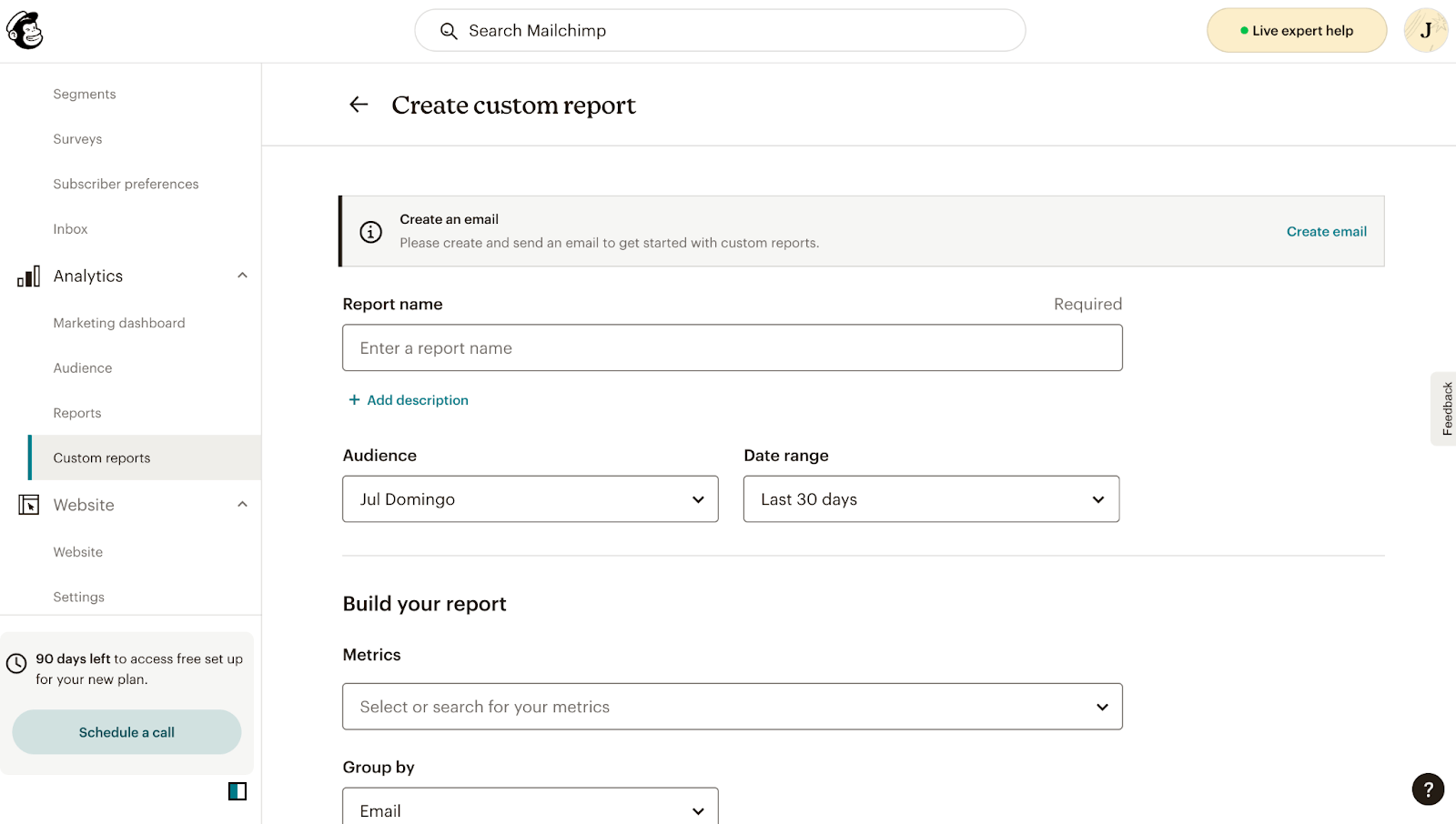
Mailchimp’s custom reports
Beyond email, it also monitors metrics for landing pages, automations, and social posts, allowing you to see your marketing performance from a broader perspective.
Winner: Mailchimp is the champ of metrics with its comprehensiveness and customizability. So if you’re all for creating data-driven strategies, it will definitely be the cornerstone for decision-making.
Beehiiv – 7
Mailchimp – 4
Round 10: Integrations
Beehiiv has foundational integrations available to simplify migrating newsletter content from other platforms like Substack, importing contacts from forms and websites, and sharing content updates with followers on apps like Discord and Slack.
All of that to say, its interoperability functions are pretty basic. To integrate it with other platforms, you’d need to rely on third-party tools Zapier.
Mailchimp, being around for almost two decades, already works with tons of third-party apps—more than 250 of them! These pre-built integrations are sorted into 19 categories, which includes subscription management, content, contact management, and forms and surveys.
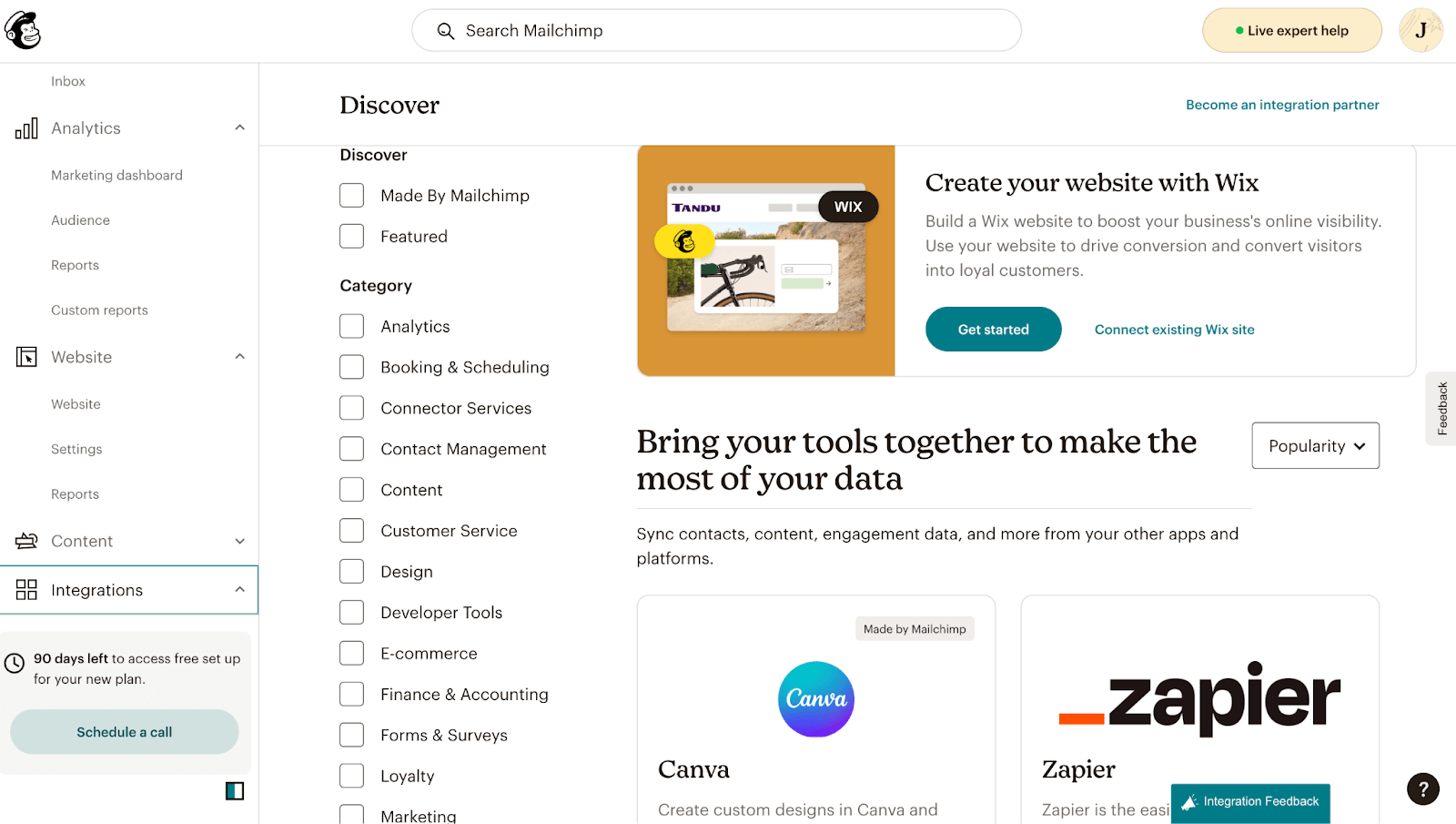
Mailchimp offers a huge library of integrations
If you own an online store, connecting your existing ecommerce tech stack will be a breeze as well.
Winner: Mailchimp is the obvious winner. With its vast integration library, you won’t have to worry about compatibility or building workarounds for your favorite tools.
Beehiiv – 7
Mailchimp – 5
Round 11: Extras
Beehiiv was originally built as a no-frills tool for growing newsletters, but that description no longer really fits. While it still brands itself as “the newsletter platform built for growth”, Beehiiv has grown into much more than just an email tool.
With its 2025 Winter Release, Beehiiv is clearly moving toward becoming a full creator ecosystem. One of the biggest additions is its AI-powered website builder, which lets you launch a branded website in minutes. Your newsletter posts, paid content, digital products, and subscriber signups can all live in one place, making it feel more like a Substack-style media platform than a traditional ESP.
Beehiiv has also added native podcast support. You can now host your podcast directly on the platform, automatically sync episodes, and showcase them alongside your newsletter and other content on your site.
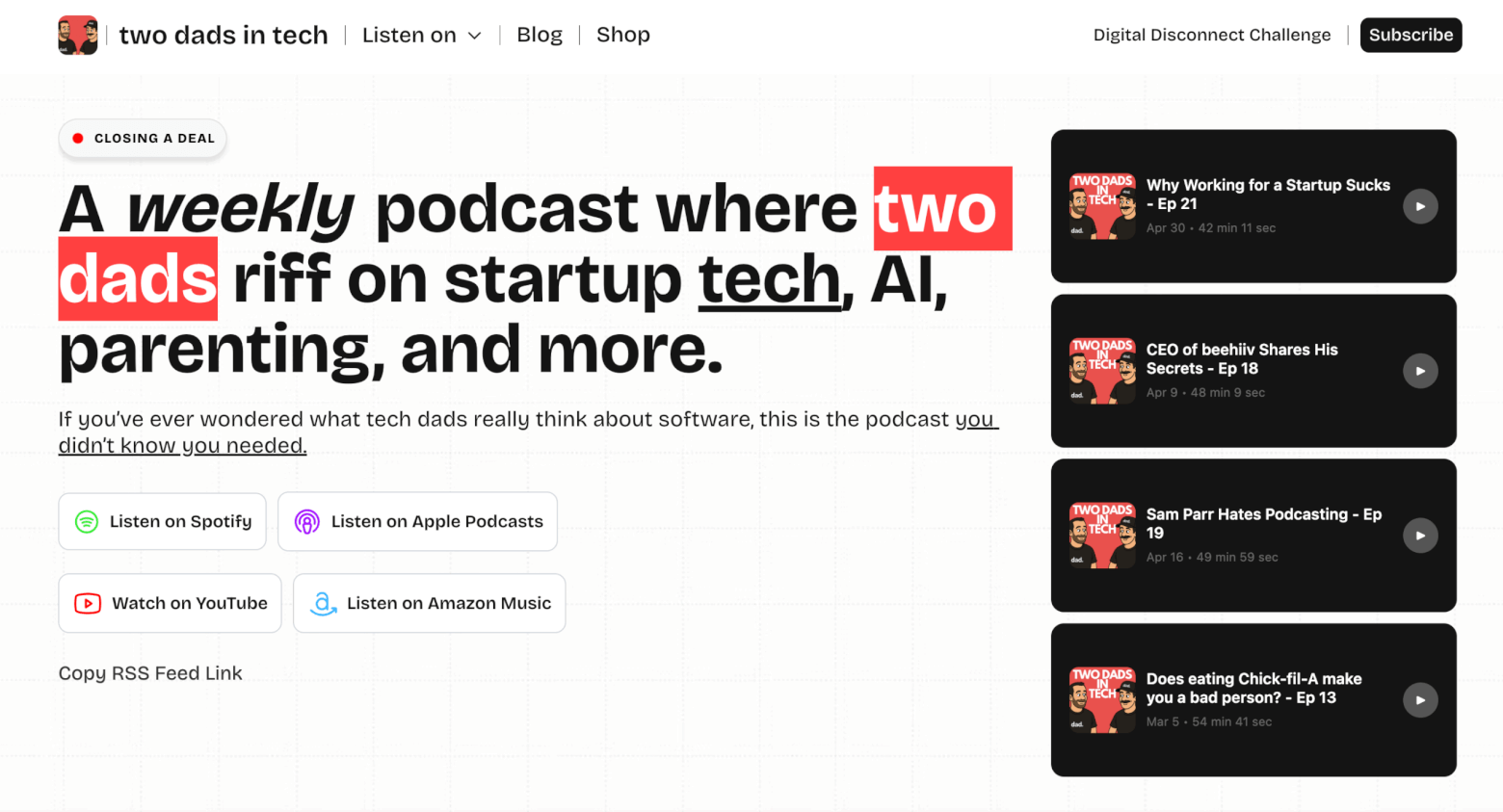
The Two Dads in Tech website incorporates a podcast and is hosted on Beehiiv
AI is still part of the picture too, but it’s more focused on creator workflows. Beehiiv offers writing assistance, editing support, and tools that help you publish and manage content faster, rather than trying to replace your entire marketing strategy.
Plus, Beehiiv isn’t stingy on product development. They listen to users and incorporate feedback through regular product updates. So ask, because you might receive. You can find the latest additions here—they post almost monthly.
Mailchimp, by comparison, still offers a broader marketing toolkit. It’s designed as an all-in-one marketing platform, with email, SMS, social posting, automations, and reporting aimed mainly at businesses rather than creators. It also includes a website builder, which can be useful if you want a simple online presence to support your campaigns.
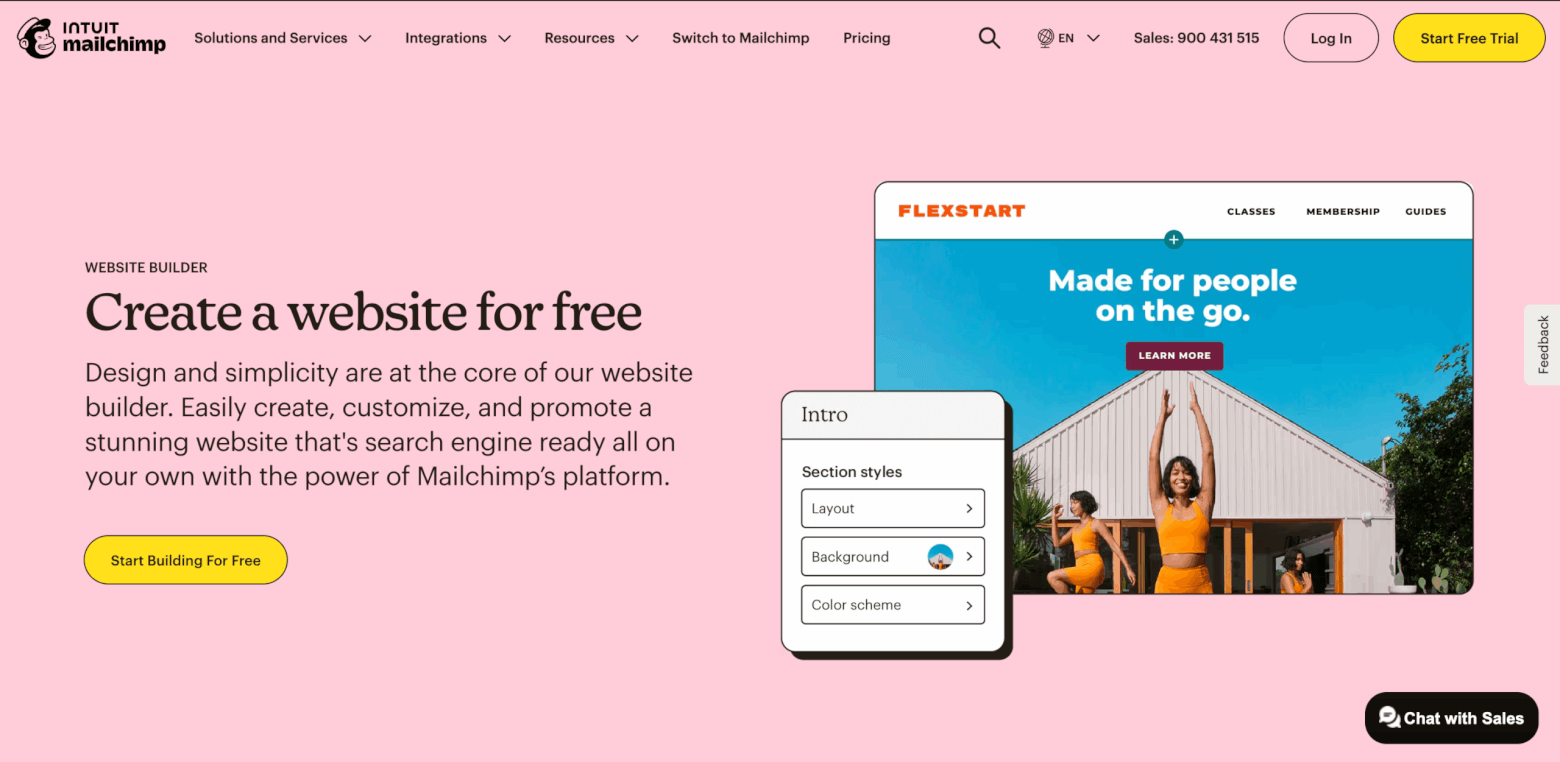
However, Mailchimp’s AI positioning has shifted. The Creative Assistant has been retired, and while Intuit Assist still plays a role in areas like copy suggestions and automation support, the focus is more on optimization and commerce-driven use cases than on content creation.
Winner: It’s no longer a clear win for Mailchimp. Beehiiv has caught up fast and now offers far more “extras” than it used to, especially for creators who want to run newsletters, websites, podcasts, and products from one platform. Mailchimp still wins on breadth and traditional marketing features, but Beehiiv now feels like the stronger option if your main goal is building a creator-led publication. This round’s another tie!
Beehiiv – 8
Mailchimp – 6
Round 12: Pricing
Both Beehiiv and Mailchimp offer free plans—though Beehiiv’s is notably more generous.
For no extra cost, you can manage an account with 2,500 subscribers, making it a standout choice at the entry level. The free account also comes with perks like audience segmentation and customized emails.
Mailchimp’s free plan, on the other hand, is more basic. You have a very small limit of 250 contacts and only 500 sends a month, which means that if you have growth in mind, you probably won’t be able to stay on it for very long.
Both platforms have one thing in common, though: You need a paid plan to access advanced tools and capabilities, so let’s compare their closest similar tiers: Beehiiv’s Lite plan and Mailchimp’s Standard plan.
Beehiiv’s Lite plan starts at $59/month for 1,000 contacts, while Mailchimp’s Standard plan is priced at $20/month for 500 contacts.
But here’s what you don’t see at the outset: Mailchimp’s plans have monthly email-sending limits, whereas Beehiiv’s Scale plan includes unlimited sends.
Plus, Beehiiv’s Scale plan comes with growth-friendly tools for content creators and marketers like Beehiiv AI, audio newsletters, a recommendation network, and magic links.
Mailchimp’s Standard plan is also packed with features, but many are more ecommerce-leaning (such as abandoned cart recovery, customer journey building, and MMS marketing).
Finally, scaling up with Beehiiv is easier on the wallet—the fully-featured Pro plan starts at $109/month, while Mailchimp’s Premium plan starts at $350/month. That’s a big jump.
Winner: Beehiiv’s pricing plan is more beneficial to content-focused individuals. You get unlimited sends and have an easy option to scale your subscription as your following grows.
That’s our final round, which means we have an overall winner… Beehiiv, with a final score of 9 vs Mailchimp’s 6!
Side-by-side comparison of Beehiiv vs Mailchimp
Detailed comparison of features


Select newsletter software
You can only select up to five email marketing tools.
You have to select at least two live chat tools.
Mailchimp vs Beehiiv: What’s The Right Choice For You?
While Mailchimp remains a powerful tool for businesses running complex marketing campaigns, Beehiiv comes out on top—especially if you’re a content creator, writer, or solo marketer focused on growing and monetizing a newsletter.
Beehiiv keeps things simple without sacrificing powerful features. With built-in monetization tools, a clean editor, referral and recommendation systems, and a more generous pricing model, it’s an ideal platform for creators who want to focus on content and community, without the clutter or steep costs.
That’s not to say Mailchimp doesn’t have its place. It still leads in areas like automation, analytics, and integrations, making it a solid choice for larger teams or ecommerce brands. But for the growing number of creators who want a tool purpose-built for newsletters, Beehiiv is the smarter, more scalable choice.
> Read our buzz-worthy review of Beehiiv here.
> Take Beehiiv for a completely sting-free trial here.
Looking for an alternative to Mailchimp that’s more affordable? Platforms like Mailerlite or Brevo offer similar features at lower price points—and might be better suited to your workflow.
> Read our honest review of Mailchimp here.
> Take a swing at Mailchimp for free today.
The authors
Learn more about us

We keep our content up to date
05 Oct 2026 - Beehiiv pricing updates, changes to Recommendations Network
29 Jan 2026 - Reduced limits on Mailchimp free plan
18 Dec 2025 - General update
25 July 2025 - Added deliverability section and updated scores
29 May 2025 - Beehiiv pricing updates
Our Methodology
This article has been written and researched following our EmailTooltester methodology.
Our Methodology