

You write a valuable email, hit send, and wait.
But all you get are a few opens, maybe a couple of clicks if you’re lucky, then silence. So you tweak the subject line, add more tips, and make it “more valuable.” And still… not enough engagement.
Your emails aren’t being ignored because your audience is “too busy” or their inbox is “too crowded.” It's that your emails don’t make people feel anything. They’re easy to skim past and even easier to forget.
One way to make your subscribers feel something is through storytelling in email marketing.
Story-driven emails use real moments, emotions and experiences to pull readers in, make them think, “wait, I’ve felt like that before.” And when people emotionally connect with your message, they are far more likely to keep reading and take action.
In this post, you’ll learn how to use storytelling to improve your email marketing campaigns, plus real examples from brands doing email storytelling well. You’ll also discover how to find great stories even when you think you have nothing to say.
Why storytelling works in email marketing
Before getting into how to use storytelling in emails, it’s worth understanding the “why.” Because storytelling isn’t just a nice creative touch. It affects how people pay attention, remember information, and connect with a message.
Stories are persuasive
Think about how you read emails in your inbox.
You open an email packed with tips, and you just scan it. Maybe you save it for later, or you don’t.
But when an email is story-driven, you’re sucked in. You read from start to finish, and more often than not, you take action.
In 2007, Carnegie Mellon researchers tested two donation brochures for Save the Children.
One listed statistic on food shortage, drought, and famine across Africa. The other told the story of Rokia, a seven-year-old girl from Mali, and what a donation could specifically change in her life.
Readers who received the fact-based version donated an average of $1.14. While those who received the story donated $2.38. More than twice as much.
This is what stories do. They persuade people to engage and take action.
Stories are more memorable
Advice fades fast. But stories stick.
Your subscribers might forget the exact steps you shared. But they’ll remember the moment you described, the situation that felt familiar, and the feeling it created
That’s what makes your emails stand out in an inbox full of “helpful content.” And that’s what makes them reply, act, and read your next emails.
A Stanford University study by Chip Heath (described in the book, Made to Stick) found that 63% of students could recall a story from a presentation, while only 5% remembered a single statistic.
In fact, to get examples to include in this post, I searched stories I remembered reading from specific senders.
Stories make your emails feel personal
Stories don’t feel like content. They feel like you’re talking directly to your subscribers.
When you share a specific moment, a real situation, or even a small observation, your email stops feeling like a broadcast and starts feeling like a message. That’s what builds connection.
Neuroeconomist, Paul Zak, in a 2014 Harvard Business Review article, noted that stories trigger the release of cortisol, dopamine, and oxytocin in the brain — chemicals that drive focus, emotional connection, and genuine empathy.
Plus, a Motista study that gathered data from 100 retailers found that emotionally connected customers stay loyal for an average of 5.1 years compared to 3.4 years for satisfied customers.
In summary, storytelling isn’t just a way to write better emails. It’s how you build the kind of relationship that increases engagement and keeps subscribers long after their first purchase.
What storytelling in email marketing actually means
This is where most people get stuck. They hear “use storytelling” and assume they need to write long, dramatic emails with a big reveal at the end. But that's not the case.
Email storytelling doesn’t mean writing a long essay or turning every newsletter into a personal transformation story. You need a three-act narrative in every marketing email.
At its core, storytelling in email marketing means one thing.
Its about making your subscribers feel something specific before you ask them to act.
Sometimes that happens in one paragraph. Other times, throughout the email. Which means the goal isn’t to write more. It’s to write more specifically.
One precise detail that puts the reader inside a moment beats a paragraph of relatable generality. Because once they’re inside that moment, they continue reading.
Pro Tip: Before you write your next email, finish this sentence: “My reader is sitting somewhere right now, feeling ______.”
That feeling is your opening line. Everything else follows from it.
3 key storytelling elements every email needs
Great email storytelling isn’t about how creative you are. It’s about using these three key storytelling elements in your email:
Character — It’s not you, it’s them
Subscribers don’t open your emails to hear about your business. They open your emails asking, “Is this about me?” or “How does this help me?”
So, the character in your email story is never the brand. It’s the reader at the precise moment they need what you’re offering.
The more precisely you describe the character, the more readers self-identify.
Vague characters, such as “business owners,” “marketers,” and “people who struggle with X,” create vague connections. While precise characters create the “I’ve experienced this” moment that makes subscribers engage.
Examples:
- A finance coach’s subscriber who just got her first salary raise and has no idea what to do with the extra $1,500 a month, so she’s just letting it sit there.
- A course creator’s subscriber who has bought three courses in the last year and finished exactly none of them
Conflict — The problem they haven’t put words to yet
Most emails rush past the conflict to get to the offer. They offer a solution without stating the problem or pain point the character experiences.
But conflict is what creates stakes. And without stakes, there’s no reason to care about the resolution.
The conflict doesn’t need to be dramatic. It just needs to be specific.
Say, you’re a financial literacy coach targeting first-generation investors. Instead of “people struggle with investing their money.” You’ll write:
“You’re the first person in your family to make real money. You don’t want to lose it. And you’re too embarrassed to admit you have no idea what to do with it next.”
That’s a conflict. That’s what someone feels when they’re Googling ‘how to invest in stock’ for the millionth time without actually doing anything about it.
Pro Tip: Read your conflict paragraph out loud. If it sounds like a survey question (e.g., Do you struggle with X?), rewrite it as a scene.
Put the reader somewhere specific, e.g., in a meeting they can’t focus on because they’re thinking about how to explain to their boss why last month’s numbers dropped.
Resolution — Where the offer comes in naturally
This is the insight that turns your story into something helpful. It isn’t your product or offer, but the point of the story.
The resolution is what changed, what you noticed, or what you did differently. And it segues into your offer naturally because the reader already understands why the solution matters.
You’re not suddenly introducing a pitch out of nowhere. Rather, you’re saying, “Here’s the solution to the problem, and this product will help you.”
For instance, if you’re an email marketing coach writing about an inconsistent sending habit. Your story might describe staring at a blank draft for hours because you keep trying to sound ‘smart.’
The resolution of the story isn’t “buy my course.” It’s, “the emails that performed best were the ones where I stopped trying to sound impressive and started sounding ‘honest.’
Now, your offer can enter naturally: “That’s the exact writing framework I teach inside [offer].”
The conflict creates the tension, and the resolution releases it. So, the offer feels like the obvious next step.
How to use storytelling in your email campaigns
It’s one thing to know that storytelling in email marketing works. Actually writing story-driven emails without overthinking it is another thing. Here’s how to write better storytelling emails.
Start with a specific moment
Don’t start with a statement or an idea. Start with a scene – something real that your subscribers can picture.
“Email marketing is one of the most powerful tools for growing your business” is a statement. Technically true, but bland and forgettable.
“I refreshed the campaign analytics for the fourth time in one hour. Still a 23.7% open rate.” Same subject, but completely different emotional weight.
Starting with a scene doesn’t require creative writing talent. What it requires is specificity. Pick a moment and put your subscribers in it. One or two sentences are enough.
Examples:
- A fitness coach subscriber sitting in her car outside the gym, convincing herself she’ll go in tomorrow.
- A SaaS tool trial user staring at the dashboard, unsure how or where to start using the software.
Pro Tip: If you’re stuck on writing a specific moment, ask: “Where is my reader right now, before they need what I’m selling?” That’s your scene. Put them there.
Build tension; don’t rush to the point
The instinct is to explain the point of the story or rush to the transformation. But tension is what makes people lean in.
Slow the moment down just enough to let your subscribers feel it before you tell them what to do about the problem.
For example, let’s say you’re writing an email about burnout for productivity coaching clients. Most people would go straight into the lesson: “You need better systems and time management.
But adding tension sounds more like this:
“You close your laptop at 11:47 pm, telling yourself tomorrow will be different. Then tomorrow comes.
You have numerous Slack notifications to respond to, three unfinished tasks from yesterday, and a client asking if you’ve “had a chance to look at that thing yet.”
By 2 pm, you’ve been busy all day and still haven’t touched the most important task on your to-do list.”
That’s what slowing down the moment looks like. Not dragging the story out, but giving the conflict enough room for subscribers to feel it.
Use specific details, not relatable generalities
Specific details are what separate your email from other emails in your subscriber’s inbox.
Don’t write, “he started getting results.” Rather, write, “two subscribers replied to his welcome email, and one booked a call for that same afternoon.”
Instead of “this budgeting method reduces financial stress.”
Try, “this budgeting method helped her leave Target with exactly the five groceries on her list, instead of another ‘little treat’ she’d regret at checkout.”
The more specific your details are, the less your email feels like marketing copy and the more it feels like a real moment someone actually experienced.
Connect the story to one clear CTA
Yes, even story-driven emails need one clear action. But you must make sure that your CTA feels like the logical next step from the story you just told.
And it doesn’t have to be something you’re selling. Even if it’s a small shift, like something they should try before the next email.
For example, if your story is about a freelance designer who keeps undercharging because she’s afraid to lose clients, and your offer is a pricing workshop.
Your CTA doesn’t have to say “join my pricing workshop.” It can say, “reply and tell me the last number you quoted and immediately wished you’d said more.”
That reply CTA continues the story (in their head, even if they don’t reply).
Where to source amazing stories for your emails
Almost everyone who wants to try storytelling in their email campaigns asks, “But where do I find the stories to write in my emails?”
The answer is you’re already surrounded by stories. Even if you don’t leave the house.
The problem isn’t a shortage of material. It’s knowing where to look.
Your own experiences
Subscribers will always connect the most with real stories. Stories that are specific, personal, and rooted in a moment that actually happened.
Alex Cattoni, whose email list has been the primary revenue driver in her seven-figure business, uses a set of prompts to surface story ideas from everyday life:
- When did you take a major risk?
- What’s the biggest lesson you learned lately?
- When was a time you almost gave up completely?
- What mistake taught you something you couldn’t have learned any other way?
Also, Matthew Dicks, in Storyworthy, recommends a practice he calls “Homework for Life.”
Every evening, write down a single moment from your day that’s worth turning into a story. Ask yourself, “If I have to tell a story from today, what would it be?”
It doesn’t have to be about a big or compelling moment. In fact, it might feel insignificant or inconsequential.
You may also write down meaningful memories that come to mind over the course of the day.
The goal isn’t to write the full story immediately. It’s to have an inventory of stories that you can pick from whenever you want to write a story-driven email.
Pro Tip: If you’re a copywriter or marketer, build story-sourcing questions into your onboarding process.
For example, “tell me about a time a client result surprised you.” Or, “tell me about a mistake that changed how you work.”
The world around you
Most people overlook this source because they think their stories have to be personal.
But you can find stories to use in your emails in news articles you read at 7 am with your coffee, trending social media stories, and overhead conversations.
The process is to first decide what point your email needs to make, then find a story around you that illuminates it.
Make sure to look for stories that have some form of conflict. Look out for one of the types of “conflict” setup for compelling stories, suggested by Laura Belgray. Conflict between expectation and outcome is one that’s easy to find.
Pro Tip: Keep a running note on your phone. When something makes you laugh, stop, or think, “huh, that’s interesting,” log it in your notepad.
You don’t need to know what it’s for yet. The connection will show up when you’re writing the email.
How to bridge the story to your offer without it feeling awkward
This is where most story-led emails collapse. The story lands well. The reader is engaged.
And then: “Anyway, buy what I’m selling.”
The pivot is so abrupt that the reader almost gets whiplash. Alex Cattoni calls this the “awkward cringy pivot,” and suggests three reliable story bridges that would make your transition feel inevitable rather than jarring.
Bridge #1: The lesson
Extract the explicit lesson from your story, name it clearly, and use it as the pivot to your offer or CTA.
Say your email tells the story of a personal trainer who got her best client results from a simple check-in text she sent every Sunday morning.
- The lesson: “Consistency of contact matters more than complexity of content.”
- The pivot: “Which is exactly why I structured [offer] around a 10-minute weekly touchpoint instead of a 90-minute deep dive.”
The key is to name the lesson explicitly.
Don’t assume the reader will draw the same conclusion from your story that you did. Tell them how to interpret it and then show them where it leads.
Bridge #2: Compare and contrast
This bridge leans into the brain’s compulsion to resolve tension.
Before vs. after. Then vs. now. What you thought was true vs. what turned out to be true. What you wanted vs. the surprising outcome you got.
For instance, a business coach whose clients are burnt-out freelancers could write a story that follows a freelance illustrator who knew every productivity framework, but still couldn't get proposals out on time.
- The compare and contrast bridge: “Knowing the system isn't the problem. Following it is the problem.
- Then the offer to ‘hold them accountable’ or ‘show them how to follow the principle’ comes after the bridge naturally.
Bridge #3: The metaphor
This bridge is the most sophisticated of the three. It connects the story to a parallel idea that your audience already understands intuitively, without you having to spell it out.
Metaphors work because they let subscribers emotionally understand an idea before they logically process it. Instead of explaining the lesson directly, you let the reader arrive there themselves.
Alex Cattoni once built an entire email around the peppered moth — a species whose colouring changed during the Industrial Revolution to survive on newly-darkened trees.
- The metaphor bridge: “The moth's surroundings changed, and it adapted to thrive. You can adapt and change to the environmental circumstances and opportunities around you.”
When the metaphor is specific enough, the transition into your offer feels natural because the meaning already clicked emotionally before the pitch.
6 storytelling email marketing examples
Storytelling in email marketing comes in different forms. These examples show how real brands and creators use storytelling differently while still following the same core principle — to make the reader feel something before asking them to act.
Promotional Storytelling Email
Using story narratives to create emotional buy-in before introducing the offer improves your promotional email performance.
- “It was RIGHT THERE” — Laura Belgray
This Laura Belgray email opens with a scene of a friend visiting their house and doing something odd.
The dialogue draws subscribers into the moment, especially this: “Six f***ing years! We’ve lived here six years, dealing with the dumb Brita — and that magic button’s been here the whole time?”
Then, she pivots to a coaching client she’s just had a session with, who had a hidden revenue opportunity sitting right on her own sales page, but didn’t notice.
The bridge is a metaphor: the untapped fridge button equals the untapped sales asset. And because the story is so specific, the metaphor lands effortlessly for the reader.
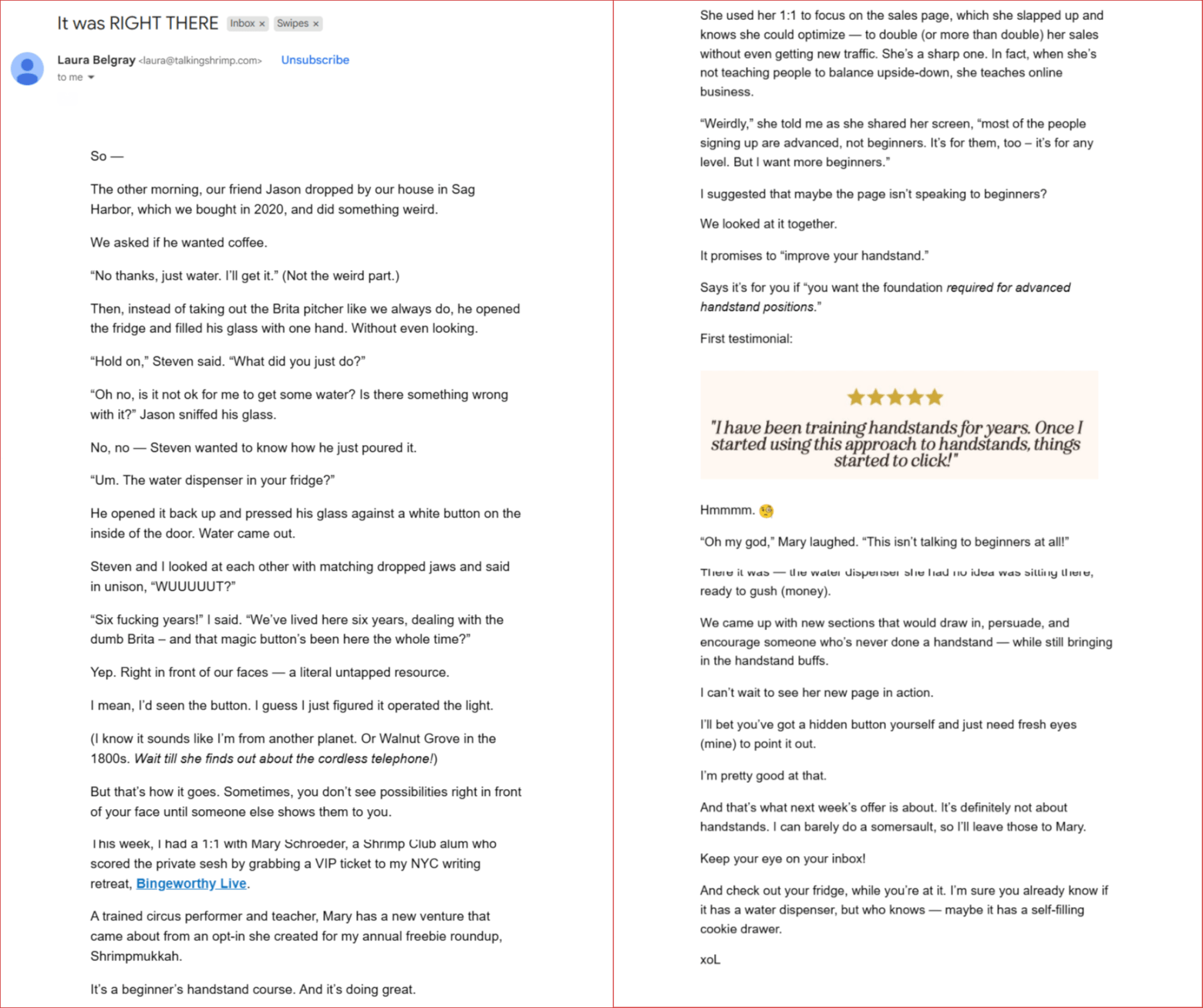
Image Source: Talking Shrimp
Why it works: A small, domestic moment creates a memorable entry into the email. And the offer doesn't appear until the reader has already made the connection. So, it doesn’t feel like they’re being sold to.
- “quite a comforting thought” — Kirsty Fanton
Another promotional storytelling email is this email by Kirsty Fanton, which opens with her at a beach at sunrise.
She’s not the main character, but the observer. And the email tells the story of what she observes, across four different scenes using specific details (the peanut acai bowl, the matcha order, the teenagers on Lime bikes).
And the business insight feels earned because the reader watched her arrive at it in real time. So, the bridge (“Just as you and I are deliciously predictable in so many ways, so too are your prospects”) segues smoothly into the pitch.
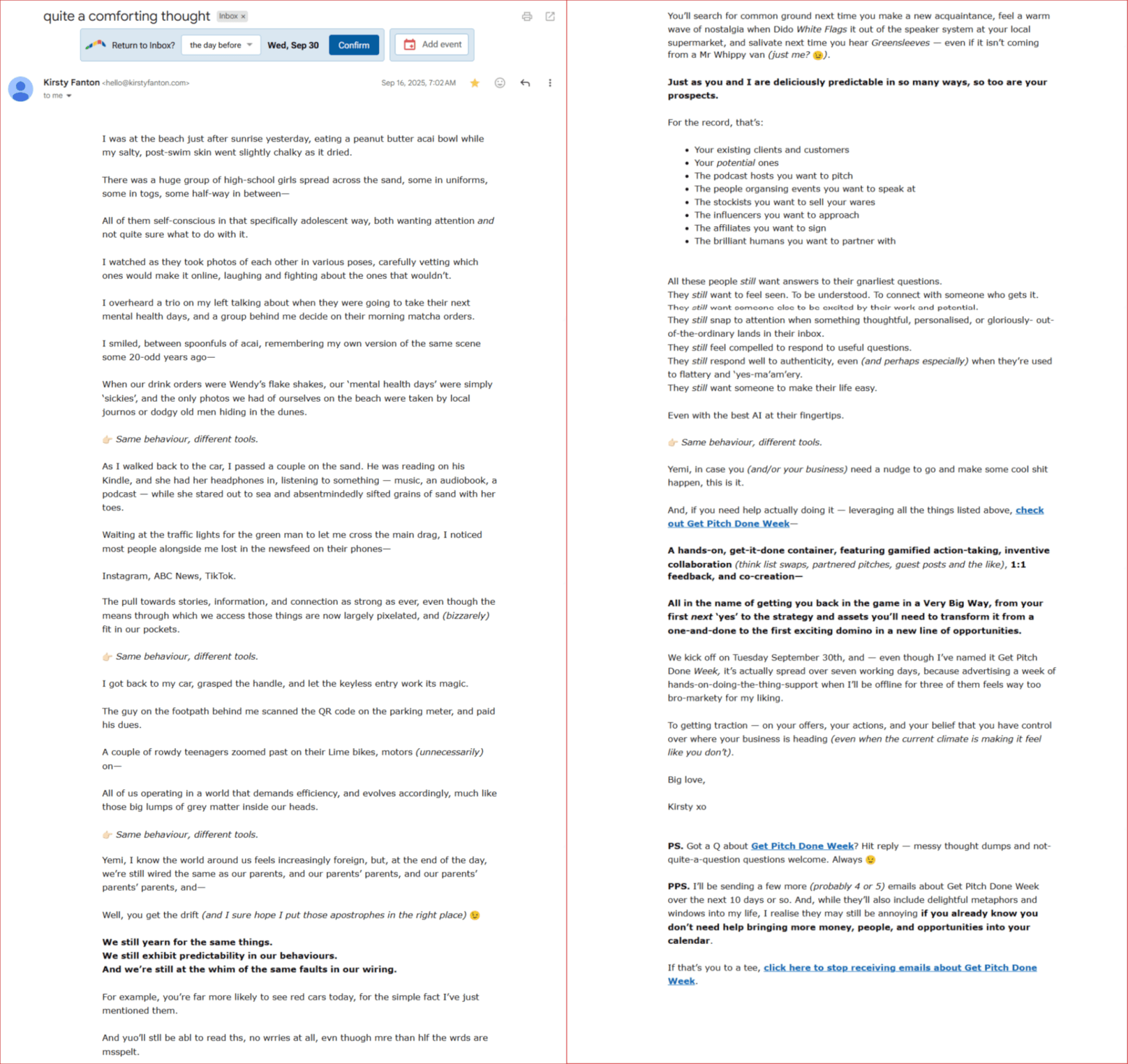
Image Source: The Business of Being Human
Why it works: You don't have to be the protagonist of your own story. Specific observations can do the same emotional work. And when done well, they're harder to scroll past than personal anecdotes.
Welcome email storytelling
You can use storytelling in your welcome emails to shape how subscribers feel about your brand from the very first interaction.
- “A letter from the leader of a circus” — The Hustle
Sam Parr doesn’t open this welcome email with a mission statement. He opens it with a scene: the moment a new subscriber presses submit, and a buzzer goes off in the office.
The email is absurd, but specific. And it makes subscribers feel like they just walked into a building full of people who are genuinely delighted they showed up.
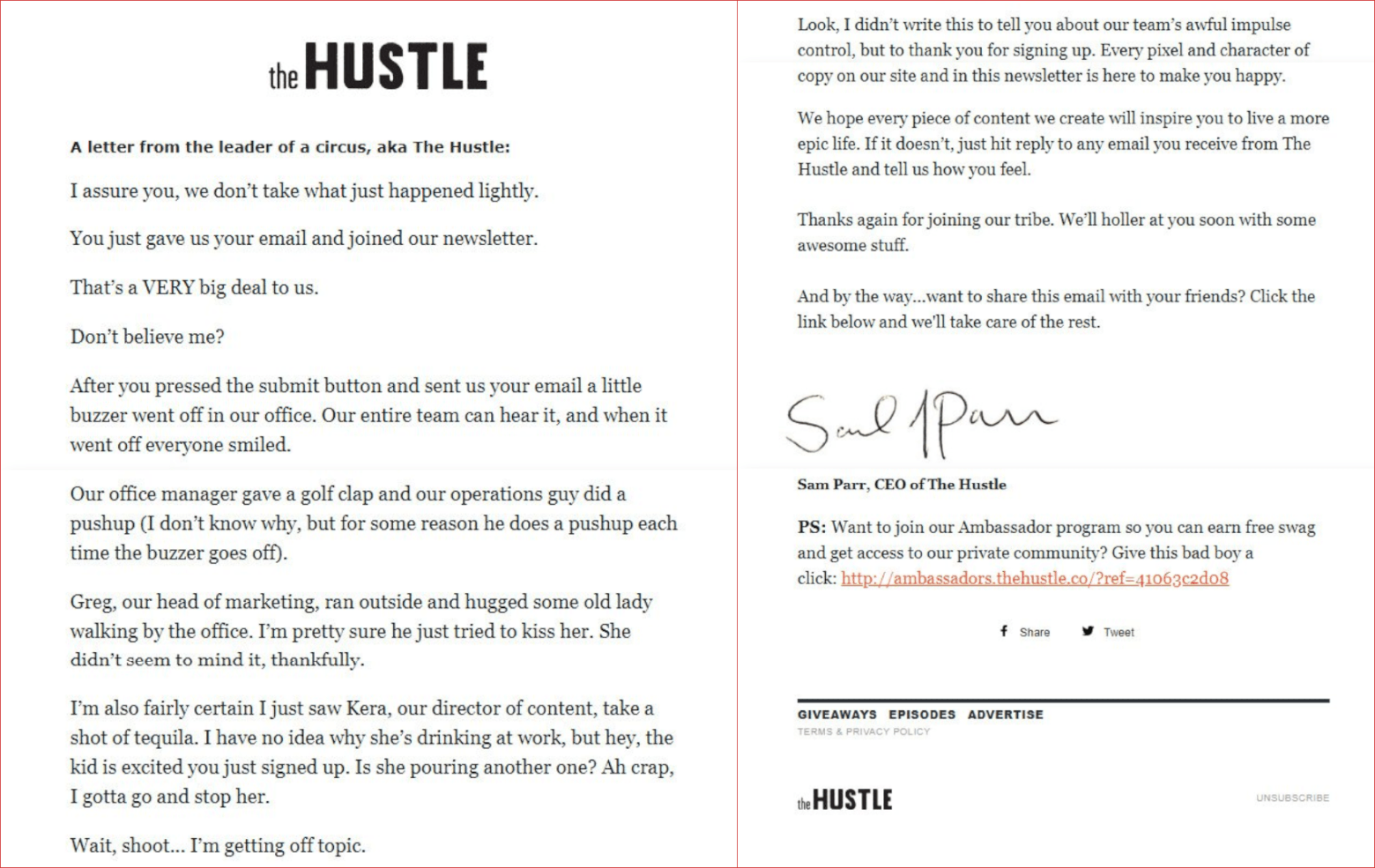
Image Source: Flourish + Grit
Why it works: A welcome email’s real job is to make subscribers feel something about the brand before they decide whether to keep opening future emails. The Hustle does this in under 300 words by making the reader the protagonist of a story
- Share with Confidence” — Partake Foods
Denise opens her welcome email with one sentence of conflict: “I didn't understand what it meant to live with food allergies until my daughter Vivi was born.”
Character + conflict, in eleven words. And the resolution enters without a hard sell.
She set out to make treats Vivi could actually enjoy — safe, allergen-free, something she'd actually want to eat — and Partake was born.
Then, she closes the email without being pushy with a simple CTA that invites subscribers to “Shop Partake Cookies.”
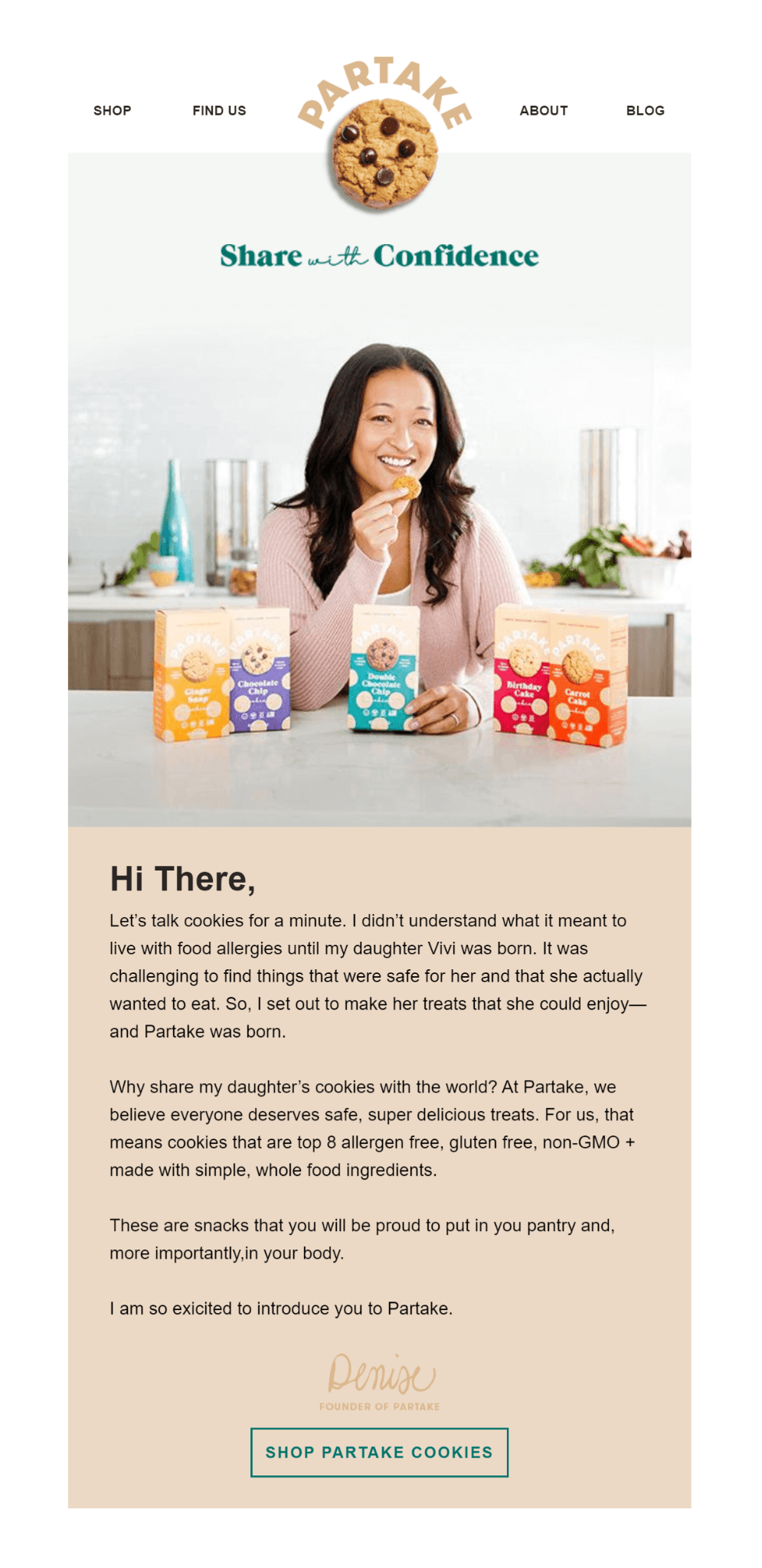
Image Source: Partake Foods
Why it works: The founder story earns its place because it's grounded in a specific person and a specific problem, not in a vague mission statement
Newsletter email storytelling
Storytelling keep subscribers emotionally invested in your newsletter, even when there’s nothing being sold directly.
- “The first time I went viral” — Kieran Drew
The newsletter opens with six words, “It’s 7 am, August 21st 2021.” And it’s followed by the tension of his hands shaking as he opens his laptop.
The story is one most content creators will privately recognise. Months of effort, nothing working, and then a single personal post changing everything overnight.
The lesson is explicit: “My mistake was thinking content was just about sharing information. It is about creating a connection.”
Then the pivot is doubling down on storytelling, growing his newsletter, and generating over $1.4m.
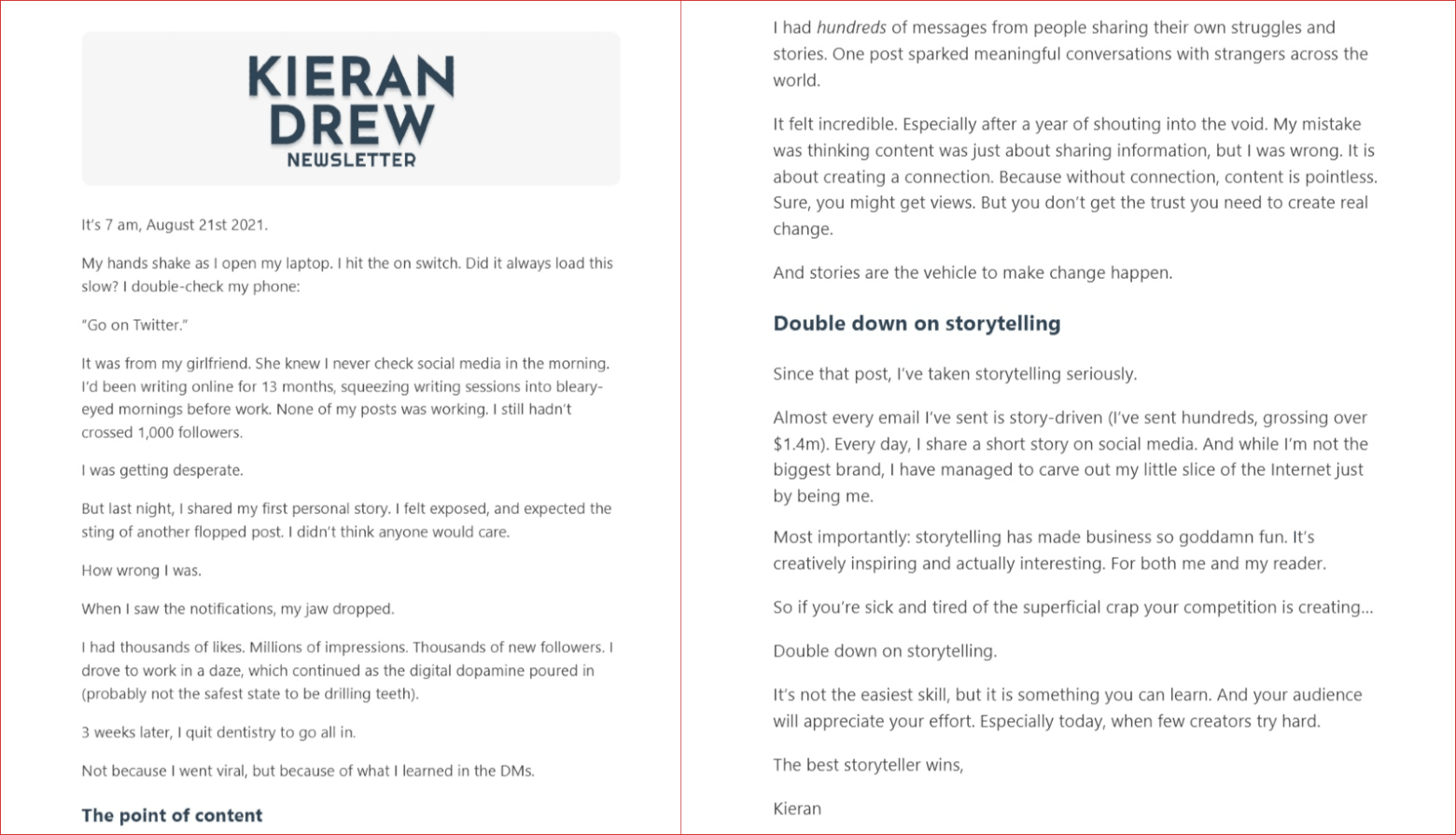
Image Source: Kieran Drew Newsletter
Why it works: The specific time-stamp (7 am, August 21st 2021) is one of the most underused techniques in email writing. It snaps the reader into the scene instantly and signals that this is a real moment, not a rhetorical device.
- “I Think I Gaslit Myself into Productivity” — Ash Ambirge
Ash Ambirge opens this newsletter with wallpaper. Specifically, the wallpaper she’s been meaning to hang for a year and a half.
It goes on for several “ridiculous” paragraphs. But the real conflict in the story is avoidance, and it’s completely relatable.
The bridge is direct. “You know what this reminds me of?” works because of the “bear with me. I promise this makes sense,” that follows.
And it does make sense when she makes her point a couple of paragraphs later.
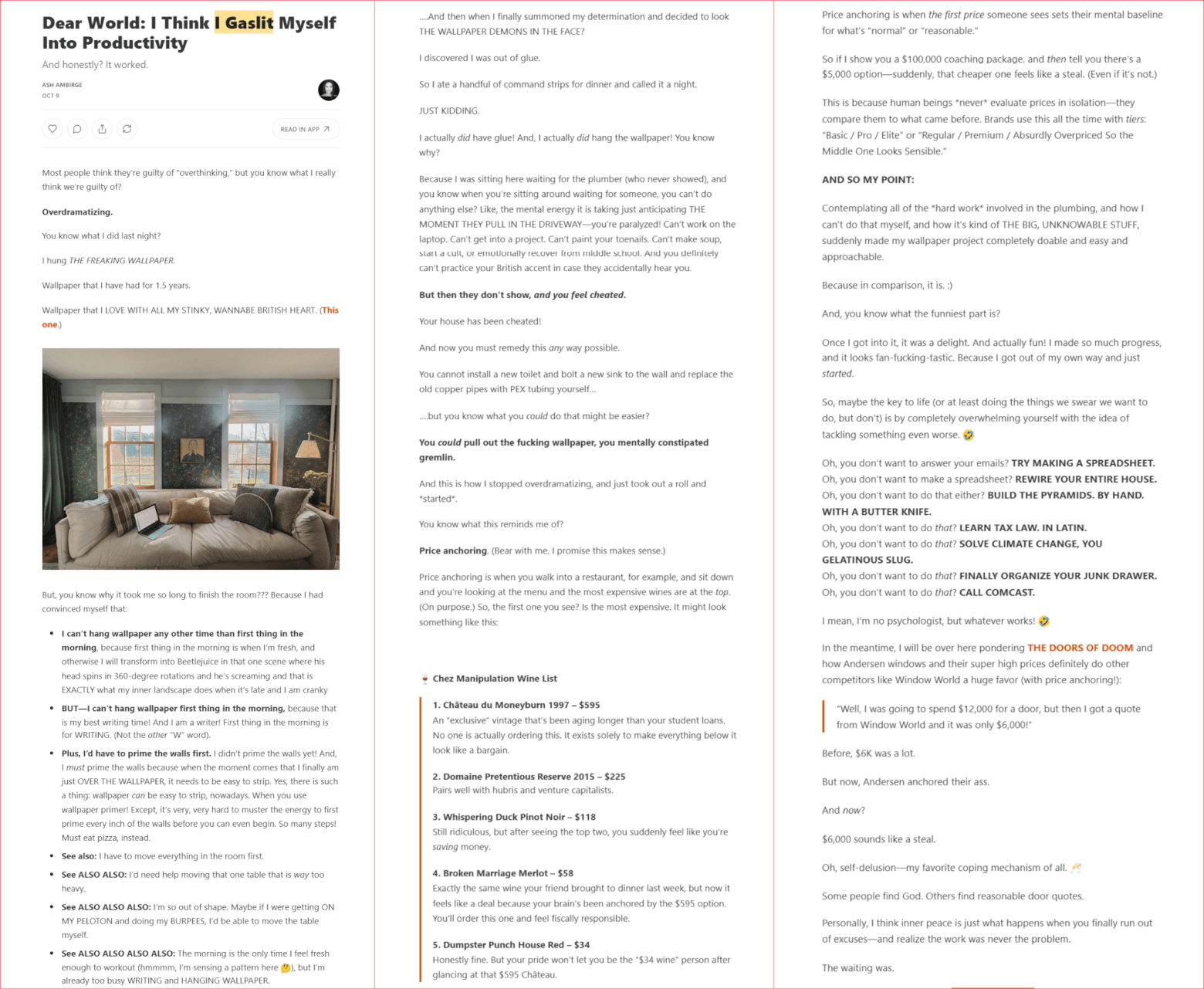
Image Source: Trailer Park Girl Eats World
Why it works: The self-aware humor makes the story relatable. Everyone has their own “wallpaper project” they’ve mentally inflated into something exhausting. Ash turned an ordinary situation into emotional recognition, then bridged it into a bigger insight.
ESP tools that support better email storytelling
You don’t need a specific tool to write better stories. You can open a blank doc right now and write a stronger email than most brands send all week.
But if you want those stories to reach the right people at the right time, and actually lead somewhere, your email service provider (ESP) matters. Because storytelling works best when it’s not random. It works when it’s consistent, triggered, and connected across emails.
Here are a few tools that make that easier.
ActiveCampaign — Best for complex, behavior-triggered sequences
ActiveCampaign is the most powerful email automation tool we’ve tested, with its outstanding segmentation feature.
You can tag subscribers by behavior, such as what they clicked or what page they visited on your website. Then, assign lead scores based on their actions and send them personalized emails.
Dynamic content also goes one step further in ActiveCampaign. You can show different story angles inside the same email based on what you know about each subscriber.
However, it comes with a learning curve and no free plan. Paid plans start at $19/month for 1,000 subscribers.
Read our ActiveCampaign Review →
Brevo — Best affordable option for businesses
Most ESPs charge per subscriber on your list. Brevo charges per email sent. So, you have a large segmented list of 50,000 subscribers and only pay for what you actually send to them.
For story-driven emails, where you’re often sending different sequences to different segments, that’s a meaningful advantage. And you can get up to 300 emails/day on the free plan.
Also, Brevo’s workflow builder handles triggers based on contact data, email engagement, web behaviour, and ecommerce activity.
Or, if you’re ready to try Brevo, sign up for our free Brevo mini-course that walks you through account setup, contact management, and creating your first email campaign.
Kit (formerly ConvertKit) — Best for independent creators
Kit was built for creators (i.e., coaches, course creators, newsletter writers, etc.). And it has precise tagging and segmenting capabilities that update automatically as subscribers take action.
Whether they’re signing up via specific forms, clicking links, or completing purchases, the visual automation builder lets you see exactly which segment subscribers belong to.
The free plan supports up to 10,000 subscribers with unlimited emails and one automation. Paid plans start at $39/month and unlock unlimited automations and other features that let you identify your most engaged subscribers.
Klaviyo — Best for ecommerce businesses
Klaviyo is built specifically to meet the needs of ecommerce businesses. Unlike most ESPs, where segments are built and then used, segments automatically adjust in real time as customer behaviors change.
So, the right story is always going to the right subscriber based on what they did this week, not when they first signed up. And there’s no limit on the number of conditions you can stack into a segment.
Plus, it’s RFM (Recency, Frequency, Monetary) model segments customers by purchase patterns, giving you a behavioural map to write stories that resonate with each group.
The free plan allows only 250 subscribers and 500 emails/month. However, you’ll have access to almost all the features Klaviyo offers, except for their AI tools.
Mailchimp — Best starting point for businesses
Mailchimp is the most widely used ESP when people are just getting started with email marketing. Its segmentation capabilities cover the fundamentals that story emails require.
Its Customer Journey feature lets you build automated story sequences triggered by subscribers' actions. And it has AI tools that help with subject lines and content suggestions.
However, the free plan is the most restrictive, with no automation or scheduling capabilities. And you can only have 250 subscribers and send 500 emails per month.
Whatever ESP tool you choose, email segmentation and personalization capabilities are crucial for sending targeted emails.
Think about what it means to send the right story email at the right time.
Let’s say you’re a personal finance coach with two groups of subscribers on your list: people who downloaded your free budgeting guide and haven’t bought anything yet, and clients who have paid for one of your programs.
Sending both groups the same story-driven nurture sequence won’t work. One group needs to feel seen in their frustration, while the other needs to feel supported in their progress to the next step.
Common email storytelling mistakes that kill engagement
Most story-driven emails don’t underperform just because the story was bad. Often, one of these common mistakes was made:
- Making yourself the hero
Your brand isn’t the main character. If your email is about you or your business, you lose your subscriber’s attention.
Sure, you can mention your brand’s journey, values, and passion, but only when it serves as a mirror. Share your experience only when it reflects something your subscriber is feeling or provides an answer to a problem they’re facing.
- Writing a story with no conflict
A story where everything goes smoothly isn’t a story. It's a testimonial. Without conflict, there are no stakes. And without stakes, your subscriber has no reason to keep reading.
If your email moves straight from “here’s who we are” to “here’s what we offer,” you've skipped the only part that creates connection.
- Burying the point
Be careful not to ramble while trying to set the scene. If you’re three paragraphs in and your subscribers still don’t feel anything specific, you’ve lost them. Scene setting is a tool, not a warm-up exercise.
- Forcing a story where a direct email would work better
Not every email needs to be story-driven. Transactional emails, shipping confirmation emails, and quick product updates don’t need a three-act structure.
Forcing a story where it doesn’t fit is awkward. Save the storytelling framework for emails where you're asking for emotional investment, such as welcome sequences, re-engagement campaigns, product launch emails, and newsletters.
- Telling your subscribers how to feel instead of showing the scene
Emotional directives like “this is so exciting” or “we’re thrilled to share” don’t evoke feelings. They signal something should feel meaningful without giving a reason to feel it.
On the other hand, “Fourteen students hit their first paying clients this month, and three of them started with zero experience six months ago,” shows the scene and evokes a feeling.
- Confusing “conversational” with “casual”
Yes, your email should sound human, but the voice depends on who’s reading. For example, a finance coach whose subscribers are high-earning professionals must not write like they’re texting a friend or have rhetorical asides to feel personal.
The goal is to be conversational for your audience, not conversational in general. A warm, direct tone goes a long way in any niche. But the vocabulary, sentence length, and level of humor should match what your specific subscriber actually sounds like.
- Not tracking reply rates
Open and click-through rates aren’t enough for storytelling emails. They matter. But unlike reply rates, they don’t tell you whether the story landed.
If subscribers are replying (maybe with their own experiences), that means your email built an emotional connection with them. If they aren’t, the conflict probably isn’t specific enough, and they can’t see themselves in it.
Conclusion: Your emails don't need more tips; they need better storytelling
After reading this guide, you’re probably thinking this takes more effort.
That’s fair. But consider what stays the same if your emails keep sounding like every other “helpful” email in your subscribers’ inboxes. You’ll still spend hours writing emails that get skimmed in four seconds and archived without a click, reply, or sale.
You don't need to become a “storyteller” or rewrite your entire email strategy overnight.
Start with one email. Maybe your welcome email, next newsletter, or seasonal promo.
Instead of opening with a tip, open with a moment. Instead of rushing to the lesson, let the reader feel the tension first. Then, guide them to what it means and what to do next.
Because the difference between emails people ignore and emails people read and remember comes down to one thing: whether they felt something while reading it.
If you’ve tried storytelling in your email marketing, share what worked and what didn’t in the comments.
The authors
Learn more about us

Our Methodology
This article has been written and researched following our EmailTooltester methodology.
Our Methodology