


Salesforce is buying Braze. And looking at our own data, I can see why that might be a smart move.
At EmailTooltester, we’ve been tracking which email marketing platforms real brands are using. Not only that – we’ve also been keeping an eye on where they go when they switch providers.
Using our own tool, Email Detective, we’ve detected 149 platform switches so far. Not the biggest dataset, I know – but enough to reveal some interesting early trends. And unlike surveys or market-share estimates, these are actual platform changes we’ve detected in the wild.
Braze is currently the biggest winner, with 19 brands switching to the platform and only three leaving. Klaviyo and Iterable aren’t far behind.
At the other end of the table, things aren’t looking quite so rosy for Mailchimp. We’ve spotted 16 brands leaving the platform, compared to just two joining. Salesforce Marketing Cloud has also lost more brands than it’s gained.
And when we look at where brands are coming from and where they’re going, some interesting patterns start to emerge.
Which email marketing platforms are winning and losing brands?
Let’s start with the big picture. We looked at all 149 platform switches detected by Email Detective and counted how many brands each provider gained and lost. Here’s how the 15 most interesting platforms compare:
| Platform | Won | Lost | Net |
|---|---|---|---|
| Braze | 19 | 3 | +16 |
| Klaviyo | 18 | 5 | +13 |
| Iterable | 13 | 4 | +9 |
| HubSpot | 11 | 3 | +8 |
| Customer.io | 12 | 5 | +7 |
| Adobe Journey Optimizer | 6 | 1 | +5 |
| Bloomreach | 6 | 2 | +4 |
| ActiveCampaign | 4 | 4 | 0 |
| Shopify Messaging | 3 | 5 | -2 |
| Salesforce Marketing Cloud | 14 | 17 | -3 |
| Emarsys | 2 | 5 | -3 |
| Sailthru | 2 | 5 | -3 |
| Adobe Campaign | 2 | 6 | -4 |
| Responsys | 1 | 6 | -5 |
| Mailchimp | 2 | 16 | -14 |
Braze comes out on top, gaining 19 brands while losing just three, giving it a net gain of 16. Klaviyo follows closely with a net gain of 13, while Iterable takes third place with nine.
These three platforms have something in common: they all focus heavily on customer data, deep personalization, and automated marketing campaigns. They also go beyond traditional email marketing, offering ways to engage customers across multiple channels.
Could this be a sign that brands are moving away from traditional email marketing tools toward more sophisticated customer engagement platforms? It’s certainly one possible explanation. Although it doesn’t really explain Salesforce Marketing Cloud’s case – after gaining 14 brands (but losing 17), it has seen more switching activity than any other platforms in our ranking.
And then there’s Mailchimp. With just two incoming brands and 16 departures, it has the biggest net loss in our dataset, at minus 14. That’s quite a contrast to Braze and Klaviyo, and especially interesting given Mailchimp’s position as one of the best-known names in email marketing.
Of course, these figures don’t tell us why individual brands decided to switch. And because we’re working with a relatively small sample, they shouldn’t be confused with overall market share or customer churn rates.
But let’s take a closer look to see which platforms brands are actually switching between.
Braze and Iterable are winning over enterprise customers
Given Salesforce’s recent acquisition announcement, Braze (our biggest winner) is an interesting case to examine.
Of the 19 brands we’ve seen move to Braze, six came from Salesforce Marketing Cloud, three from SAP Emarsys, and two from Oracle Responsys. Others switched from Adobe Campaign, Adobe Journey Optimizer, Cheetah Digital, Selligent, Zeta Global, and Iterable.
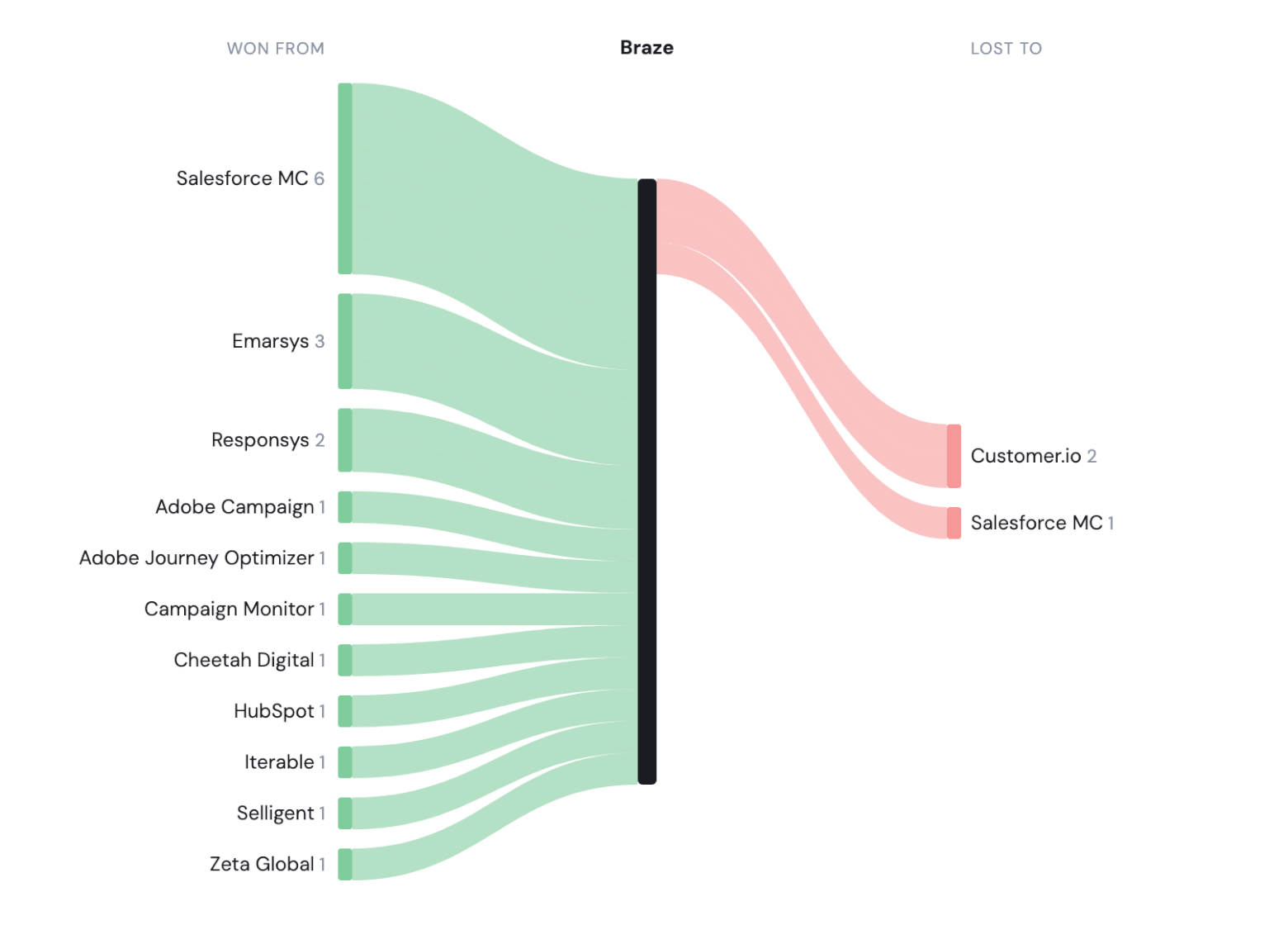
Notice anything? Most of these aren’t exactly basic newsletter tools. They’re established platforms used by larger businesses to manage complex marketing campaigns and customer relationships – including Salesforce, Braze’s new owner.
And it’s not just our data suggesting that Salesforce’s marketing business is facing some pressure. According to a BMO Capital Markets analyst, Salesforce’s Marketing & Commerce Cloud revenue has declined for three consecutive quarters.
Meanwhile, Braze has been growing rapidly. Its latest financial results show a 15% increase in customers and 26% revenue growth year over year.
So Salesforce is spending around $5.7 billion to acquire a fast-growing company with technology that could strengthen its own marketing offering. Of course, I can’t tell you whether losing customers to Braze played any part in Salesforce’s decision. But looking at these numbers, the acquisition starts to make quite a bit of sense.
Braze isn’t the only platform attracting brands from established enterprise marketing providers. Iterable has also been picking up customers from some familiar names.
Four brands moved from Customer.io to Iterable, two from Cheetah Digital, and another two from Sailthru. We also spotted migrations from Acoustic, MessageGears, Maropost, Salesforce Marketing Cloud, and even one from Mailchimp.
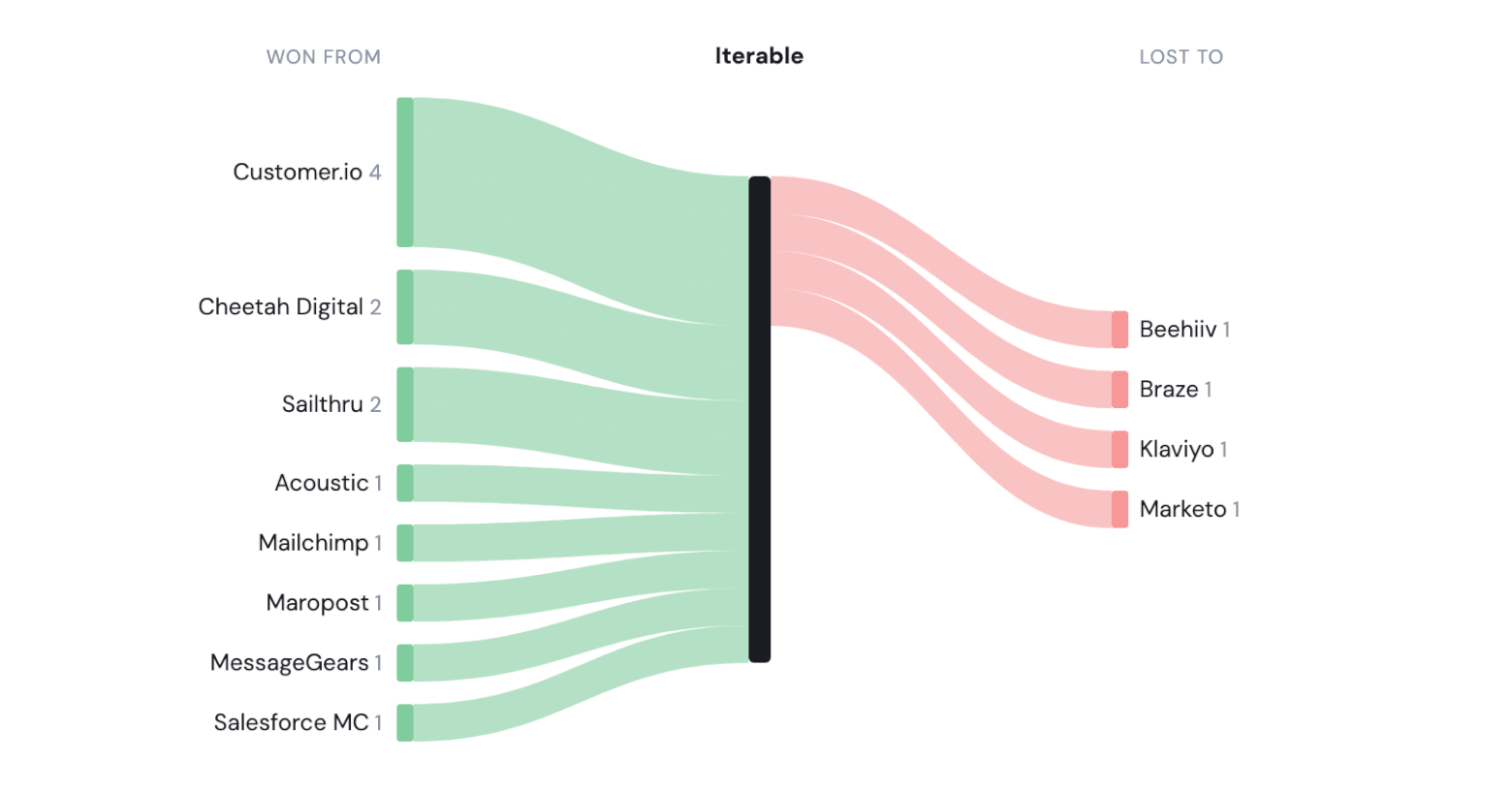
Again, there’s a pattern. Iterable seems to be competing successfully with platforms that offer advanced marketing automation and customer engagement features, rather than primarily attracting businesses using simple email newsletter software.
Both Braze and Iterable put a strong emphasis on personalized customer journeys, using data and customer behavior to trigger messages across email, mobile, and other channels. So it’s possible that some brands are looking for more flexibility or more sophisticated ways to communicate with their customers.
Klaviyo, on the other hand, is winning customers from a somewhat different mix of competitors.
Klaviyo is attracting brands from across the market
Klaviyo is another big winner in our dataset, with 18 brands joining and only five leaving. But when we look at where those brands are coming from, the picture is a little different compared to Braze.
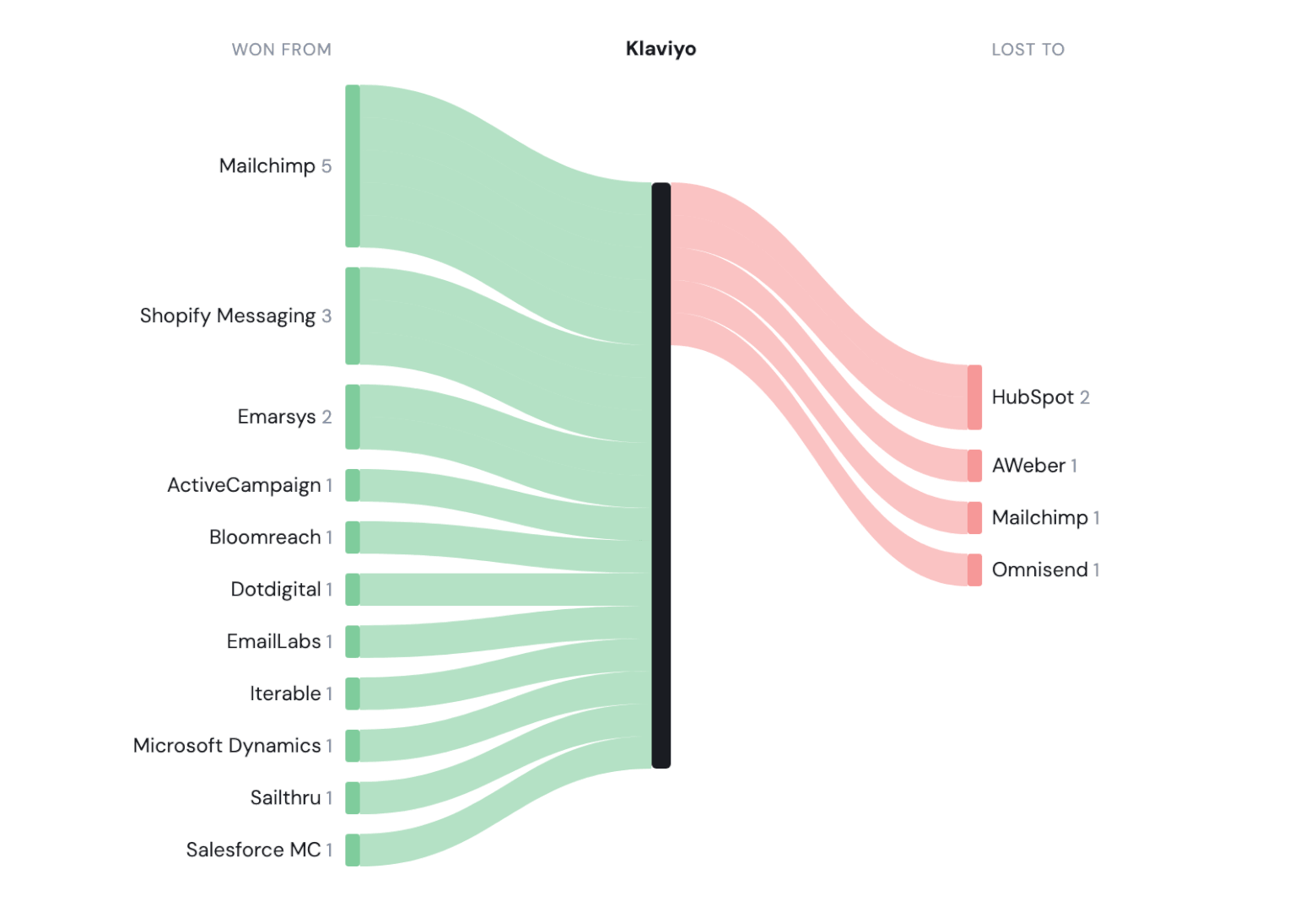
Perhaps unsurprisingly, Mailchimp and Shopify Messaging are among the platforms losing brands to Klaviyo. Given Klaviyo’s strong focus on ecommerce, these migrations make sense.
Klaviyo integrates closely with platforms like Shopify and offers features designed specifically for online stores, such as abandoned cart emails, product recommendations, and customer segmentation based on purchase behavior. For an ecommerce business that’s outgrowing a more basic email marketing setup, it’s easy to see the appeal.
But we’ve also detected migrations from SAP Emarsys, Salesforce Marketing Cloud, Microsoft Dynamics, Bloomreach, Sailthru, and Iterable – platforms that offer sophisticated marketing capabilities. So Klaviyo isn’t necessarily just an upgrade path for smaller online stores. It’s also competing with established enterprise marketing providers.
Of course, we can’t tell whether these brands switched because of pricing, features, integrations, or something else entirely. Still, Klaviyo’s migration patterns suggest it’s attracting businesses from several different parts of the market, rather than just one particular type of competitor.
And that brings us to another familiar name, but one that’s having a rather different experience in our dataset: Mailchimp.
Mailchimp is losing customers in two different directions
Of the 149 platform switches we’ve detected, 16 brands moved away from Mailchimp, while only two switched to it. That gives it a net loss of 14, the worst result of any provider in our analysis.
As I mentioned earlier, Klaviyo was the most popular destination, attracting five former Mailchimp customers. But other brands went in a completely different direction. Two switched to Kit, another two to MailerLite, and one to Beehiiv. We also spotted a move to Listmonk, an open-source newsletter platform.
These tools generally appeal to a different audience than Klaviyo. Kit and Beehiiv are particularly popular with creators and newsletter publishers, while MailerLite focuses on making email marketing accessible and affordable for smaller businesses.
So Mailchimp appears to be facing competition from both ends of the market. Could Mailchimp be getting squeezed in the middle?
Possibly. Mailchimp has spent years expanding beyond its roots as a straightforward newsletter tool, adding features like automations, ecommerce integrations, and marketing CRM capabilities. And during this time, we’ve spoken to a lot of customers who have grown increasingly frustrated with its lack of focus.
On one side, we’ve seen many businesses moving to platforms with more specialized ecommerce and automation capabilities. On the other, there are brands choosing tools focused on newsletters, creators, or simpler email marketing.
And then there’s HubSpot, Customer.io, Iterable, ActiveCampaign, and CleverTap, which each attracted one former Mailchimp brand, adding even more variety to the picture.
Interestingly, our findings aren’t the only indication that Mailchimp might be having a difficult time. According to its parent company Intuit’s financial results, Mailchimp’s revenue actually declined by around 1% in 2026 despite repeated price increases and free plan allowance reductions. And Intuit isn’t expecting much improvement next year, forecasting flat or slightly declining revenue.
That’s quite a contrast to Braze and Klaviyo, which both reported year-over-year revenue growth of around 26% in their latest quarterly results.
What do these switching patterns tell us about the email marketing market?
For me, the biggest takeaway is that brands don’t all seem to be moving in the same direction. Instead, they’re gravitating toward platforms that serve more specific needs. Our early findings suggest that specialization and a clear target audience could be increasingly important in the email marketing market.
Braze, Klaviyo, and Iterable are clearly doing something right when it comes to attracting brands in our sample. Whether it’s their automation capabilities, ecommerce features, or something else, they’re winning more brands than they’re losing.
Mailchimp’s position is also worth watching. Its customers are moving to a surprisingly wide variety of alternatives, which raises questions about how well a general-purpose email marketing platform can compete with more specialized tools.
And then there’s Salesforce buying Braze. Considering that Braze has been attracting customers from Salesforce Marketing Cloud and other established enterprise platforms, the timing is certainly interesting.
Our sample might be small, but we’re not the only ones seeing these patterns. Braze and Klaviyo are both reporting strong customer and revenue growth. Meanwhile, Mailchimp’s parent company has reported declining revenue, and Salesforce’s marketing business is facing its own challenges.
We’ll continue tracking these migrations with Email Detective, as I’m curious to see whether the same platforms are still leading the rankings when we have a much larger dataset. I’ll be sure to share what we find.
How we collected the data
The findings in this article come from Email Detective, our own tool for identifying which email service providers brands use.
Email Detective analyzes technical information from emails we’ve received to identify the platforms behind them. By tracking these signals over time, we can spot when a brand appears to move from one provider to another.
For this analysis, we identified 149 platform switches and compared how many brands each provider gained and lost.
There are a few important limitations worth mentioning:
- Our sample is relatively small. These 149 switches are only a tiny fraction of the email marketing market, so the results shouldn’t be treated as representative of the entire industry.
- We can’t always distinguish marketing from transactional emails. A detected change might involve a company’s transactional email infrastructure rather than its main email marketing platform.
- Brands can use several providers simultaneously. A change in the platform we detect doesn’t necessarily mean a company has completely abandoned its previous provider.
- We don’t know why brands switched. Our data shows which platforms brands moved between, but not whether the decision was driven by pricing, features, customer support, or something else.
Despite these limitations, I think the data offers an interesting glimpse into how the market is changing. And as we collect more observations, we’ll hopefully be able to identify which patterns are here to stay.
The authors
Learn more about us

Our Methodology
This article has been written and researched following our EmailTooltester methodology.
Our Methodology