

While it is widely accepted that it takes 8 touchpoints to make a sale, our research suggests that in 2025, the actual number of touchpoints before a sale varies between 1 and 50, depending on the prospect’s buying stage:
- Inactive customers only need 1–3 touches on average
- A warm inbound lead will need 5–12 touches
- A cold prospect can require 20–50 touches
As you can see, the actual number of sales touchpoints is not that straightforward. And, depending on your industry, product, or customer, it might not even be relevant at all.
Rather than focusing on an exact number of touchpoints, it’s more useful to take a look at the research and best practice, and come up with some guidelines specific to your buyers, and the journey they take.
I’ve uncovered the most relevant research on the topic, and in this article, share the most important findings – as well as some tips on how you as a marketer can make each touchpoint as meaningful as possible.
So, let's dive in and explore the world of touchpoints and how they impact the buyer's journey. By the end of this article, you'll have a better understanding of how to create effective marketing touchpoints that lead to conversions.
The problem with the number 8
The studies that have identified 8 as the required number of touchpoints for a sale tend to see touchpoints being largely sales-driven. So, while phone calls, prospecting emails, LinkedIn messages, and trade show interactions count as a touchpoint, marketing tactics such as newsletters, email funnels, and webinars do not.
What’s more, they also define the endpoint as a conversion, rather than an actual sale. This could be a meeting, conversation, demo, or a trial – meaning you may still be a while off from a final sale.
And so, while many businesses might find 8 a nice, tidy number of touchpoints to commit to, the reality is far more nuanced. In sales performance leader Jeb Blount’s book, Fanatical Prospecting, he suggests that the actual number of touchpoints can vary widely depending on the customer’s familiarity with the brand:
- Inactive customer: 1-3 touches
- Familiar prospect in buying window: 1-5 touches
- Familiar prospect not in buying window: 3-10 touches
- Warm inbound lead: 5-12 touches
- Somewhat familiar prospect: 5-20 touches
- Cold prospect: 20-50 touches
In short, sticking to a hard-and-fast rule of 8 touchpoints doesn’t make a whole lot of sense for most businesses, who are likely to be using a combination of marketing and sales tactics as touchpoints, and who will be encountering prospects with varying levels of familiarity with their brand.
Now, let’s take a look at what exactly counts as a touchpoint in B2B.
What is a touchpoint?
A touchpoint in marketing and sales refers to any point of interaction between a customer or potential customer and a brand, product, or service. This interaction can occur through a variety of channels, including email, social media, phone, in-person meetings, or website visits.
Touchpoints can be initiated by either the seller or customer. Examples of touchpoints in marketing and sales include:
- Advertising or promotional materials that a customer sees or hears
- Website or mobile app visits
- Emails or newsletters received by the customer
- Online content consumed by the customer, such as webinars, white papers, or blog articles
- Sales calls or meetings with a representative of the company
- Social media interactions, such as comments or direct messages
- Customer support interactions, such as chat or phone calls
- Customer reviews or testimonials viewed by the customer
- Push notifications or SMS messages
- Mobile app notifications or in-app messages
Each touchpoint offers an opportunity to engage with the customer, provide valuable information, and build trust and loyalty. Effective marketing and sales strategies aim to create a seamless and consistent customer experience across all touchpoints, from the first interaction to the final sale and beyond.
Note that workers from seven in ten industries choose email as their preferred communication tool, making it a great B2B channel.
Do touchpoints really work?
On their own, probably not – but cumulatively, absolutely. Here’s a personal example – perhaps you’ve had something similar happen to you. This example might seem somewhat mundane, yet it illustrates perfectly the potential impact of touchpoints.
Being a mother of two little girls, I follow a ‘momfluencer' who lives in the same town and also has two children. Although I don't consider myself an avid Instagram user, I found myself getting a sneak peek into her life, family, and hobbies every day, unintentionally.
Then, one day, as I stood at a bus stop, who happened to show up? You guessed it – the momfluencer.
I was about to give her a warm greeting, as I would with any friend I casually ran into – before realizing that she had no clue who I was.
And here I was, ready to invite her for a coffee and a chat!
In sales and marketing, that’s a little like how touchpoints work. Before someone becomes a customer, touchpoints – regardless of who they’re initiated by – help a prospect get to know and trust a company better. And each touchpoint can bring them closer to a sale.
And it's not just about building trust. When you first reach out to prospective customers, they might not be ready to make a purchase. However, through touchpoints, you can at least provide a subtle reminder of your presence. This way, if they ever decide to buy, they'll remember your name, hopefully associating it with positive emotions.
So touchpoints can help to build awareness, as well nurturing customers closer to a sale.
I’ve taken a look at multiple studies, and the data supports this:
- Buyers don’t usually make direct contact with sellers until they have completed 61% of their customer journeys.
- For B2B customers, it takes an average of 10.1 months to complete the buying process.
- Consumers consume about 7.5 hours of content before they trust a brand enough to make a significant purchase.
So, the exposure to multiple touchpoints is crucial in getting customers to convert. These touchpoints should start early – even before sales teams are involved. And that’s where Marketing can step in.
Which kinds of touchpoints are the most effective?
As we can see, marketing teams have a key role to play in creating touchpoints, and nurturing buyers toward a sale. This can help to ease the burden on time-pressed sales teams, whose efforts should be focused at the bottom of the funnel on converting hotter leads.
The key, of course, is personalizing content to make these marketing interactions feel more like a one-on-one conversation – even if they’re not. That means that email nurturing campaigns need to be tailored according to prospects’ interests, pain points, and buying stage (which any decent marketing automation software should let you do).
Some businesses take this a step further, creating entire campaigns that are fully personalized to an individual account. In account-based marketing (ABM), marketing and sales teams create thought leadership pieces and value propositions that are tailored to each account they target (and in some cases, to individuals within that account).
A joint 2022 study by Momentum ITSMA and the ABM Leadership Alliance found that 72% of businesses that implemented ABM programs found them to deliver higher ROI than other types of marketing. The tactics they identified as being the most effective included:
- Account-specific content and thought leadership
- Email marketing and newsletters
- Executive-to-executive relationship programs
- Paid social media
- Webinars and virtual events
- Targeted digital ads/retargeting
- In-person events
- Paid search
Even if your business isn’t implementing ABM, there are a few learnings here that you can apply to your own campaigns: namely, that content should be as personalized as possible, and that you can use a combination of tactics and channels to create effective touchpoints.
Demand Gen Report's 2026 survey showed that marketers continue to see the value of offering content in a variety of formats. Here's how respondents ranked different content types based on their effectiveness:
1. Video content
2. Blog posts and articles
3. Webinars and live events
4. Case studies and testimonials
5. Interactive content
6. Podcasts
Many also pointed out the growing need for more engaging content, particularly video.
The report also gives marketers a good piece of advice: Create interactive content – such as gamified experiences, ROI calculators, and quizzes – as these can both engage prospects and help collect valuable information throughout the buying journey.
There’s also evidence in support of getting sales teams involved earlier. According to research by the RAIN Group, 71% of B2B buyers want to hear from sellers early in the buying process – specifically, to help with generating new ideas to benefit the business. So, it always pays to offer this option in all your marketing touchpoints – a simple call-to-action for a meeting in a marketing email or at the end of a blog article could very well do the trick.
Lastly, B2B buyers are increasingly using a combination of digital channels, AI tools, and human interactions throughout the buying process.
Gartner's research found that 70% of B2B buyers prefer a fully digital or self-service buying experience for at least part of their purchase journey. This doesn't mean they want to eliminate sales altogether. Instead, take it as a sign to give buyers the flexibility to research products, compare options, access pricing, and evaluate solutions independently before deciding when it's worth speaking to a sales representative.
Building touchpoints around the buyer’s journey
Marketing strategies differ among businesses, but there’s one universally-accepted rule: they should be built according to the buyer’s journey, whatever that might look like for your business.
While every buyer journey is unique, frameworks can help marketers identify the moments where meaningful interactions are most likely to influence purchasing decisions.
The framework below demonstrates the typical buying process (with a caveat, as we'll explain in a minute). It can help you figure out what opportunities you have to “meet” the customer with a touchpoint that can help bring them closer to a sale.
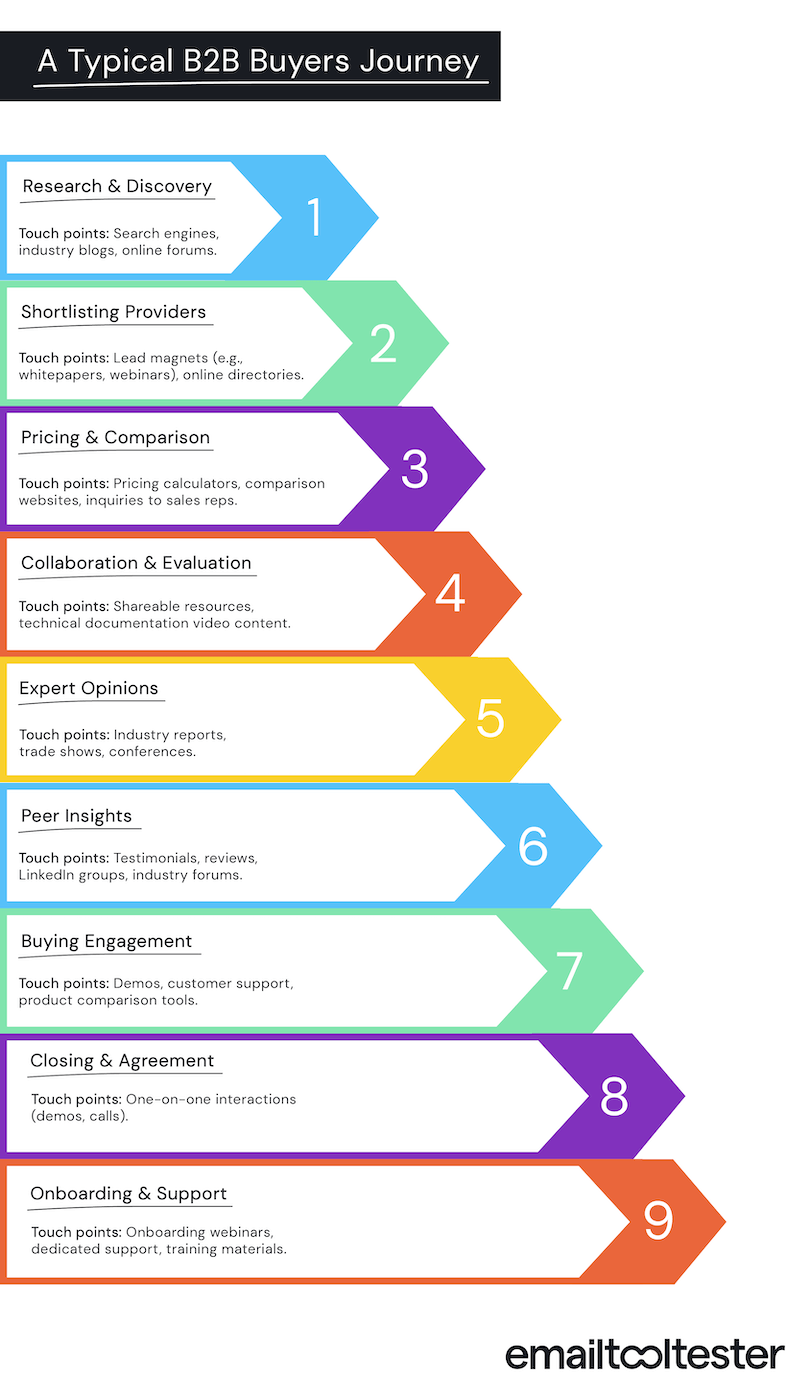
The 9 stages in a typical B2B buyer's journey – Infographic: EmailTooltester
But keep in mind: Gartner’s recent research showed that B2B buyers no longer follow a fixed sequence of stages. Instead, they research solutions, check information, compare vendors, and then revisit previous touchpoints as they assess which options best meet their needs.
This non-linear process lets them gather enough information and establish internal consensus, often completing much of this work independently before reaching out to your sales team. In fact, 67% of B2B participants mentioned preferring a rep-free experience.
So when designing touchpoints, don’t treat them as steps in a rigid sales funnel. Treat them as resources that help buyers complete key buying tasks whenever necessary.
For example:
Research and Discovery
You can increase the likelihood of being found by optimizing your website for search engines (SEO) and ensuring your content remains easy to discover and revisit.
Since buyers typically begin their journey with online research, strong SEO helps your content appear when they're actively looking for solutions.
For easy revisiting, make sure relevant pages are easy to find, navigate, and share whenever they need them.
You’ll also need to keep up with AI-powered search engines. Providing clear, authoritative answers can also improve your visibility in AI-generated results. You can further increase your reach by running search ads on Google and other online channels.
Since buyers often revisit resources (blog posts, product pages, etc.) throughout their buying journey, create a range of content that helps them complete different buying tasks.
Shortlisting
It seems like getting on buyers' radar early is important. Data shows that 95% of the time, the vendor B2B prospects ultimately choose was already on their Day One shortlist. Buyers also evaluate an average of around five vendors before making a decision.
To get shortlisted as a potential provider, you could offer a lead magnet (such as a webinar, ebook, or whitepaper) in exchange for registration. This can help to establish you as an expert in the field and pave the way for further one-on-one email nurturing via your B2B email marketing software.
Offering comprehensive product demonstrations or free trials is equally important if you want to earn a place on that shortlist, as 65% of B2B buyers use them to evaluate potential solutions.
Pricing and Comparison
To help prospects collect pricing information, you could offer search-optimized pricing tables, calculators, and cost comparisons on your site.
Transparency is absolutely important since 69% of buyers say they're frustrated when vendors don't provide clear pricing information. Some 57% also want vendor content to clearly demonstrate the potential return on investment (ROI).
So, let’s say you already have their email address captured from stage 2; you could include this information in email campaigns to your prospects.
Collaboration
Did you know that the typical B2B buying decision often involves 13 internal stakeholders and 9 external influencers? Sounds like a lot, but that’s just the average, according to Forrester’s latest data.
To help your prospects align with their fellow decision-makers within the company, offer authoritative, insightful content that’s easy to share (e.g., is not gated, and can be shared via social media or email). You should also create resources and templates (such as an ROI memo) to help them build a strong business case.
Fit/Implementation Checking
To help prospects evaluate whether your solution would fit with existing partners, you could include targeted emails featuring case studies of other businesses who have done something similar. Mixology Digital reports 54% of B2B buyers look for these types of content when evaluating vendors.
Other types of content that would be handy here are security/compliance FAQs, migration checklists, integration pages, and implementation guides.
If you have AI capabilities, it’s also a good idea to show how these can support your prospect’s business.
Validation and Peer Insights
As your prospects narrow down their options, independent validation becomes increasingly important. At this point, they don’t want to just listen to what you’re saying; they’ll start looking for people who have benefitted from your products or services.
Research shows that 68% of B2B buyers value customer reviews and testimonials and 58% rely on recommendations from peers or colleagues. Other important resources include independent industry reports written by experts in the field.
What all these types of content have in common is that they provide impartial, third-party perspectives that can help buyers validate their decisions and build confidence in you.
Closing and Agreement
Sales reps are still very much part of the buying journey, helping buyers address commercial discussions and final concerns. In fact, buyers are engaging with sales earlier than they did the previous year, with the average point of first contact shifting from 69% of the way through the buying journey in 2024 to 61% in 2025. That means roughly six to seven weeks sooner.
Personalized demos, one-to-one meetings, pricing discussions, and procurement or contract conversations help buyers gain internal approval and seal the deal.
Onboarding and Support
The sale is complete, but the customer journey is just beginning. So you still need to create touchpoints that help customers get the most value from your product.
Examples are effective onboarding webinars, training materials, dedicated customer support, and knowledge bases. These can all help customers adopt your product more quickly and help them derive value from it sooner.
Plus, they also lay the foundation for long-term satisfaction, retention, and future expansion opportunities.
Strategies for reducing touchpoints through digitalization
To reduce the number of touchpoints needed in B2B customer journeys, digitalization strategies play a crucial role (according to a research paper from Linköping University).
By digitalizing sequences of touchpoints, businesses can enable simultaneous interactions among multiple actors, thus reducing the overall number of required touchpoints. This involves increased coordination and integration, moving away from reliance on individual relationships and exchanges towards more collective interaction levels.
For example, integrating a comprehensive CRM system can centralize customer interactions, allowing for simultaneous engagement across various departments. Additionally, virtual product demos or webinars can replace several preliminary meetings, presenting detailed information in a single, interactive session.
8 practical steps to creating more effective marketing touchpoints
To use touchpoints effectively in order to convert buyers, you and your marketing team can take the following steps:
1. Know your buyer
Not all your leads will become buyers, so it’s important to be able to identify those who are most likely to convert. Coming up with an ideal client profile will be key to helping you create touchpoints that hit the mark.
Start by gathering data on your existing customers, as well as potential customers, to learn about their demographics, interests, behavior, and preferences. This information can be collected through surveys, interviews, focus groups, and online analytics tools.
Once you have collected customer data, analyze it to identify patterns and trends. Look for commonalities among your most loyal and profitable customers, such as age, gender, location, buying habits, and interests.
Then, use the data you have collected to create buyer personas, which are detailed descriptions of your ideal customers. A buyer persona should include information about the customer's demographics, needs, pain points, goals, and preferences.
Bear in mind that modern B2B purchases often involve multiple stakeholders. Preparing touchpoints for different personas for each member of the buying group is much more effective than focusing on a single decision-maker.
2. Identify the touchpoints
Now that you know who your ideal customer is, identify all the touchpoints where your target audience interacts with your brand. This could include the website, social media, email, offline events, customer service, etc.
According to McKinsey, B2B buyers continue to follow the “rule of thirds” throughout the buying journey: roughly one-third prefer in-person interactions, one-third favour remote communication, and one-third prefer digital self-service. These touchpoints could include AI-powered search, your website, social media, email, offline events, customer support, and conversations with your sales team.
To identify the touchpoints, you can use tools like Google Analytics to track website traffic and behavior, social media listening tools like Hootsuite to monitor brand mentions and engagement on social media, and customer service tools like Livechat to track interactions with customers. This will give you a better understanding of how your target audience finds you, and how they are engaging with you.
3. Understand the buyer's journey
Once the touchpoints are identified, it is important to understand the buyer's journey and the role each touchpoint plays in the conversion process. This helps in creating a relevant message for each touchpoint. Since the buyer’s journey is often non-linear, it helps to create a relevant message for each touchpoint.
Think about the different stages of the customer journey, from awareness to purchase and beyond. Consider how your ideal customers behave at each stage, and what messaging and marketing channels are most effective for reaching them.
You can use tools like customer journey mapping software like Smaply, allowing you visualize and analyze the different stages of the customer journey. You can also use CRM platforms like Hubspot, which provides a centralized view of the customer's interactions across different touchpoints, allowing marketers to understand how they are moving through the funnel.
4. Create a consistent message
The messaging across all touchpoints – whether that’s your website, email, lead magnets, or other content – should be consistent and in line with your brand's positioning. This creates a sense of familiarity and trust in the buyer's mind.
Make sure this messaging highlights your business’s expertise in the area, as well as speaking directly to the buyer’s pain points.
To help create a consistent message, you can use email automation software like GetResponse or ActiveCampaign to create and automate email campaigns, ensuring that messaging is consistent across all emails sent to the customer.
5. Personalize the experience
Marketers can use data to personalize the experience for the buyer. At the very top of the funnel, this could be as simple as running paid search ads or using retargeting. But further down, this includes sending thought leadership around topics they’ve expressed interest in, recommending solutions based on their browsing history, and providing them content around the stage they’re likely to be at in their journey.
Again, this is where your marketing automation software will come in handy, allowing you to send personalized emails based on customer behavior.
While email is a good way to showcase your personalization capabilities, you can use first-party data, intent signals, and AI-powered recommendations to deliver more relevant content across websites and ads as well.
6. Use calls-to-action
Each touchpoint should have a clear call-to-action (CTA) that guides the buyer toward the next step in the conversion process. But remember to tailor your CTA to the buyer's current task. If you’re always pushing for a sales conversation, especially too soon, it might turn your prospects away.
This could include signing up for a newsletter, downloading a whitepaper, registering for a webinar, or requesting a meeting.
Here, it’s a good idea to use landing pages that are optimized for conversions (there are several landing page builders, like Unbounce, that can help you do that). You can also use sales funnel software or marketing automation tools to create and manage lead nurturing campaigns, ensuring that each touchpoint has a clear CTA that moves the customer toward the next stage of the funnel.
7. Measure and optimize
It will be important to measure the effectiveness of each touchpoint and optimize them for better results. This includes tracking metrics like click-through rates, conversion rates, and engagement rates.
You can get these insights directly from your email service provider or marketing automation platform. You can also use analytics tools like GA4, which provides detailed insights into website traffic and behavior, allowing marketers to identify areas for improvement. Finally, there are also A/B testing tools like Optimizely, which lets you test different variations of web pages and CTAs, ensuring that they are optimized for maximum conversions.
By following these steps and using the appropriate software and tools, you’ll be well-poised to create touchpoints that offer prospects a seamless and personalized experience, and convert them into buyers.
8. Work with your sales team
Finally, working with the sales team is a crucial step in the process of using touchpoints to convert buyers, especially towards the end of their journey. Prospects turn to them when there’s a need for contextual intelligence.
In order to effectively convert leads into customers, you’ll need to work closely with your sales team to ensure that the messaging and touchpoints being used align with the sales process and goals.
Here are some ways that you can work more closely with your sales team:
- Communication: Marketers and sales teams should regularly communicate and collaborate to ensure that they are aligned on the target audience, messaging, and the overall sales process. Regular check-ins and meetings can help to ensure that both teams are on the same page and working towards the same goals.
- Sharing data: Both teams should have access to the same CRM data and metrics to help them understand the effectiveness of each touchpoint in the customer journey. Sharing this information can help identify areas for improvement and allow for data-driven decision-making.
- Collaborative strategy: Marketers and sales teams should work together to develop a cohesive strategy that takes into account the entire customer journey, from lead generation to conversion. This includes identifying the appropriate touchpoints, messaging, and tactics to be used at each stage of the sales process.
- Feedback: Sales teams can provide valuable feedback to marketers on the effectiveness of touchpoints in converting leads into customers. This feedback can be used to refine and improve the messaging and tactics used in future campaigns.
- Alignment: Gartner found that 69% of B2B buyers report inconsistencies between information on a company's website and what sales representatives tell them. Encourage sales representatives to reinforce – never contradict – the messaging buyers have already seen on your website and in your marketing materials.
How many touchpoints before a sale: Final thoughts
The number of touchpoints required for a sale is a common question for many B2B marketers and sellers. But focusing solely on the number of touchpoints can be misleading. The quality and relevance of each touchpoint are just as important as the quantity – if not more.
In this fast-paced digital world, consumers are constantly bombarded with marketing messages from various channels. That's why creating personalized and relevant touchpoints that meet their needs and preferences is crucial.
How can you do that? By using data-driven insights to tailor your campaigns to your target audience, and to design a seamless customer experience across all touchpoints.
Instead of zeroing in on a specific number of touchpoints, focus on designing campaigns that send the right message to the right lead at the right time. This increases the chances of conversion. Of course, you can't control a buyer's journey and which touchpoints they'll encounter, but you can pre-empt what they're likely to be looking for, and design your campaigns accordingly.
In short, don't get too caught up on the number of touchpoints. Instead, focus on creating quality and relevant touchpoints that meet your audience when they need it. And don't forget to work closely with your sales team to ensure that your touchpoints align with the sales process and goals.
The authors
Learn more about us

We keep our content up to date
03 Aug 2026 - Updated data for 2026
05 Dec 2023 – Smaller updates and corrections
20 Nov 2023 – Information from the study "Digitalizing customer journeys in B2B markets" (Lundin and Kindström) added
21 Sep 2023 – Infographic added
15 Sep 2023 – Small correction
Our Methodology
This article has been written and researched following our EmailTooltester methodology.
Our Methodology